



When Sturgeon Lake Cree Nation went to court recently to challenge Alberta’s handling of the proposed Wonder Valley AI Data Centre Park project, the dispute underscored a question that is increasingly difficult to ignore: What does Canada’s artificial intelligence future require from land, water and energy systems?
Wonder Valley, which would be located south of Grande Prairie, has been advertised as the world’s largest AI data centre park. Alberta’s major projects listing describes its first phase as a 1.4-gigawatt off-grid power system leveraging the provincial natural gas and geothermal resources.
The project is only one example of a broader trend. The federal government’s new “AI for All” strategy links AI to economic growth, jobs and national competitiveness. The strategy also points to expanding “sovereign compute” and supporting the construction of large-scale AI data centres.
Read more:
Sovereign AI? Anthropic shutdown reveals Canada’s weakness
AI is resource-dependent
These ambitions make the environmental debates significant. AI is often described as if it lives in “the cloud.” The persistent controversies regarding Wonder Valley illustrate the fallacy of this metaphor.
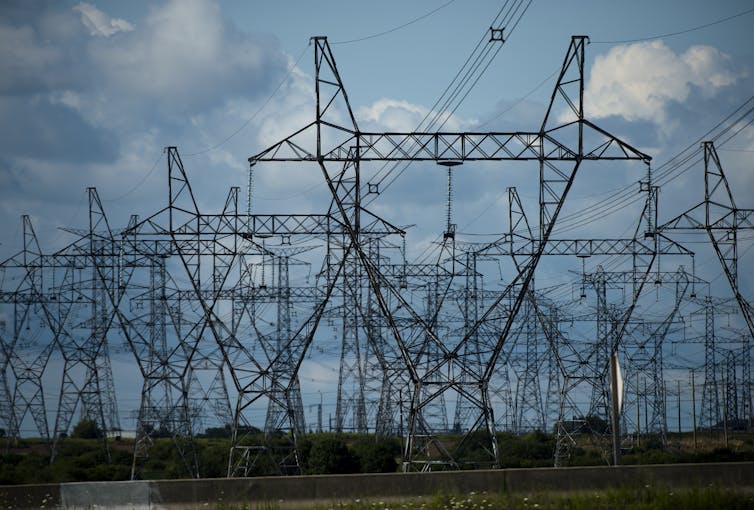
Artificial intelligence relies on material resources: land, electricity, water, cooling systems, transmission lines, gas infrastructure, minerals and servers. When those demands become concentrated in one place, AI becomes an environmental and energy issue.
My research focuses on environmental communication, including the politics of fossil fuel development in Canada. In my recent book on Alberta oilsands communication, I examined how oilsands projects are framed as matters of prosperity, national interest and technological progress. As someone who follows Alberta’s energy politics closely, the media coverage of Wonder Valley caught my attention.
My analysis of articles published by mainstream Canadian outlets about the project’s launch phase revealed a telling pattern. Coverage was limited for a proposal of such scale, but the stories that did appear carried strong symbolic weight.
Wonder Valley has been touted for the substantial investment it could bring, and as an opportunity to convert Alberta’s energy resources into a competitive edge in the AI economy. That narrative, however, deserves scrutiny.
AI’s use of resources
THE CANADIAN PRESS/Jack Farrell
AI data centres are industrial facilities built to keep servers running continuously. This requires reliable electricity, cooling and backup systems.
The International Energy Agency predicts that global electricity consumption from data centres, primarily driven by AI development, could more than double by 2030, reaching about 945 terawatt-hours.
Water is also crucial. Depending on design and location, data centres may use large amounts of water directly for cooling or indirectly through electricity generation. Reporting by The Narwhal has raised serious concerns about Canada’s data centre boom, especially where projects are proposed in water-stressed regions or on contested land.
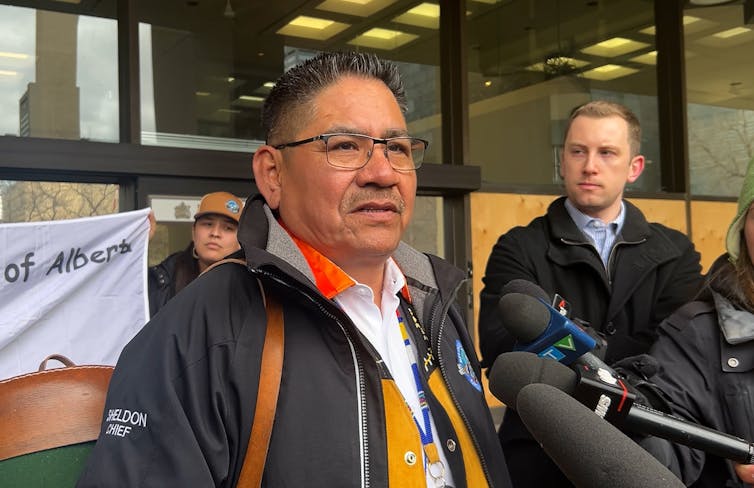
The main concern raised by Sturgeon Lake Cree Nation regards the project’s potential water use and the duty to consult Indigenous nations on developments that could impact them.
This is why the Wonder Valley debate cannot be reduced to a simple narrative of “Alberta is open for business.” It is also about who gets access to water, whose power system is reorganized and whose land and resources are made available for AI infrastructure.
What the cloud hides
The cloud metaphor makes these material demands less visible. It encourages us to think of digital services as weightless, clean and placeless. Researchers of digital infrastructure have long challenged this view. Media scholar Mél Hogan’s research on data centres’ alarming water consumption shows how digital systems are bound to local ecosystems.
Similarly, scholars like Sean Cubitt, Richard Maxwell and Toby Miller have argued that media technologies are never environmentally neutral. They depend on extraction, energy use and waste.
Another useful idea is the “digital sublime,” which describes how new technologies are often surrounded by myths of transformation, inevitability and national renewal. Such myths can make infrastructure projects appear almost beyond ordinary political debate.
The promotional language surrounding Wonder Valley are consistent with this pattern. The emphasis on scale, innovation and Alberta’s future as an AI hub resulted in environmental concerns being either disregarded or treated as technical issues to be resolved at a later time.
THE CANADIAN PRESS/Nathan Denette
Data as the new oil
One of the most revealing phrases in coverage of Alberta’s AI ambitions is that “data is the new oil.”
In one sense, the phrase is meant to signal opportunity. It suggests Alberta can use its energy expertise, gas reserves, cold climate and industrial land to compete in the global AI economy.
But it also reveals continuity. The project is not presented as a break from Alberta’s fossil fuel economy. It is framed as its next stage. Natural gas is positioned to power artificial intelligence.
Recent reporting by The Tyee has shown how data centres are being discussed as “creating new markets for Canadian natural gas producers.” This should concern Canadians. If AI infrastructure becomes a new justification for fossil fuel expansion, then the language of innovation may end up extending older forms of resource dependence.
Rethinking AI infrastructure
Canada needs a comprehensive AI strategy; however, a strategy that lauds data centres without adequately considering energy, water, land and Indigenous rights is insufficient.
Before governments promote AI data centres as engines of economic growth, they should require transparent public disclosure of expected electricity demand, water use, emissions, land impacts and consultation processes. Treaty obligations should not be treated as procedural hurdles. They should shape whether and how projects proceed.
The key challenge confronting Canada is whether it will build AI infrastructure through the same old resource development playbook or whether it will use this moment to set stronger rules for a more accountable digital economy.