



You are sitting at your computer, interacting with a generative AI model like ChatGPT Image or Midjourney. You have a distinct picture in your mind, and you begin with a simple, general prompt: a chair in a cozy room.
The image appears, but you frown. You realize that to get what you want, you must elaborate, so you experiment with more descriptive prompts: Dark mahogany wood. Dim yellow lamplight. Late autumn dusk. You keep revising, trying to discover which words the machine needs and which words it ignores.
You are wrestling with a problem: how do you describe a feeling? How do you communicate warmth, melancholy, intimacy or calm — not to another human being, but to a machine?
This is one novel frustration of the AI age, yet millions of users searching for the “right prompt” are engaging in an old literary practice: turning mental images, vague desires and atmospheric intuitions into precise language.
Modernist writers and description
Generative AI has transformed description from a literary technique into a mass social skill.
This frustration in fact has an unexpected literary history. More than a century ago, writers faced a similar question when new visual technologies began to change how reality could be represented. Photography, and later cinema, could capture surfaces, bodies and landscapes with a speed and accuracy prose could not match. If machines could show the visible world more efficiently than language, what was writing for?
In Strange Likeness: Description and the Modernist Novel, literary scholar Dora Zhang argues that many early 20th-century novelists responded by rethinking the role of description itself.
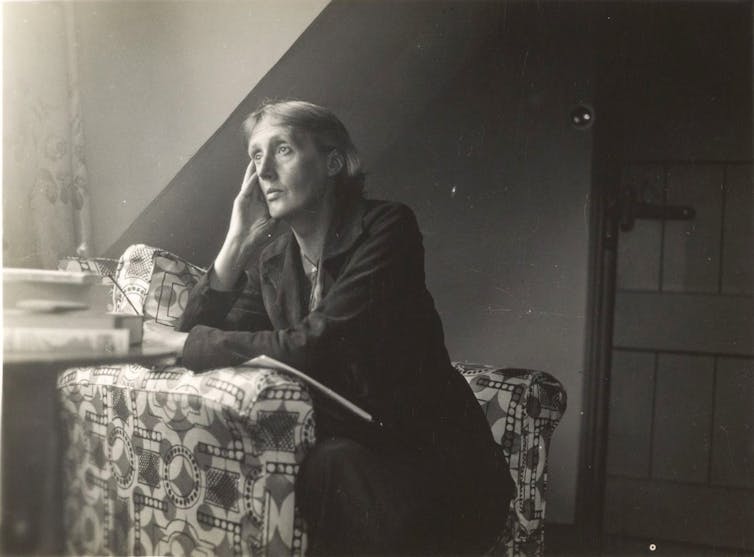
(Harvard University Library/Wikimedia)
Rather than competing with cameras in the faithful rendering of objects, modernist writers such as Henry James, Marcel Proust and Virginia Woolf turned toward phenomena that resisted mechanical capture: atmosphere, sensation, relation, mood and the shifting textures of consciousness.
This helps explain why modernist fiction can feel so different from the realism of the 19th century.
Read more:
The real Henry James will never stand up – that’s his greatest legacy
Shift from earlier novels
Earlier realist novels by writers like Honoré de Balzac and Charles Dickens often described rooms, clothes and streets in exhaustive detail, helping readers imagine social worlds they could not directly see.
Modernist writers still described, but they increasingly described what did not simply look like anything at all: the tension in a room, the strange resemblance between two unrelated things, the emotional weather of an afternoon, the half-formed feeling of memory returning.
In other words, when cameras became better at recording surfaces, literature moved toward what surfaces could not contain.
Evoking atmosphere
Generative AI has unexpectedly reversed that history. Photography reduced the need for verbal depiction by allowing images to be mechanically captured. AI systems increase the need for verbal depiction by requiring users to verbally specify the qualities of desired images.
To generate a scene, you must now do for the machine what earlier novelists once did for readers: translate objects, spaces and moods into words. The challenge is not just naming things. Anyone who has used image generators knows that describing objects alone does not produce satisfying images.
You also need what internet culture now calls the “vibe.” Vibe refers to the diffuse emotional and sensory qualities that surround objects without being reducible to them. It is the kind of phenomenon modernist writers became increasingly interested in describing.
In this sense, prompt writing combines two older literary tasks at once: the realist description of concrete things and the modernist evocation of atmosphere.

(AP Photo/Jae C. Hong)
Interacting with generative models
Interacting with these generative models also draws attention to a phenomenon that literary scholar Elaine Scarry has long contemplated. We could also think about prompting, as a writerly, descriptive act, as demonstrating what she refers to as “perceptual mimesis.”
Mimesis (Greek for “imitation”) through esthetic theory has been concerned with “representation.” Scarry’s literary criticism has explored how authors’ discriptions act as instructions to guide the reader’s vivid mental images.
Reflecting on using language to represent our ideas in dialogue with machines opens up reverberating questions about how this could affect our thoughts about ourselves and the world.
AI boom hasn’t ended writing
We often hear that AI will replace writers. In one important sense, it has done the opposite. It has redistributed one of writing’s oldest skills across everyday life.
Office workers, students, teenagers, marketers and hobbyists now spend their time refining prompts, comparing phrases and learning how slight changes in wording alter results. They are practising description, even if they don’t call it that.
The AI boom has not ended writing. It has made writers of us all.