



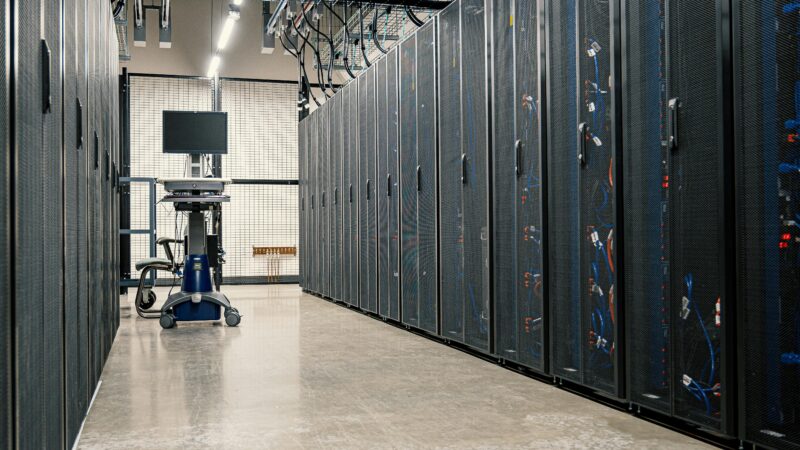
Server racks in a data center. Image by Brett Sayles via Pexels. License: Free to use.
By Julius Okoth
Between the late 1980s and early 2000s, Kenya experienced a massive influx of polythene greenhouse technology led by multinationals such as DCK, Oserian, and Aquila Farm. Naivasha became the epicenter of this floral revolution because of its unique geographic advantages and proximity to Lake Naivasha, which provided the fresh water needed for large-scale greenhouse irrigation. This polythene greenhouse technology allowed farmers to control humidity and temperature, making it possible to grow high-quality roses, which have become Kenya’s primary floral export, thereby making Naivasha the “rose capital” of the world.

A greenhouse in Naivasha, Kenya. Screenshot from video ‘FLOWERS are Big in Kenya: Tour This Flower Farm with Me in Naivasha!’ on YouTube. Fair use.
Workers’ rights violations
While polythene greenhouse technology by multinationals promised economic salvation and provided thousands of jobs, it simultaneously ignited long-standing disputes and faced persistent allegations of workers’ rights violations, health concerns, environmental concerns, and tax evasion and avoidance.
These long-standing disputes led to increased pressure from international fair-trade bodies and local activists to enforce stricter compliance and ensure that Kenya’s “flower basket” benefits the local economy, workers, and the environment as much as it does the exporters.
Today, the rapid growth of Artificial Intelligence (AI) is triggering a global “scramble” for infrastructure, mirroring the expansion of polythene greenhouse corporations. Tech giants like Google, Meta, and Microsoft are intensifying data center construction across countries in the Global Majority, attracted by abundant land, cheap resources, and lax regulatory environments that often disregard the core tenets of local rights and justice.
History is repeating itself in Naivasha, Kenya, with a new industrial wave of data center construction sweeping through the same region as tech giants like Microsoft and G42 are embarking on a USD 1 billion “green” data center project in Olkaria, Naivasha. This new wave of industrial construction in Naivasha, marketed as the “backbone of the digital economy,” mirrors the earlier floral boom. They are also offering familiar pledges of job creation and technological growth, but evading scrutiny regarding land rights, environmental rights, digital rights and sovereignty, tax justice, labor, and human rights. Social actors in the Global Minority are already sounding the alarm on how data centers “guzzle” water and violate communities’ labor rights.
Are data centers a boon for Kenya’s economy, or are they going to abuse Kenyan citizens’ rights?
The construction of data center infrastructure in Kenya is a double-edged sword. While these data storage facilities are often marketed as the “backbone of the digital economy,” their physical presence introduces significant risks related to land rights, water exploitation, labor abuses and violation, tax evasions and avoidance and the deepening of existing inequalities. Also, the rapid construction of data centers might entrench a new form of digital colonialism just as the cut-flower industry sparked debates over land rights, labor conditions, environmental sustainability and tax justice in Kenya. The parallel between the polythene greenhouses of the 1980s and the high-tech server farms of today suggests that without rigorous oversight, the promise of a digital future may come at the same heavy cost to human rights and environmental justice as the floral exports that preceded it.
The construction of Microsoft and G42’s data center has raised several questions in the minds of many Kenyan activists and citizens: Will Microsoft and G42 pay land rates and rents at the same scale as ordinary Kenyans for the Olkaria site, or will they be granted exemptions? Who will carry the burden of the massive water and electricity consumption required for these facilities ? Will the burden fall on the Kenyan taxpayer or the corporations themselves? Will the local economy be bypassed through “tax holidays” and profit-shifting maneuvers that drain the local economy? How will the storage of sensitive national data be protected when the infrastructure is controlled by foreign entities like the US and UAE?
While Microsoft is registered in the US, specifically incorporated in the state of Washington, with its global headquarters in Redmond, Washington, G42 is a prominent artificial intelligence and cloud computing holding company registered and headquartered in Abu Dhabi, United Arab Emirates (UAE).
G42 has a massive strategic partnership with Microsoft, which recently invested USD1.5 billion in the company. In the context of the Kenya project, G42 often acts as the regional infrastructure lead, while Microsoft provides the software and cloud platform (Azure).
The Microsoft and G42 data center in Olkaria, Naivasha, is being built on land owned by the Kenya Electricity Generating Company (KenGen). The project is located within the KenGen Green Energy Park, a 342-hectare (845-acre) industrial zone situated at the Olkaria geothermal fields. This park was established by KenGen to allow industrial investors to set up facilities near the source of geothermal power for a direct and sustainable energy supply. By building on KenGen’s land, the data center can be powered entirely by renewable geothermal energy produced on-site. While the land is KenGen’s, the facility itself is a collaborative investment between Microsoft and G42, in partnership with the Kenyan Ministry of Information, Communications and the Digital Economy. Will Microsoft and G42 pay land rates and rents at the same scale as ordinary Kenyans for the Olkaria site after acquiring land for free?
Impact on Kenya’s revenue-generating systems
Kenya and the UAE are signatories to a Double Taxation Agreement (DTA), a bilateral treaty designed to foster trade by ensuring companies are not taxed twice on the same income. Traditionally, these “tax peace treaties” allocate taxing rights between the country where the income is generated (the source state) and the country where the company is headquartered (the residence state).
The Kenya-UAE DTA was signed in 2011. While Kenya maintains a standard corporate tax rate of 30 percent, the UAE is a significantly lower-tax jurisdiction, with rates historically ranging from 0 percent to 9 percent (following their 2023 corporate tax reforms). This disparity creates a significant fiscal challenge. Under the treaty, a firm like G42, which serves as a regional infrastructure lead and is headquartered in the UAE, can utilize the DTA to minimize its Kenyan tax exposure. Specifically, profits generated from Kenyan operations can be moved to the UAE through payments for services, royalties, or interest, a practice known as profit shifting. The DTA often lowers the withholding tax rates on these outward payments, effectively “shifting” the tax base from Kenya’s 30 percent environment to the UAE’s lower-tax regime, reducing withholding tax. This mechanism leaves the Kenya Revenue Authority (KRA) with a diminished tax base, as the primary taxing rights for a UAE-resident company often lean toward its home jurisdiction rather than where the physical infrastructure is located.
The Kenyan power sector operates like a relay race, where electricity is “passed” from production to the final consumer through three distinct stages: generation, transmission, and distribution. KenGen handles the generation phase, creating power that is then transported across the country via the Kenya Electricity Transmission Company Limited (KETRACO’s) high-voltage transmission lines. Finally, Kenya Power acts as the sole distributor, purchasing this energy to retail it directly to the public.
As G42 and Microsoft construct their power-hungry data centers within the KenGen Green Energy Park, they will likely bypass the Kenya Power and Lighting Company (KPLC) to source electricity directly from the producer. While this direct-supply model offers efficiency for the investors, it raises a critical question: will Kenya as a whole benefit or lose when such large-scale projects do not contribute to the national distributor’s revenue?
Kenya Power (KPLC) relies on large industrial customers to “subsidize” the cost of providing cheap electricity to rural and residential homes. When the biggest consumers (like data centers) bypass KPLC, the utility loses its most profitable customers. If KPLC loses its high-paying industrial revenue, it may be forced to increase tariffs for ordinary Kenyans to cover its fixed operational costs. A cost burden to ordinary Kenyan citizens.
Direct deals mean that the money goes straight to KenGen. While this helps KenGen expand, it doesn’t necessarily help KETRACO or KPLC modernize the aging “middle-track” grid that serves the rest of the country, leading to grid stagnation.
Hidden cost to the Kenyan taxpayer
Like many multinational corporations operating in Kenya, it is highly probable that the G42 and Microsoft data centers in Olkaria will utilize structured labor models, such as independent contracting, third-party outsourcing, and Professional Employer Organizations (PEOs), to manage their human resources.
If G42 and Microsoft adopt these models, the Kenyan government risks losing out on traditional “paycheck tax” revenue that is vital to the national budget. Specifically, if thousands of workers are categorized as contractors rather than employees, the state misses out on direct contributions to the Social Health Insurance Fund (SHIF), as well as the 1.5 percent affordable housing levy and tiered National Social Security Fund(NSSF) contributions, both of which require employer matching. These outsourced models shift the entire statutory burden to the worker, often resulting in lower compliance and smaller total contributions to the state.
This creates a “Double Bypass” effect: when direct power supply (bypassing Kenya Power’s revenue) is combined with outsourced labor (bypassing the PAYE and levy pools), the project risks becoming an economic “enclave” that operates within Kenya’s borders without fully nourishing the local ecosystem.
The paradox of ‘green energy’
While the G42/Microsoft project is celebrated for its use of “green” geothermal energy, it faces a significant challenge of aquifer depletion. Large-scale data centers act as “giant radiators,” requiring massive amounts of fresh water for their cooling systems. To prevent thousands of servers from overheating, these facilities typically rely on evaporative cooling, a process that “consumes” water by converting it into steam.
In the semi-arid region of Olkaria and the nearby Lake Naivasha basin, water is a finite and precious resource. If the project relies on this basin, it will create an immediate resource conflict, competing with local small-scale farmers and Kenya’s multi-billion-shilling flower industry. Furthermore, the project will risk being labeled as “green washing” if its water consumption exceeds the basin’s natural replenishment rate. Even the use of boreholes poses a threat; excessive extraction can lower the water table, drying up local wells and reducing the water available for domestic use and livestock.
Data centers don’t just “consume” water; they often degrade it. Even when water isn’t evaporated, the “blowdown” water (the leftover mineral-heavy water) sometimes requires careful treatment before being returned to the environment to avoid thermal pollution or chemical runoff.
The paradox of “green energy” is that geothermal power is carbon-neutral, but the cooling requirements for AI infrastructure can be ecologically expensive.
Julius Okoth is a social justice activist with a special focus on labor rights and tax justice in Kenya.