



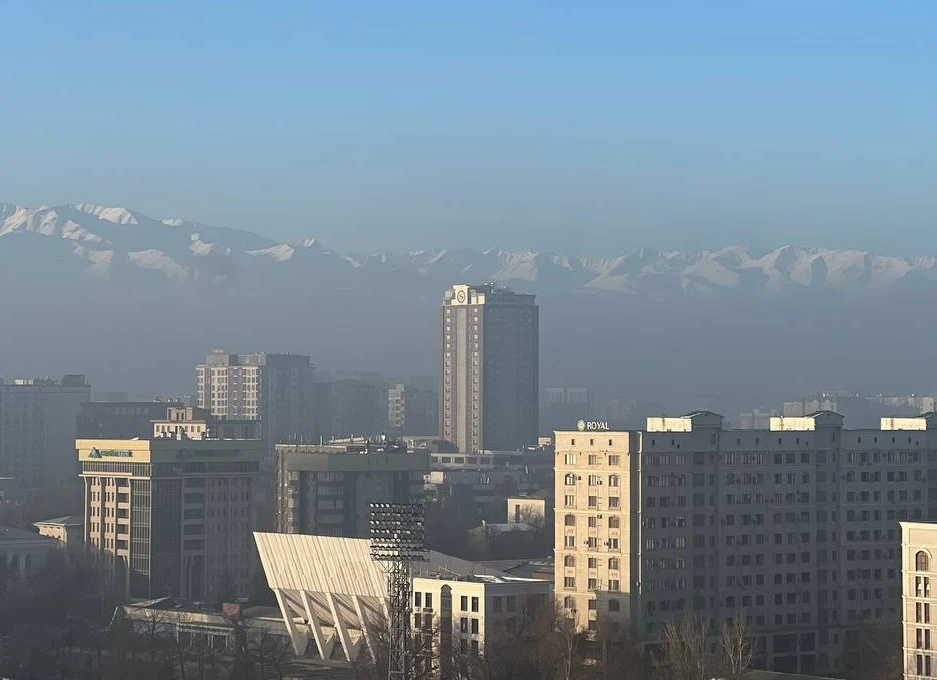
Kyrgyzstan’s capital, Bishkek, covered in smog. Photo by Elina Turalyeva. Used with permission.
This article was written by Olga Loginova and Oliver Fisk for Vlast and published on May 5, 2026. An edited version of the article is published on Global Voices under a media partnership agreement. It is also part of Global Voices’ May 2026 Spotlight, “Global crisis, local solutions.” You can support this coverage by donating here.
When it comes to air pollution, Central Asia’s major cities are among the worst in the world. IQAir, a Swiss company that measures global air quality, regularly designates Kazakhstan, Kyrgyzstan, and Uzbekistan’s major cities as having “very unhealthy” or “hazardous” air.
The company’s 2025 ranking of the most polluted countries ranked Uzbekistan 10th out of 143 monitored countries, followed closely by Kyrgyzstan in 19th place, and Kazakhstan in 29th.
With air pollution in the region only worsening, Vlast spoke to experts and activists from Uzbekistan, Kyrgyzstan, and Kazakhstan to learn which smog-fighting strategies each country is currently adopting and to hear which solutions might prove effective across the entire region.
Uzbekistan
As a thick, conspicuously yellow smog descended on Uzbekistan’s capital of Tashkent one Saturday last November, life in the city somehow went on as if it was not there at all. And yet, distressingly, air pollution had reached “life-threatening” levels, according to IQAir.
Before long, Uzbekistan’s government responded. President Shavkat Mirziyoyev introduced emergency measures to try to immediately improve the environmental situation in Tashkent, but his actions were primarily punitive.
Authorities launched nighttime environmental raids against groups accused of directly contributing to air pollution. The raids were conducted by the “ecological police,” a body established days prior by presidential decree.
Less punitively, Uzbek authorities also deployed water trucks to spray dust from Tashkent’s streets and trees and reduce overall air pollution.
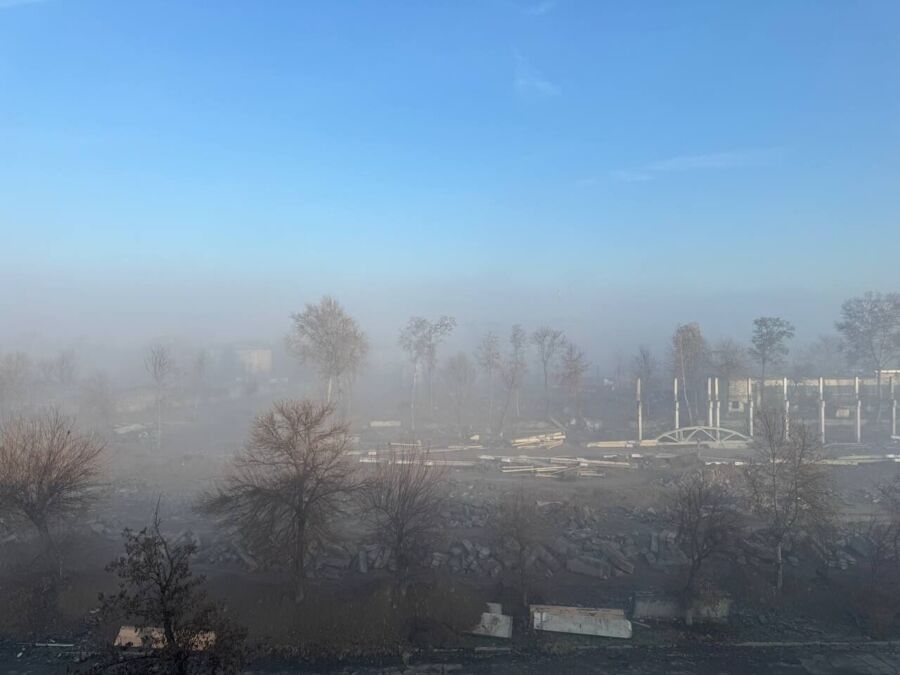
Uzbekistan’s capital Tashkent covered in dust and smog. Screenshot of the image from Troll.uz public Telegram channel. Fair use.
Uzbekistan environmental activist Mutabar Khushvatova told Vlast that the government needs to think beyond man-made factors and better incorporate geographical factors into policymaking.
Tashkent is situated in a low-lying area, and polluted air lingers over the city, and some of the pollution might even be coming from outside of Uzbekistan, such as from neighboring regions of Kazakhstan.
Emphasizing the transnational nature of the issue, Khushvatova also noted that the rapidly drying-up Aral Sea leaches noxious dust and salt particles from its seabed, worsening air quality in both countries.
“Another major factor is the country’s rapid industrial growth recently,” Khushvatova told Vlast.
Uzbekistan’s government, meanwhile, has set out a national program to grant tax breaks and other financial incentives to businesses that incorporate alternative energy sources into their production.
In a similar vein, local authorities in Tashkent are also focusing their environmental agenda around a reimagined form of urban development.
They have proposed building a greenbelt around the city to shield it from dust storms, as well as the mandatory preservation of ‘wind corridors’ — pathways through which fresh air can flow to disperse pollutants.
Kyrgyzstan
The capital, Bishkek, which regularly finds itself ranked among the world’s most polluted cities during the winter, is primarily plagued by extremely fine, inhalable particles called PM 2.5.
As a spokesperson for the World Bank, which has pledged USD 50 million to improve air quality in Kyrgyzstan, previously told Vlast, exposure to these particles “poses serious health risks, leading to respiratory infections, cancer, cardiovascular diseases, and premature deaths.”
For Azat Ruziev, a Kyrgyz climate journalist and campaigner against fossil fuel use, these issues primarily stem from major cities like Bishkek, Karakol, and Osh lacking the same air-sensitive approach to urban planning that appears to be currently gathering steam in Uzbekistan.
In his view, Kyrgyzstan’s government has failed to regulate key sources of pollution and has not anticipated the environmental consequences of rapid urban growth. Ruziev told Vlast:
As a result, the whole system is basically broken now. The wind can’t clean the city the way it used to, so pollution and dust just hang in the air.
Transport regulation in the burgeoning city poses a similar problem, with cars still being the primary means of transport. This, according to Ruziev, poses a problem, as authorities have failed to properly control emissions from vehicles or limit the rapid growth in car use.
These governance failures have been compounded by Bishkek’s ever-increasing status as the heart of Kyrgyzstan’s economy. The city has rapidly grown in recent years to become home to nearly half of the country’s urban population.
In view of Bishkek’s growing importance as an urban hub, a new master plan setting out the capital’s development path through 2050 does have several provisions relating to improving air pollution.
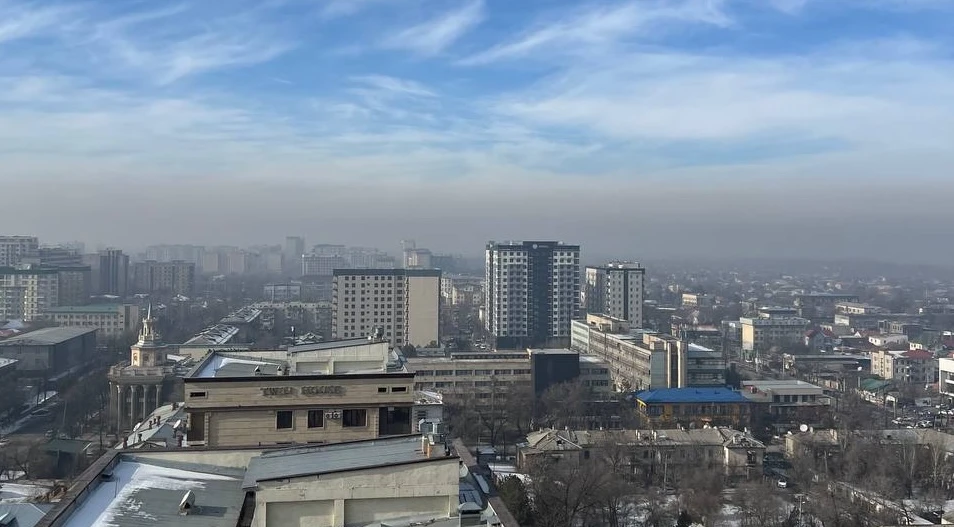
Bishkek. Photo by Elina Turalyeva. Used with permission.
Central to this is a gradual shift away from coal as a source of heating and electricity. According to the plan, existing combined heat and power plants will be converted to cleaner fuels — primarily gas — as new sources of solar and hydropower will be built to meet anticipated increases in electricity demand.
The master plan also appears to put anti-smog measures at the heart of its urban planning.
It calls for a new bypass road and 175-kilometer railway to divert transit traffic away from residential areas, as well as expanded public transport, tram lines, and cycling infrastructure to reduce car use and turn the capital into a “15-minute city.”
Green space will also increase sharply under the plan, via the construction of new parks and a floating urban forest, bringing up the city’s green spaces from 450 to 3,400 hectares.
Kazakhstan
Kazakhstan, for its part, offers a cautionary tale in the problems that can arise when policymakers and experts cannot agree on the real sources of air pollution. As several experts told Vlast, the country is suffering from a lack of consensus over the science behind its air problems, making it even harder to solve them.
In the Ministry of Ecology’s telling, the primary sources of air pollution in Kazakhstan are motor vehicles, the private sector, and small businesses.
Scientific data, on the other hand, point to the industrial sector and coal burning for heating and electricity generation purposes as the primary drivers of bad air.
But despite their differing views on the causes of air pollution at a national level, Kazakhstan’s scientific community and government appear to almost agree on the need to reduce coal burning in Almaty, the largest city located in the south.
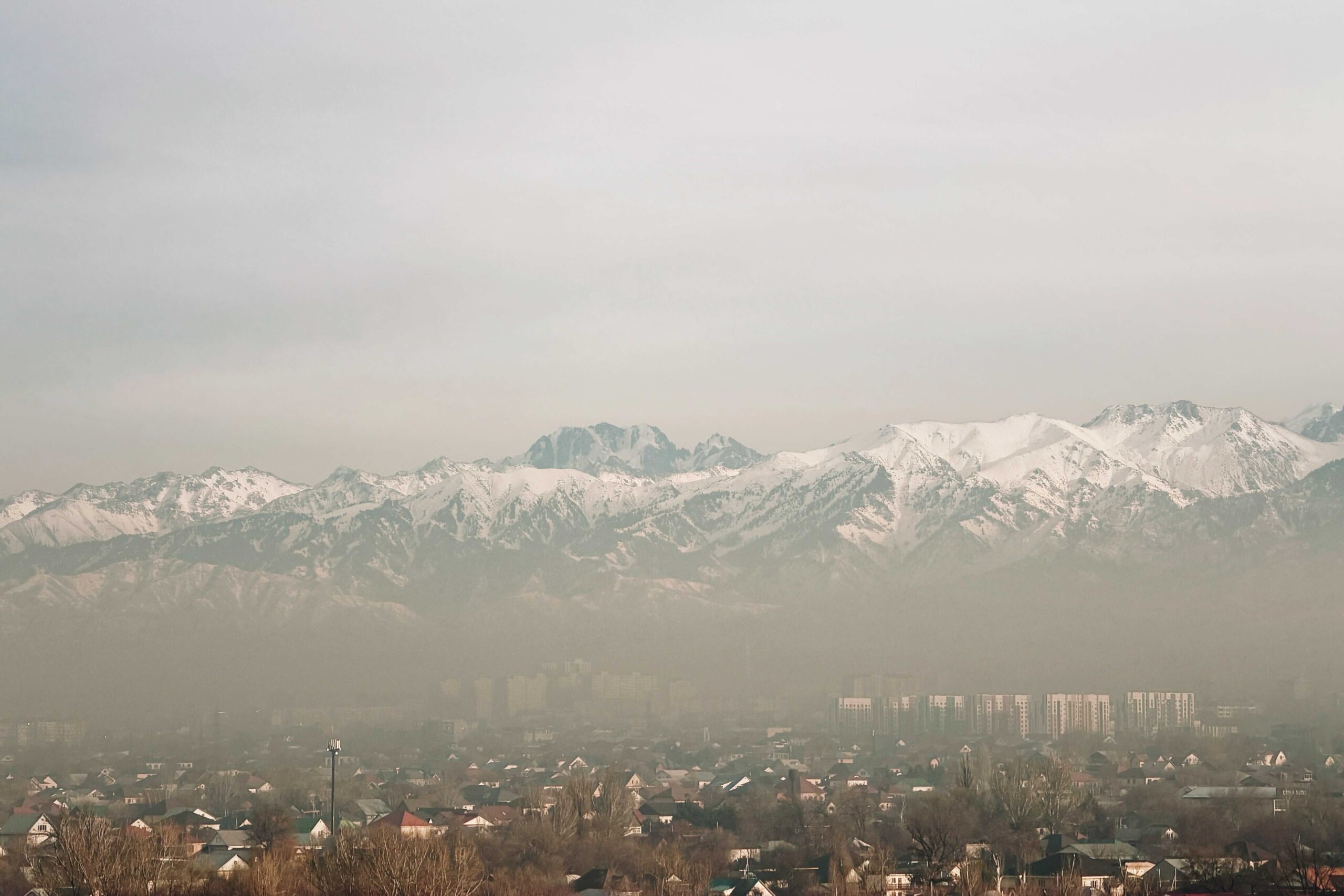
Almaty covered in smog. Photo by Daniyar Mussirov. Used with permission.
By the end of the year, the southern metropolis is set to introduce a ban on burning solid and liquid fuels for heating purposes in residential areas where it is possible to use gas.
The local authorities have also mandated that one of the city’s major coal-fired power plants be converted to a natural gas-powered station by the end of 2026.
The Almaty city council has also adopted air quality protection regulations that are more in line with the Ministry of Ecology’s views on the vehicle- and small business-centric sources of air pollution.
These measures will impose tolls on older vehicles, subsidize purchases of newer vehicles, and establish closer monitoring of barbecue establishments, while mitigating harm where possible.
Signaling its approval, the Ministry of Ecology has instructed all cities to develop regulations similar to those being adopted in Almaty. And that gives pause to Nassiba Baimatova, head of an analytical chemistry lab in Almaty. She told Vlast:
All decisions must be based on scientific research. Unfortunately, that’s not how things are done here. Hardly anyone [in government] ever consults scientists.
Only time will tell if the government’s “one solution fits all” approach, contested by scientists, will prove effective.