



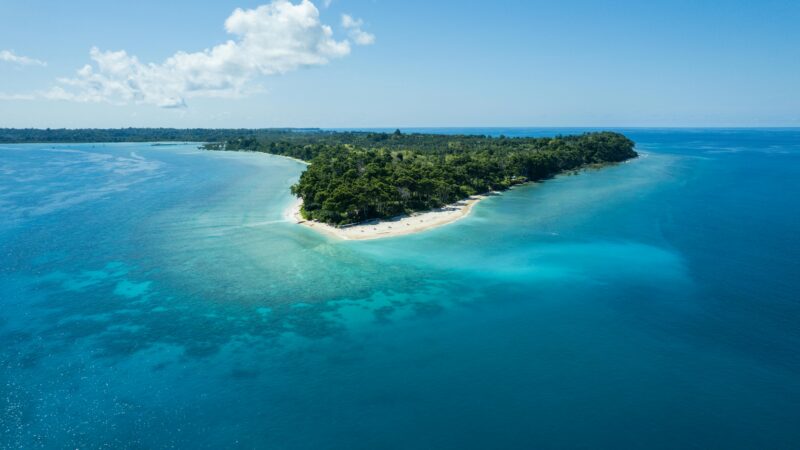
A drone shot of Neil Island. Image from Pexels. Fair use.
A massive infrastructure project planned for Great Nicobar Island, part of India’s Nicobar Islands, an island chain owned and managed by India in the eastern Indian Ocean, has triggered growing debate over development, environmental risks, and the future of Indigenous communities.
The proposed Great Nicobar Development Project includes a transshipment port, an international airport, a township, and a power plant. First proposed by NITI Aayog (policy commission) in the late 2010s, the project received environmental clearance in 2022 and has since moved into the early stages of implementation. The Indian government has described the project as strategically significant because of the island’s location near the Strait of Malacca, one of the world’s busiest maritime trade routes.
Government officials have defended the project as strategically important for strengthening India’s maritime presence in the Indo-Pacific and reducing dependence on foreign transshipment hubs. The project has also received backing from defense commentators and retired military officials. Speaking to Indo-Asian News Service (IANS), Major General (Retd.) Arvind Bhatia argued that the development could enhance India’s surveillance and maritime capabilities near the Strait of Malacca — one of the world’s busiest shipping routes — while improving the country’s long-term strategic and economic position in the region.
The project returned to national attention in April 2026 after Rahul Gandhi, the Leader of the Opposition in the Indian Lok Sabha (lower house of the parliament), visited Great Nicobar and criticized the scale of the proposed development during a public event on the island. Subsequent criticism from opposition leaders in parliament further intensified public debate over the project’s ecological impact and its implications for Indigenous communities.
An ecologically fragile island
Great Nicobar Island is known for its tropical rainforests, coastal ecosystems, and rich biodiversity.
Galathea Bay, where the proposed port is expected to be built, is considered one of the most important nesting grounds for the giant leatherback turtle in the northern Indian Ocean. Environmental groups and marine researchers have raised concerns about the fragile marine ecosystem surrounding the bay. Scientists cited by the Wildlife Institute of India, as well as conservation researchers interviewed by Mongabay India, have pointed to the presence of thousands of coral colonies in the area, which is not visible in government maps. Recent reporting by Scroll India also highlighted concerns over the ecological impact of construction near critical leatherback turtle nesting sites.
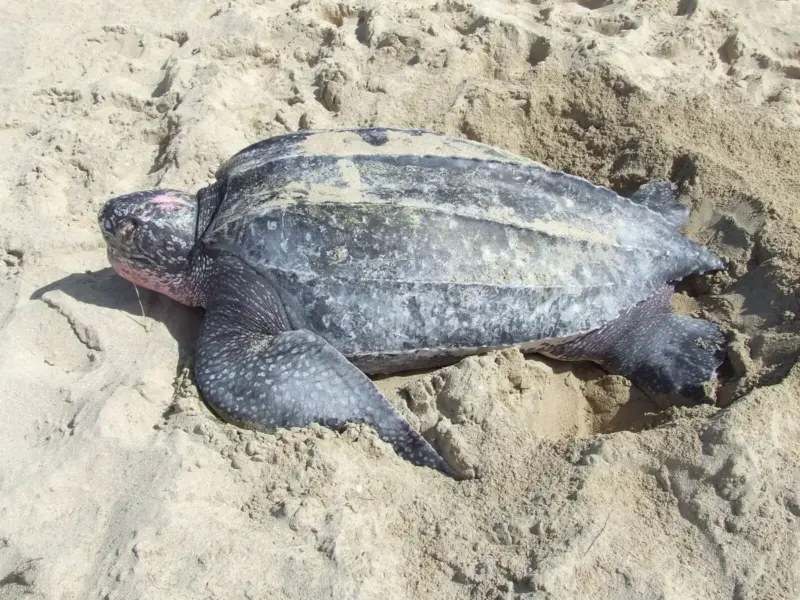
A leatherback sea turtle. Image from Animalia. License CC BY 2.0.
Critics of the project, including environmental lawyer Ritwick Dutta and researchers associated with the Society for Andaman and Nicobar Ecology (SANE), have warned about large-scale tree felling, biodiversity loss, and habitat disruption linked to the development. According to a 2026 Press Information Bureau (PIB) release on the project, the estimated number of trees in the affected area is 1.865 million, with up to 711,000 trees expected to be felled in phases as part of the forest diversion process.
The concerns, however, extend beyond biodiversity alone.
Great Nicobar lies in a high seismic zone and was heavily affected by the 2004 Indian Ocean earthquake and tsunami, one of the deadliest natural disasters in recent history. Parts of the island experienced land subsidence after the tsunami, permanently altering sections of the coastline. Environmental analysis published by Earth.org noted that the island’s geological vulnerability continues to shape debate over large-scale infrastructure expansion.
That history remains central to concerns about whether an island vulnerable to earthquakes, coastal erosion, and escalating climate risks can sustain the scale of urban and industrial development now being proposed. In a recent analysis published by the Economic Times, it was also noted that parts of Great Nicobar underwent major geological transformation following the 2004 tsunami.
Indigenous communities and changing realities
The island is also home to the Shompen, a Particularly Vulnerable Tribal Group (PVTGs — a government classification within India) with limited contact with the outside world, and the Nicobarese community, whose lives remain closely tied to the region’s forests and coastal ecosystems.
Environmental researchers and rights groups have questioned whether Indigenous communities were adequately consulted during the project’s approval process. Recent reporting by Mongabay India documented concerns raised by tribal leaders, environmental researchers, and civil society groups over transparency, land diversion, and consultation procedures linked to the development.
The debate has been especially sensitive in the case of the Shompen community because of their relative isolation. Researchers have warned that large-scale migration and population influx linked to future urbanization could create long-term social and public health pressures for Indigenous communities living on the island. Similar concerns have been reflected in reporting by Scroll and independent environmental researchers. Questions have also been raised about how demographic change could gradually reshape the region’s ecological and cultural balance.
Public debate around the project has increasingly spilled onto social media platforms as well. Supporters have framed the development as strategically important for India’s maritime security and economic interests, particularly because of Great Nicobar’s proximity to the Strait of Malacca. Political commentators, defense analysts, and public figures on X have argued that the project could strengthen India’s strategic position in the Indo-Pacific region.
Critics, meanwhile, have used social media to highlight concerns over deforestation, biodiversity loss, ecological vulnerability, and the future of Indigenous communities, particularly given the island’s fragile coastal ecosystem and its experience during the 2004 tsunami.
Competing visions of development
Supporters of the project, including government officials and retired military commentators, have described the Great Nicobar Development Project as strategically important for strengthening India’s maritime infrastructure and reducing dependence on foreign transshipment ports.
Critics, including environmental lawyer Ritwick Dutta and conservation groups such as the Society for Andaman and Nicobar Ecology (SANE), have questioned the long-term ecological consequences of large-scale construction on one of India’s most environmentally fragile islands.
For many observers, the debate surrounding Great Nicobar reflects a broader question facing climate-vulnerable regions: how to balance economic ambition and strategic interests with ecological survival and Indigenous rights.