



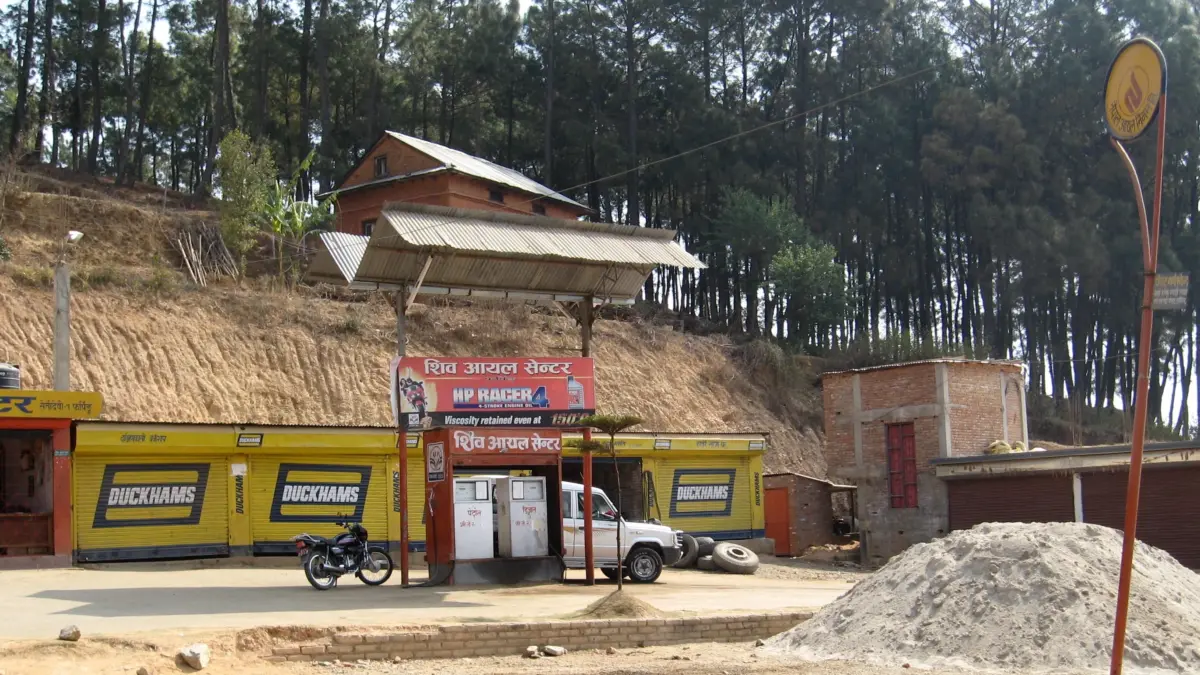
A petrol station in Kathmandu. Image by Ralf Lotys via Wikimedia Commons. CC BY-SA 3.0.
As reported by Rising Nepal Daily, Sumitra Khatiwada, a resident of Kathmandu on a fixed monthly income, has watched the cost of running her household climb week after week since March 2026. Cooking gas, vegetables, transport — everything is going up at once. “If prices continue to rise, life will become even more difficult for workers,” she said, urging the government to strengthen market monitoring and prevent artificial price hikes.
Her concern mirrors a crisis spreading across Nepal. Nepal raised fuel prices for the fourth time in a single month in April 2026, making petroleum products the most expensive among regional peers. Under the revised rates, petrol in Kathmandu now costs NPR 219 per litre (USD 1.48), while diesel is priced at NPR 207 (USD 1.40) per litre.
A war far away, a crisis close to home
Nepal Oil Corporation stated that due to the ongoing war in West Asia, international market prices for petroleum products have been continuously rising. The conflict involving the United States, Israel, and Iran has disrupted export flows through the Strait of Hormuz, through which nearly a third of the world’s seaborne oil passes.
As per a report by Rising Nepal Daily, petrol had been priced at just NPR 137 per litre (USD 0.93) in January 2026. Over just 18 days, petrol prices jumped by NPR 45 per litre, a 60 percent surge in under three weeks,while diesel and kerosene rose by NPR 40 per litre, a pace of increase Nepal had not seen even at the start of the Russia-Ukraine war.
Nepal’s vulnerability runs deeper than most of its neighbours. As per independent digital media platform The Logical Indian, Nepal is completely dependent on imported petroleum products, with the NOC functioning as the exclusive importer and distributor, largely sourcing supplies from India under a long-standing bilateral arrangement. More than 60 percent of petroleum consumption is accounted for by the transportation sector.
According to the Department of Customs, in the first seven months of fiscal year 2025/26, Nepal spent NPR 139.10 billion (about USD 1 billion) on imports of petrol, diesel, and LPG alone. As noted by Nepal News, with no domestic refining capacity and a single supplier pipeline, there is almost no policy buffer when prices spike internationally.
The most expensive pump in South Asia
A regional comparison makes Nepal’s position stark. Nepal’s petrol has reached NPR 219 per litre (USD 1.48), above Pakistan (USD 1.36), Sri Lanka (USD 1.30), India (USD 1.02), Bhutan (USD 1.06), the Maldives (USD 1.04), Afghanistan (about USD 0.95), and Bangladesh (USD 0.87). As per a report from Nepal-based digital news and social media platform PressAdda, even countries like Pakistan and Sri Lanka, which are going through their own economic crises, have cheaper petrol prices than Nepal.
The pump price is only the beginning of the impact. Diesel was priced at NPR 139 per litre in February, meaning it jumped by 31 percent within a single month. The World Bank projected Nepal’s economic growth to slow to 2.3 percent in fiscal year 2025–26, down from 4.6 percent in 2024–25, partly reflecting the impact of the conflict in Western Asia.
The price of rice has already increased by NPR 100 to 200 (about USD 0.75 to 1.50) per 25-kg sack, while vegetables remain expensive. Price watchdogs warn that fuel costs act as a multiplier across the supply chain; a small increase at the pump can mean significantly higher prices for food, transport, and household essentials within weeks.
Transport fares are now officially higher too. The Department of Transport Management approved a 16.71 percent rise in passenger fares on inter-provincial routes, with cargo rates rising by 21.68 percent on hill routes and 15.75 percent on Tarai routes.
“As freight charges have increased by three times, market prices could rise by up to 50 percent. If tensions escalate further, it will be a disaster,” said Rajendra Sangraula, president of the Nepal Freight Forwarders Association.
A new government’s first economic test
Nepal’s Rastriya Swatantra Party government, led by Prime Minister Balendra Shah, known popularly as Balen, came to power following elections in March 2026. Those elections were held after the previous KP Sharma Oli government collapsed following the September 2025 Gen Z protests, which were partly driven by public anger over economic mismanagement and a government-ordered social media ban.
The RSP government has introduced several emergency measures to manage the crisis. As reported by Rising Nepal Daily, a Cabinet meeting reduced customs duty and infrastructure tax on fuel by 50 percent to ensure smooth supply. The government also introduced a two-day weekend, Saturday and Sunday, for government offices and educational institutions to cut fuel consumption. According to Ratopati, fuel quotas for high-ranking government officials have been reduced, and wholesale fuel distribution is being controlled. Meanwhile, due to acute LPG shortages, the NOC has been directing distributors to supply only half-filled cooking gas cylinders to households to stretch limited stocks.
But these steps have not reversed the trend. Despite the 50 percent tax exemption, the impact has been minimal due to the continuous rise in crude oil prices globally. According to Ratopati, NOC Executive Director Chandika Bhatta reported a fortnightly loss of approximately NPR 14 billion (about USD 105 million), NPR 930 million daily, based on data from March 30 to April 8, 2026.
A governance gap has also emerged inside the ministry itself. A ministry official was quoted as saying the absence of a dedicated minister is making it difficult to reach decisions on price adjustments, noting that deciding whether to control inflation or to facilitate supply through automatic pricing “is only possible at the political level.”
Consumer groups have publicly called for more. “The higher fuel price has already started to impact consumers. The corporation seems focused only on calculating its losses,” said Prem Lal Maharjan, president of the National Consumer Forum. “Who will hear consumer grievances?”
Citizens take to the streets and to social media
The anger has moved beyond private frustration. On April 16, Joint Student Unions organised a protest at Maitighar, a central public square in Kathmandu, Nepal’s capital, demanding the immediate repeal of taxes imposed on petroleum products. Protesters carried placards calling for a price adjustment and a relief package for the public, with student leaders warning of further agitation if the government fails to act.
On social media, where nearly 48 percent of Nepal’s population is active, one of the highest rates in South Asia, the fuel crisis has become a defining public debate. For a government that rode the wave of digital populism and benefited from it, analysts have noted that navigating these challenges will be a daunting task.
The trucking sector has also formally objected. The Federation of Truck Transport Entrepreneurs of Nepal issued a statement saying the price hike has angered consumers and will directly affect the transport sector, reminding authorities of a prior written agreement requiring automatic fare adjustments whenever fuel prices fluctuate by more than NPR 5 per litre.
The bigger structural question
Economists point to a vulnerability that will outlast this crisis. Economist Gunakar Bhatta told Rising Nepal Daily that the prolonged energy crisis is increasing supply-side pressures across both imported and domestically produced goods. “When the prices of food and non-food items increase, people are forced to spend more to sustain their livelihoods,” he said.
Former National Planning Commission Vice Chairman Dipendra Bahadur Kshetri warned that if military actions targeting Iran continue, Nepali workers in Gulf countries could lose their jobs, a critical risk given that remittances totalled NPR 1.261 trillion (about USD 8.45 billion) in the first seven months of fiscal year 2025/26 alone.
NOC has warned that prices could rise by a further 20 to 30 percent, with the corporation owing NPR 16.37 billion (USD 123 million) to the Indian Oil Corporation, its sole supplier, with the next payment due April 23.
Yet analysts point to a longer-term path out. Nepal already generates over 90 percent of its electricity from hydropower, and the country has been among the fastest EV adopters in South Asia. As Climate Home News reported, electric vehicles now make up about three-quarters of new car sales in Nepal, partly due to tax policies cutting EV import duties to 43 percent compared with 257 percent for petrol vehicles. While private EV adoption is growing, long-haul public transport and freight vehicles remain almost entirely dependent on diesel, meaning the crisis hitting ordinary Nepalis today is also the strongest argument yet for the government to accelerate the green transition.
For Sumitra Khatiwada and millions of others on fixed incomes, the next NOC price announcement is not an abstraction. It is next week’s grocery bill.