



Image by Global Voices on Canva Pro.
This story is part of Undertones, Global Voices’ Civic Media Observatory’s newsletter and column. Subscribe to Undertones.
This post is part of Global Voices’ April 2026 Spotlight series, “Human perspectives on AI.” This series will offer insight into how AI is being used in global majority countries, how its use and implementation are affecting individual communities, what this AI experiment might mean for future generations, and more. You can support this coverage by donating here.
Since the beginning of his presidency, Nayib Bukele has presented himself and his government as a force of innovation. In 2021, El Salvador approved the Bitcoin Law, becoming the first country to adopt Bitcoin as legal tender. This regulation was reformed in 2025, following pressure from the International Monetary Fund regarding Bitcoin adoption risks, at which point the text approved by the Legislative Assembly made the use of the cryptocurrency voluntary rather than mandatory.
Modernizing public sector processes and services through artificial intelligence (AI) has become another important aspect of the Bukele’s administration’s promotion. In 2023, El Salvador’s government signed an agreement with Google under which the tech company was tasked with supporting the country’s public sector digital transformation. In 2024, Google opened a new office in El Salvador dedicated to providing these services. A similar agreement was signed in late 2025 with xAI to launch Grok for Education, an initiative expected to reach 5,000 schools and over one million children.
In April 2026, while promoting the SovAI Summit, a conference held in El Salvador for those who do not want to be “left behind in regulatory stagnation,” Stacy Herbert, Director of El Salvador’s National Bitcoin Office, stated in a post on X that the country is “the World’s AI Sandbox.” She argued that “while the rest of the world builds regulatory walls around AI, El Salvador chose a bolder path: fully integrating it into a national strategy for rapid human progress,” referring to the country’s regulatory framework advancing the use of AI.
Narrative: With the support of AI, El Salvador is building the best public healthcare system in the world
That same month, in the vein of integrating AI for “rapid human progress,” El Salvador’s government announced the launch of the second phase of DoctorSV, a telemedicine app initially set in motion in 2025 with the support of the Development Bank of Latin America and the Caribbean (CAF) and Google.
In an address to the nation, Bukele — together with Guy Nae, Public Sector Head of Google Cloud SpLatam; Edgardo Von Euw, a physician specializing in the public sector and AI application; Stella Aslibekyan, who has a PhD in epidemiology; and Pablo Bartol, Social and Human Development Manager at CAF — pushed the narrative that the public healthcare system his government is building with the help of AI is uniquely improving the healthcare sector and will become a reference for the rest of the world.
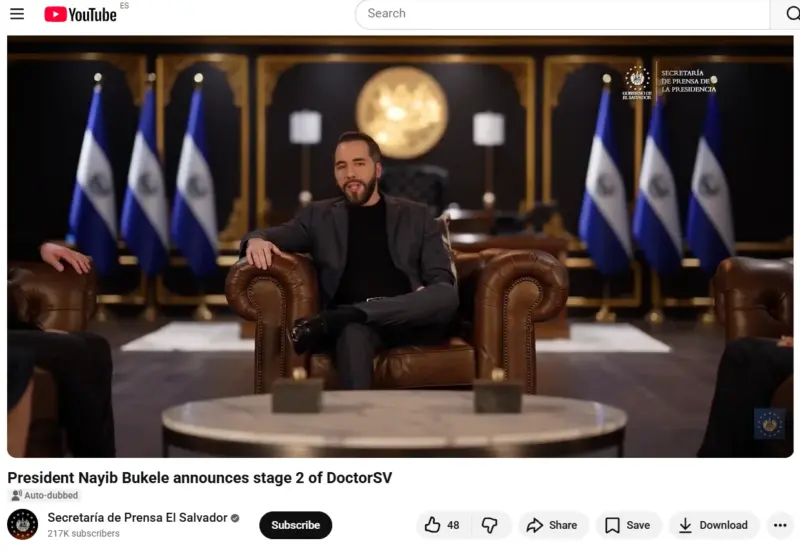
Screenshot from a YouTube video shared by the Press Office of El Salvador, where President Nayib Bukele announced, in a national address, Phase 2 of DoctorSV. Fair use.
Von Euw argued that the AI assistant integrated into the telemedicine app will help identify chronic disease risks by analyzing medical records via a questionnaire that patients will answer, automatically creating orders for lab analysis without the need for an in-person doctor’s appointment. He added that once the lab results come back, the AI assistant will provide a diagnostic classification to the doctor, who can assist through the app. He also explained that by sending messages and scheduling calls for the doctors, the AI assistant will help ensure patients follow up on their treatments. Bukele described the tech as “a person” dedicated to ensuring that each Salvadoran adheres to their treatment, something he argued even the private sector cannot offer.
Efficiency is directly tied to AI under this narrative. Bukele has repeatedly referred to the time Salvadorans would save thanks to it, while Von Euw claimed that this would be the first system in the world to integrate AI “horizontally” from beginning to end — something Bukele suggested not even developed countries are doing at the moment.
It is also a narrative asserted by both local and media outlets supportive of Bukele, including Diario El Salvador and Colombian magazine Revista Semana. Likewise, it has been shared in The Lancet, a peer-reviewed general medical journal, in a publication arguing that “El Salvador’s program offers a replicable model for efforts seeking to leverage the potential of AI to enhance healthcare delivery in resource-constrained settings,” expectations likewise communicated by the CAF.
The context surrounding the narrative
Meanwhile, doctors and healthcare workers point to the progressive deterioration of the public healthcare system, with insufficient coverage, deficiencies in care quality, shortages of medical supplies, and a lack of transparency in health policy — which, they argue, adversely affect both healthcare professionals and the general population. Bukele’s administration has been firing large numbers of public healthcare workers, with more than 7,700 reported layoffs in 2025.
Rafael Aguirre, secretary of the Union of Doctors of Social Security Workers (SIMETRISSS), and Iván Solano, president of the Medical College, have also warned of a potential shift toward privatization with the 2025 Law for Creating the National Hospital Network — a regulation they argue increases the concentration of power within the executive branch, and potentially tighter control over health workers.
In response to the announcement of the second phase of DoctorSV, Aguirre argued that lack of face-to-face interaction limits comprehensive clinical evaluation, potentially leading to errors or delays in the detection of complications. Managing chronic illnesses, he noted, effectively depends on direct doctor monitoring and regular evaluation of the patient’s medical history.
In an interview with the BBC, Solano stated, “We don’t disagree with DoctorSV; what we don’t think is right is that this platform is given preferential treatment, both in budget and supplies.” At the same time, he recognized that for some Salvadorans, the app might be an immediate solution. Solano also expressed concerns about the funding scheme behind the app, as the resources come from a loan rather than from sustainable, long-term public funds. Aguirre added that with the launch of this app, El Salvador has become a “testing lab” once more, just as it was with Bitcoin.
Cybersecurity experts have cautioned that “there is still not enough information to guarantee that the tool will adequately safeguard citizens’ medical records.” In the past, privacy has been an issue with other government-backed apps in El Salvador. In 2021, businesspeople, journalists, and human rights activists reported that their personal data was being used without their authorization in El Chivo Wallet. Government institutions were also hacked several times in 2024.
In his national address, Bukele highlighted what he considers his government’s positive reputation regarding security policies, to hint at the reputational impact of the launch of the AI-assisted healthcare system. Reflecting on its potential to make the country a reference for the region and the world, he linked the AI hype to his administration’s claims of proven success.
There have been attempts to replicate and celebrate the government’s security policy — supported by a 2022 State of Exception that is still in effect — for its rapid results, but it is being widely questioned for alleged human rights violations, including the use of Pegasus spyware to track journalists.