



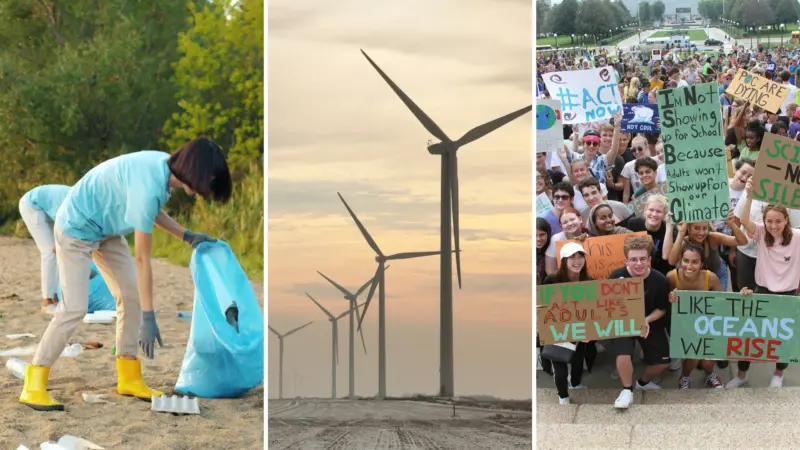
Image courtesy of Sydney Allen via Canva Pro. Left: Women participating in a beach cleanup campaign. Middle: Windmills. Right: Youth environmental protesters. Image via Rawpixel (CC0 1.0).
This post is part of Global Voices’ May 2026 Spotlight series, “Global crisis, local solutions.” This series will offer stories of resistance and successful climate action, insight into how communities in the Global South are fighting back against the crisis, analysis of what this might mean for future generations, and more. You can support this coverage by donating here.
The climate crisis can feel like an insurmountable problem, and for good reason. Humans aren’t very good at conceptualizing — let alone coming up with solutions to — large-scale issues. And it doesn’t get much larger than an Earth-wide crisis hundreds of years in the making. Much of the news around climate change focuses on troubling developments, including increasingly common devastating weather events; rising sea levels that could overtake entire archipelagos and displace millions; heatwaves that are making some parts of the world borderline unlivable; glacial lake outburst floods (GLOFs) that can devastate mountain communities, and countries already implementing stricter border regulations to head off future waves of climate migrants.
Journalists and climate scientists aren’t wrong for sounding the alarm. After all, collectively, as a species, we aren’t doing a very good job of mitigating the crisis, even though we’ve known about it for decades. Corporations still carry out emissions-intensive activities unchecked; nearly every population on earth has microplastics in their bodies because of widespread plastic pollution, yet we continue to utilize an astonishing amount of single-use containers and packaging, and big tech companies are barreling full force toward an AI-powered future with little regard for how the resource-heavy technology might impact surrounding communities.
Combined, all of these challenges can be frightening, and it’s no surprise that a 2022 study published in Lancet Planetary Health found that 60 percent of young people globally are “very worried” about the future of the planet. So why is Global Voices choosing to launch a Spotlight on climate solutions amid this less-than-cheery landscape? I’ll explain.
It’s practical
The climate crisis scares me. I will openly admit that, and it’s easy to feel nihilistic about our future when those in power seem fairly unmoved by the predicament we face. However, one thing that keeps me motivated is reading about success stories and resilience where people made a difference in their own communities.
Global Voices has shared stories of the largest seed bank in Africa, coral restoration projects in the Indonesian archipelago, communities in Latin America successfully pushing back against water- and energy-intensive data centers that would drain their precious environmental resources, conservation campaigns that have revived endangered species in Nepal, the use of vetiver plants in the Caribbean to help combat environmental impacts like drought and flooding, and forest reclamation efforts led by the Indigenous communities in Thailand, just to name a few. On one hand, these stories are deeply inspiring and can provide a much-needed emotional boost amid a fairly depressing news cycle. On the other hand, they can also offer something more practical: a roadmap.
It is important to share replicable, scalable examples of successful climate action because that’s the only way these strategies can be employed in other communities that need them.
Communities suffering from shrinking bodies of water can look to Kazakhstan’s ongoing, successful restoration of the Aral Sea. Environmentalists seeking to include Indigenous communities in their conservation strategies need only look to Nepal and its work with Chepang community leaders when creating national parks. In Jamaica, which experienced the effects of Hurricane Melissa last year, people have been finding innovative ways to secure their properties’ roofs, and amid worsening annual hurricanes and tropical storms — strategies that could be incredibly useful in other places that experience annual storms, such as the Philippines.
It’s easy to feel helpless in the face of a problem as big as the climate crisis, but sharing success stories can help mitigate that feeling. It shows those on the front lines of climate action that we see them, appreciate them, and want to follow their lead.
Psychological support

Climate anxiety. Image courtesy of Sydney Allen via Canva Pro.
“Climate anxiety, also known as “eco-anxiety,” a phenomenon where people feel a deep-seated anxiety or despair about climate change, has become more and more widespread in recent years. This is likely tied to the increasing number of natural disasters and severe weather patterns, as well as increases in generalized anxiety, but it may also be linked to increased social media usage, “doomscrolling,” competitive news cycles that, on some level, need consumers to be scared so they keep coming back, which keeps ratings up.
Eco anxiety is particularly common among people who have experienced or been exposed to climate disasters, such as flooding, wildfires, droughts, or territory destruction. While much of the research on this subject has centered on the Global North, it makes sense to assume that those in more climate-vulnerable states, who are disproportionately affected by the climate crisis, would be more acutely concerned about future environmental disasters.
Research shows that climate anxiety doesn’t affect everyone in the same way. For some, when managed effectively, it can be a motivating factor, spurring them to engage in positive climate action and activism. But when anxiety tips into hopelessness and despair, it can be devastating for community engagement. A 2023 study published in the “International Journal of Environmental Research and Public Health” found that climate anxiety can induce “eco-paralysis” — a state in which people feel the world’s situation is beyond repair. This leads to nihilism and inaction, which is simply unhelpful when we are facing a crisis that requires significant global cooperation and behavioral changes.
When people feel a situation is hopeless, they are less likely to push for change, adapt their habits, or support those doing positive climate work. This can increase apathy and make it more difficult for environmental defenders and activists to achieve the lasting climate action that we, as a society, desperately need.
This is particularly important for young people.
In an interview with UNICEF, John Jamir Benzon R. Aruta, a climate researcher in the Philippines, explains how climate-induced psychological stress can affect children.
“Children and young people are particularly at risk for climate anxiety. Although climate anxiety is a natural and adaptive response to the real and existential threats of climate crisis, climate anxiety can cause depression, anxiety, and trouble sleeping, among others, in young people. Many young people around the world are very worried about their future on a warming planet.”
This anxiety can have real consequences. As Elissa Epel, a researcher at UC San Francisco, notes: “If our young people can’t have hope and engage in climate action, then we’re going to have that much harder of a time bending the curve back.”
Sharing stories of hope and progress can break this bleak cycle and energize people to find ways to contribute in their own communities.
Change starts at the community level
Life is hard now, and we have no guarantee it’s going to get better anytime soon. It’s important to celebrate the wins as they emerge and nurture gratitude and respect for our fellow humans.
The reality is, it is very difficult to make global change in how we approach our environment. But on a community level? It’s much easier to make a difference.
A small-scale shift toward a greener life looks much more attainable and is something most individuals could achieve, whether they’re a top international climate expert or just a regular person interested in making a change in their community.
That could look different for different people. In some spaces, that might mean planting biodiversity hotspots, where Indigenous plants can thrive and support the local ecology. In others, that might mean launching education campaigns about plastic use, protesting, organizing river cleanups, or eating less meat. Some people might lobby local officials to increase funding for recycling or increase electric vehicle infrastructure. Others might help create a community resilience hub in their neighborhood, which can help organize aid when disasters strike. We can all vote with our wallets and intentionally support companies that are implementing greener policies, while shaming those who don’t.
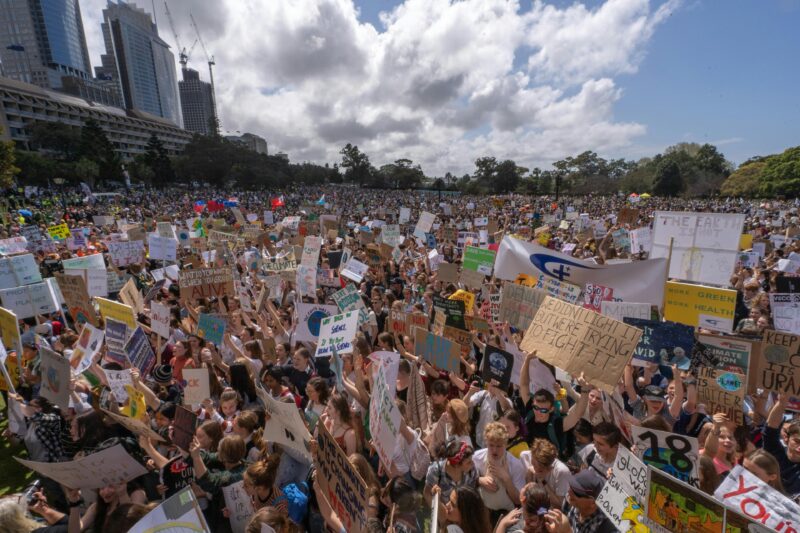
A large-scale climate protest in Australia. Image via Pexels. Free to use.
The possibilities are endless, and they all contribute to a greater goal of encouraging more people to think critically about our consumption habits, the politicians we vote for, and the companies we support.
Communities in the Global South are often both the most affected by climate change and the most innovative in their responses, partly out of necessity. Many of our global community of contributors, academics, activists, translators, and researchers are on the front lines of climate change and in a prime position to tell the stories of resilience and success we need to hear most. Throughout May 2026, check in regularly on Global Voices to stay updated. Who knows what you might be motivated to do next.