



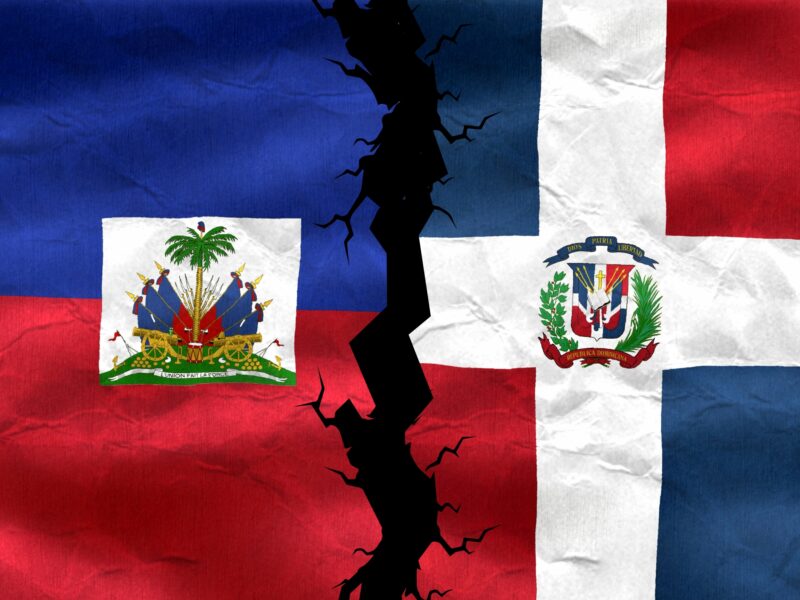
The Haitian and Dominican Republic flags with a fissure down the middle. Feature image created using Canva Pro.
By Jude Pierre Louis
Evens (a pseudonym) fled Haiti in August 2021 at the age of 33. A former socio-professional who worked in the Haitian public administration, he entered the Dominican Republic illegally. His displacement was driven by the escalation of gang violence in the metropolitan region of Port-au-Prince, particularly the surge in kidnappings. There were multiple kidnapping cases every day; no social category was spared, not to mention the armed conflicts between rival gangs that had erupted at the time.
According to reports from the United Nations Integrated Office in Haiti (BINUH) and the Office of the United Nations High Commissioner for Human Rights (OHCHR), the period between May and September 2021 saw a significant spike in targeted violence, homicides, and abductions. The turning point that cemented Evens’ decision to leave Haiti was the assassination of President Jovenel Moïse on July 7, 2021.
From 2021 onwards, Evens lived in hiding in the Dominican Republic. He relied on support from his family in the United States, who sent him money to survive. He only ventured into the streets on rare occasions to handle personal matters, such as going to the supermarket, the pharmacy, or a money transfer office. During this period, he often used taxi services such as Uber to get around because, at the time, police rarely searched Uber vehicles. Many of these vehicles had tinted windows and were in good condition, unlike other taxi services, where vehicles were more worn and the presence of passengers more evident. Today, the police verify all types of vehicles, but back then, every time Evens was in the street and saw a police officer, his heart would race.
The reality became much more severe for Evens between 2023 and 2024, when the Dominican government implemented tougher control measures and increased the expulsion of undocumented Haitian migrants. This escalation was documented by organizations such as Amnesty International and the UNHCR, which highlighted the intensified deportation policies. This period was also marked by official communiqués from the Dominican government outlining new security and migration protocols. Evens decided to stay indoors completely, living through this time with immense stress:
Mwen oblije pase tan mwen sou rezo sosyo, gade dokimantè, fim, epi fè egzèsis fizik pou mwen pa kite estrès fini ak mwen andan kay la.
I [was] forced to spend my time on social media, watching documentaries and movies, and doing physical exercise so that I don’t let the stress consume me while I’m stuck inside the house.
If he needed something, he would have it delivered or ask an acquaintance who could walk the streets safely to buy it for him; the risk of going out was simply too high.
Years passed, and Evens had high hopes of leaving the Dominican Republic when the Biden administration introduced the Humanitarian Parole programme on January 5, 2023. This initiative allowed Haitians, Cubans, Venezuelans, and Nicaraguans to enter the United States legally for a period of two years. Evens’ family applied for him; he awaited this opportunity like parched land waiting for rain — but with the return of Donald Trump to the American presidency in January 2025, the programme was officially terminated. After more than two years of waiting, Evens never benefitted from the opportunity. He continued his life in the Dominican Republic, but with great suffering, as his dream was shattered.
Yet, he did not lose hope, remaining convinced that he would find a way to live in another country that would offer him hospitality, where he could reclaim his life and dignity. However, Evens’ ordeal worsened on December 29, 2025. While he and a friend were in the street one evening, the Dominican police arrested them. His friend, a final-year medical student with a valid student visa, was released and promptly contacted Evens’ relatives to inform them of his arrest. It was the first time in his life that Evens had been arrested. He describes that evening as the longest night, sharing a cell with drug users and other violent individuals. The stench of urine permeated the air, and the space was cramped and overcrowded:
Nan moman arestasyon mwen, mwen santi’m diminye, men sa ki tap pral frape mwen plis se andan selil la, mwen santi mwen imilye nan tout nanm ak chè mwen paske mwen pat janm swete viv yon reyalite konsa.
In the moment of my arrest, I felt diminished, but what hit me the hardest was being inside that cell. I felt humiliated in my soul and my flesh because I never wished to experience such a reality.
When morning came, Evens was transferred to an immigration centre in Santiago province called La Rotonda, where conditions were even more disheartening: heat, stench, and trash scattered throughout. That afternoon, he was placed on an overcrowded bus to the capital, Santo Domingo, and taken to another immigration detention centre called Haina. Although the distance from Santiago to the border at Dajabón/Ouanaminthe is shorter, the authorities chose to transport them on the longer route to Haina. Inside, conditions were deplorable: a light shone like a spotlight that never turned off, and the centre was so overloaded there was no space to even stretch out on the floor. Many were forced to remain standing until daybreak.
On December 31, 2025, Evens and many others were boarded onto trucks for deportation to Haiti via the Elías Piña (Dominican Republic) and Belladère border (Centre Department, Haiti). Upon arrival at Belladère, Evens received assistance from the International Organization for Migration (IOM/OIM), which provided a space for medical examinations and other essential services. They created an identity file for him, provided him with food, juice and water, and issued him a document certifying his status as a returnee/migrant.
Evens soon realised he could not return to his home in Haiti because criminal gangs had occupied the roads leading from the Centre to the Ouest Departments. He was forced to take a difficult detour:
Wout la te konplike anpil, mwen te pran yon moto-taksi. Yon bon pati nan wout la te an movez eta — an wòch, pant, chaje twou. Epi chak kote nou rive nou te oblije kanpe pou verifikasyon, swa se gwoup otodefans ki kontwole nou, oubyen ajan BSAP [Brigade de Protection des Aires Protégées].
The road was very complicated; I took a motorcycle taxi. Much of the route was in terrible condition — rocky, steep, and full of potholes. At every point, we had to stop for verification, controlled either by self-defense groups or BSAP [Brigade de Protection des Aires Protégées] agents [who are there to prevent gangs from invading the localities].
Evens eventually reached the city of Ouanaminthe in the Nord-Est Department, which shares a border with Dajabón. After several days, supported financially by his family in the U.S., he paid USD 400 (approximately 20,000 Dominican pesos) to be smuggled back into the DR illegally. This route is fraught with danger; migrants often have to get off buses to avoid checkpoints, walking through agricultural fields where thieves lie in wait. Many suffer robberies, sexual assault or even death, and reports of missing migrants on these routes are common.
Amid these challenges, Evens was struck by the solidarity among Haitians in detention. While many were fleeing insecurity, others — many of them from rural areas — had entered the Dominican Republic in search of work because Haiti offered them no prospects. He said that the Dominican authorities gave them food and water, and did not physically harm them, though the soldiers were quick to quell any violent interactions between people.
Evens’ experience reflects the reality of tens of thousands of Haitians navigating systemic racism in the DR. It is a sentiment rooted in historical antecedents, specifically the Haitian occupation of the Dominican Republic, which lasted 22 years (1822–1844). Today, ultra-nationalist groups propagate an anti-Haitian narrative in the media — a climate was worsened by the 2013 ruling TC 0168/13, which retroactively stripped citizenship from over 200,000 Dominicans of Haitian descent, a move condemned by the Inter-American Court of Human Rights.
Some Dominicans, however, show solidarity, as Evens noted:
Nan plizye sitiyasyon mwen konn ap mache nan lari, mwen wè yon veyikil polis kap vini, mwen konn rantre sou galeri oubyen an lakou yon domeniken. Mwen jis esplike li rezon ki fè’m rantre a, li pa reyaji ak mwen ak britalite. Genyen ki menm ofri mwen posibilite pou mwen chita nan salon lakay yo.
In several situations while walking the street, I’ve seen a police vehicle coming and I would step onto a Dominican’s porch or into their yard. I would explain why I was there, and they didn’t react with brutality. Some even offered me a seat in their living room.
Others respond with insults, which at times involve physical threats and xenophobic slurs like “Maldito Haitiano” (“Damned Haitian”).
Many Haitians who flee to the DR are forced into manual labour, most commonly in the construction and agricultural sectors (the Bateyes). According to reports from labor organisations and human rights groups, these workers often lack legal documents, medical coverage, or contracts. Safety conditions are poor, sometimes leading to fatal accidents. Furthermore, some employers refuse to pay wages, instead calling immigration services to deport workers who demand their rights. Migration controls remain severe, and human rights violations are frequent.
Evens remains in the Dominican Republic, often feeling depressed and discouraged by his living conditions. Yet he continues to seek ways to regain hope and confidence. Much of it rests on finding a pathway to a country where he can regain his freedom and dignity, as persistent gang violence makes a return to Haiti impossible. He continues to live his daily life with great sorrow, existing in a state of perpetual uncertainty, much like a prisoner.