




A bird’s-eye view of the Sanjiangyuan National Park. Screenshot from CGTN Nature’s YouTube Channel.
This post is part of Global Voices’ May 2026 Spotlight series, “Global crisis, local solutions.” This series will offer stories of resistance and successful climate action, insight into how communities in the Global South are fighting back against the crisis, analysis of what this might mean for future generations, and more. You can support this coverage by donating here.
Tibetans have become frontline defenders against climate change in China’s Sanjiangyuan region, known as the “Water Tower of Asia,” after three decades of domestic and international interventions to establish a co-management model for ecological conservation.
Sanjiangyuan (三江源), located in China’s western Qinghai province, is the source of the Yangtze River, the Yellow River, and the Lancang (or Mekong) River, which provide freshwater for China and the Indochina Peninsula. Approximately 90 percent of the 600,000 population that resides there are Tibetan herders.
Sanjiangyuan: The water tower of Asia
In the past few decades, global warming has led to the rapid melting of Himalayan glaciers and irregular rainfall, causing alternating droughts and floods. In China, the increase in precipitation has brought a warmer and wetter climate, prolonged the flood seasons, and expanded lake areas around the headwaters of the Yellow River and Yangtze River, which can lead to devastating as well as glacial lake flood outbursts (GLOFs). Meanwhile, countries including Vietnam, Cambodia, and Thailand, which are located along the lower stream of the Lancang/Mekong River, have faced more and more natural disasters caused by erratic water flows, including the extensive droughts between 2019 and 2021 and intense floods between 2023 and 2024.
The situation eventually evolved into a diplomatic crisis as environmental groups in the lower Mekong countries accused China of restricting downstream water flows through newly constructed Chinese dams on the upper Mekong River. In response, China shifted its stance from “water sovereignty” to “water diplomacy” by providing daily hydrological data to lower Mekong River countries beginning in November 2020.
The Chinese government views the water disputes with its neighboring countries less as a political disagreement and more as an issue stemming from the climate crisis, a problem the country has been working to address since the 1990s, when the upper reaches of the Yellow River had suffered from severe droughts, causing grasslands, wetlands, and lakes to shrink, endangering wildlife in the region, and restricting water flow to downstream populations. But the situation has improved to some extent in recent years after decades of conservation efforts.
Tibetan herders’ role in ecological conservation
The forerunners of Sanjiangyuan’s ecological conservation were the local Tibetan community in Suojia district, who set up five conservation areas in the latter half of the 1990s to protect endangered wildlife, including the snow leopard, Tibetan antelope, wild ass (onager), wild yak, and black-necked crane populations. The Tibetan herders also established a grassroots NGO in 1998, the Upper Yangtze Organization (UYO), to promote community-led conservation.
Soon after, the Leadership Group for Western China Development (西部大開發領導小組) was established in the central government to push a series of infrastructure and developmental projects, including the second phase of the Tibet-Qinghai railway (2001–2006). In western China, the Qinghai provincial government incorporated the five conservation areas into the Sanjiangyuan Reserve, which covers 153,000 square kilometers of land. The State Council upgraded the park to a national-level reserve in 2003, injecting CNY 7.5 billion (approximately USD 1.2 billion) to kick-start a 10-year rescue plan to restore grasslands, address black soil, and conserve the wetlands.
A greater price, however, was paid by local Tibetan communities, as thousands of herders had to reduce grazing and some even had to relocate their settlements for conservation purposes. Between 2005 and 2009, around 50,000 Tibetan nomads were resettled from the Sanjiangyuan Reserve to “eco-villages,” and further relocations occurred thereafter as the Reserve expanded. Both the livelihood and culture of Tibetan nomads were at stake. Against this backdrop, local and international NGOs stepped in to conduct research, explore alternative income-generating models, preserve Tibetan nomadic cultures, and mobilize community members to engage in conservation work.
For example, a Tibetan environmental activist group, the Snowland Great Rivers Environmental Protection Association, was established in 2001 to organize a network of more than 900 Tibetan volunteers to monitor wildlife and develop village-level sustainable development projects in Tibetan villages by facilitating multi-stakeholder dialogues and adopting a co-management approach. A handicraft cooperative, Half Light Handicraft, was established in 2013 by 13 Tibetan women in Yushu Tibetan Autonomous Prefecture to generate extra family income by hand-making handbags and shoes and lift the local economy.
Other domestic environmental groups, such as Sichuan-based Green River and Beijing-based Shan Shui Conservation Center, also moved into the region to conduct research on the ecological impacts of human activities and economic development and to carry out experimental projects, including garbage collection and recycling along the Qinghai-Tibet highway, to address new environmental challenges.
In 2014, the Chinese government doubled environmental investment to USD 2.6 billion and expanded the conservation area to 395,000 square meters. Two years later, in 2016, approximately one-third of the region was included in China’s national park system pilot project.
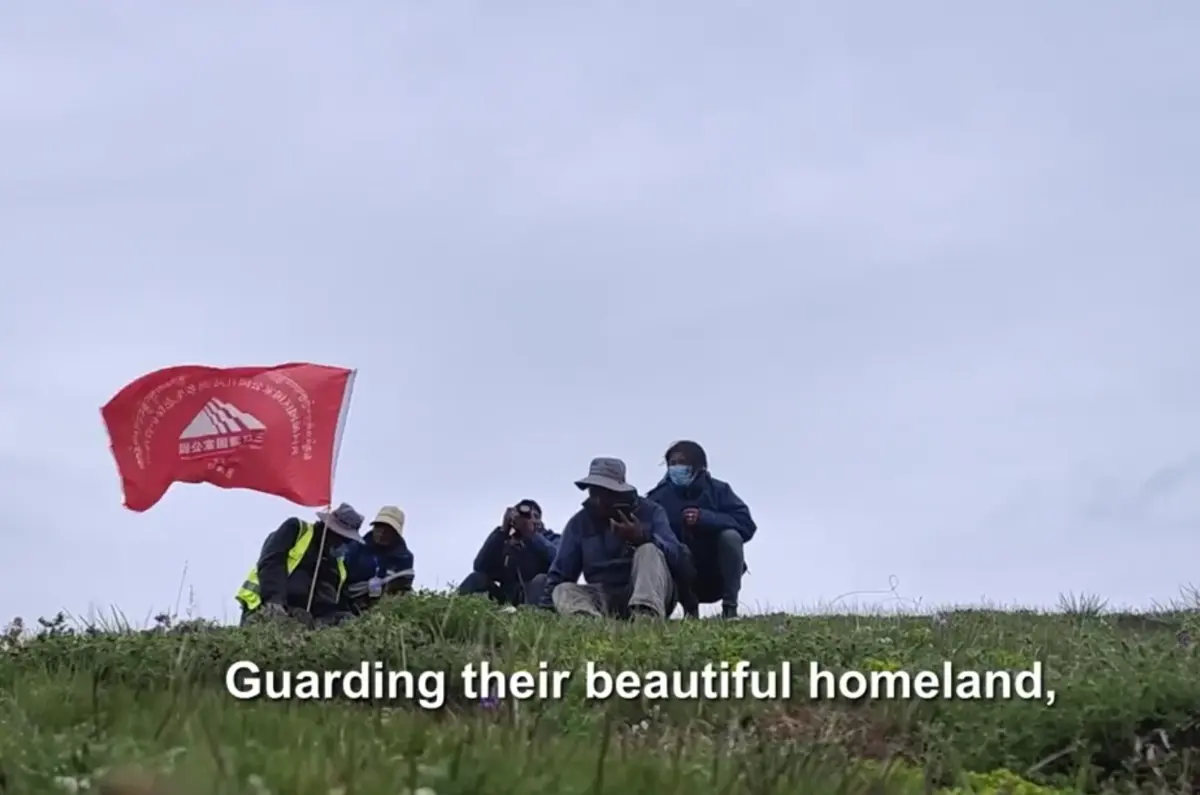
Under the “One household, one eco-guard” system, around 20,000 Tibetans take part in monitoring Sanjiangyuan’s ecology and climate change. Screenshot from New China TV’s YouTube channel.
The Qinghai provincial government was eager to turn Sanjiangyuan into a showcase of “ecological civilization” under Chinese President Xi Jinping’s leadership. Drawing on the experience of Tibetan volunteer networks, local governments worked with Tibetan communities to introduce the “One household, one eco-guard”(一戶一崗) system in 2016, turning 20,000 herders (the current figure) into conservation workers for the region. Under the system, the herders received an income of CNY 1,800–2,400 (approximately USD 350–450) to monitor water quality, wildlife, and forests, collect garbage, and report illegal behavior.
Tibetan women joining the climate fight
However, thanks to the region’s traditional patriarchal division of labor, the “One household, one eco-guard” system generally favors the male household head, and Tibetan women are often left vulnerable and sidelined.
In 2016, research conducted by the international NGO Global Environmental Institute (GEI) indicated that Tibetan girls in Sanjianyuan had fewer educational and career opportunities, as limited family income was usually allocated to their brothers, and they were delegated as caretakers for the family and the land.
In Qinghai, over 70 percent of the rural labor force is women. The international environmental group then worked with local organizations to introduce gender-specific climate-action training and helped women household heads establish cooperatives to run eco-friendly small businesses.
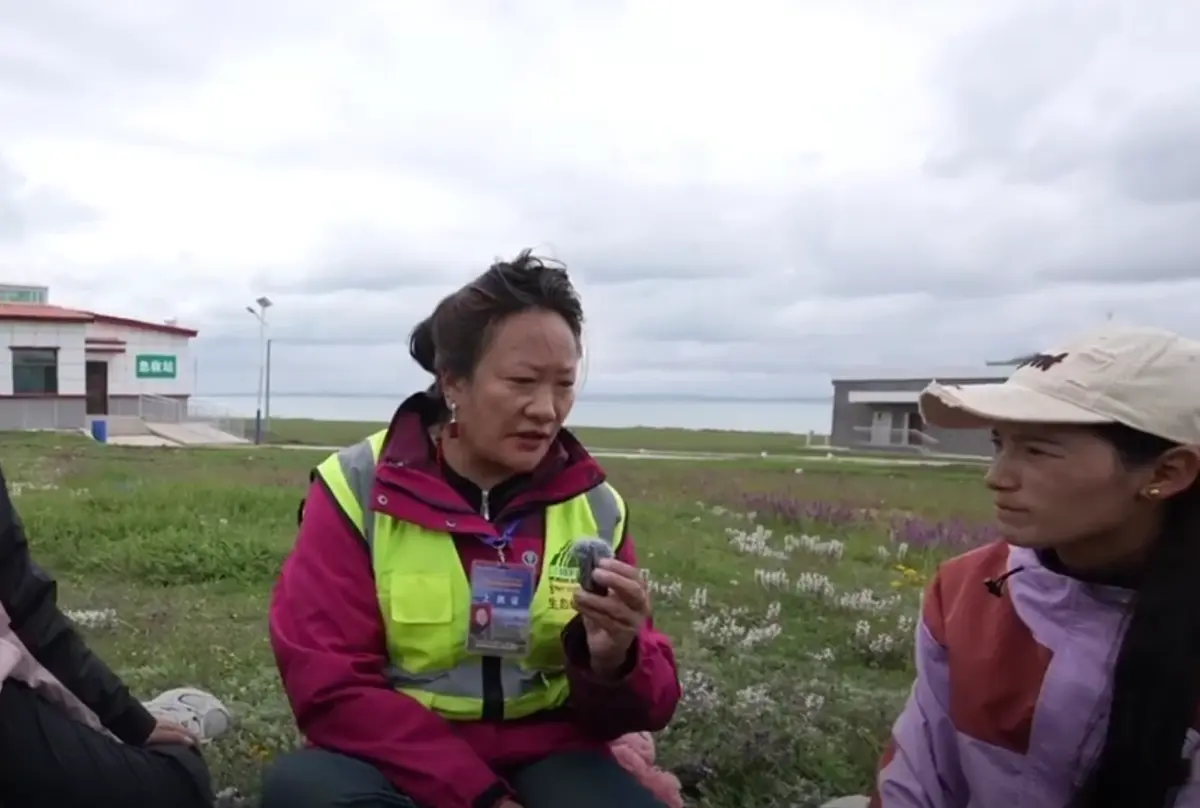
More Tibetan women have taken up the role of eco-guards. Screenshot from CGTN’s YouTube channel
Other international organizations also stepped in to empower women in Qinghai’s plateau region and strengthen their role in fighting against the climate crisis. In 2020, UN Women began funding the Sanjiangyuan Ecological and Environmental Protection Association to establish the Sanjiangyuan Female Environmental Protection Network, which provided subsidies to enable women to participate in conservation work and encouraged them to form cooperatives to run eco-friendly businesses.
Two years later, in 2024, the Qinghai government incorporated the network into their “Women’s Action for Building Sanjiangyuan’s Ecological Civilization” (生态文明江源巾帼行), a three-year program, which encourages Tibetan women to register as eco-guards, develop their careers as conservation workers in the national park, and run cooperatives to protect both the environment and Tibetan cultures.
Designated as one of the country’s first national parks in October 2021, Sanjiangyuan is often depicted as an achievement of China’s “ecological civilization.” The official success story is supported by several indicators: over the past two decades, grassland vegetation coverage has increased by 11 percent, water conservation by 6 percent, and the population of wild animals has grown, particularly the Tibetan Antelope, which has increased from less than 20,000 to over 70,000.
What is often overlooked is that the Tibetan communities sacrificed their pastoral livelihoods and gave up their settlements to create the national reserves and protect Asia’s water tower. Moreover, they have pioneered the now-institutionalized community co-management model to integrate their livelihoods with conservation needs with the help of domestic and international NGOs. Today, they are still standing on the frontline, protecting Asia’s essential water sources for billions of people along the three rivers.