



For the past several months, a coordinated digital campaign has targeted community archivists in Bangladesh who document and preserve audiovisual material related to the July 2024 Student-People’s Mass Uprising, including its history, collective memory, and records of human rights violations.
These attacks systematically exploit weaknesses in Meta’s copyright enforcement mechanisms, with the primary objective of removing Facebook pages that host critical documentation of the movement. Despite repeated appeals to Meta by affected community archivists, the responses have been limited and largely ineffective.
We spoke with at least three young documentarians through messaging platforms and phone calls. They confirmed that their Facebook pages functioned as informal but highly significant digital archives of this historical moment. A substantial portion of this content is already being used as evidentiary material in proceedings at the Bangladesh International Crimes Tribunal addressing mass violence linked to the July 2024 uprising.
When copyright strikes are submitted using fake email identities and fabricated claims, Meta removes videos and images without adequate verification or due process. For many self-organized archivist communities, Facebook has served as their primary platform for public engagement and memory preservation. As a result of Meta’s failure to ensure adequate safeguards, critical documentation is being lost, directly affecting broader transitional justice processes.
A vital platform, with coordinated abuse
Saleh Mahmud Rayhan, a student involved in the July 2024 uprising, later co-founded the July Revolutionary Alliance (JRA) with a group of his contemporaries. In an interview conducted with Global Voices via Zoom, Rayhan stated that the organization’s mandate includes collecting, preserving, and disseminating videos documenting human rights violations, using Facebook as its primary platform to reach the public.
For many young, self-organized communities in Bangladesh — often operating without formal training, technical capacity, or institutional funding — Facebook has become the default infrastructure for documentation and outreach. As the most widely used platform among Bangladeshi internet users, it serves not only as a publishing tool but also as a space to amplify victims’ voices and share evidence.
In JRA’s case, these materials have contributed to broader accountability efforts, including ongoing proceedings at the International Crimes Tribunal examining allegations of crimes against humanity, including murder and enforced disappearance, linked to the July 2024 student-led protests.
On February 15, 2026, Meta suspended JRA’s main Facebook page, which had approximately 547,000 followers, citing multiple copyright violations. However, the materials shared on the page were user-generated and distributed for non-commercial, public-interest purposes. While JRA does not claim ownership of all content, closer scrutiny suggests that those submitting the copyright complaints were not the rightful owners either.
On 22 March, JRA’s backup page, “July Revolutionary Alliance, South Region,” was also suspended on similar grounds. Although the page was later restored after multiple appeals, it remains at risk due to ongoing false claims.
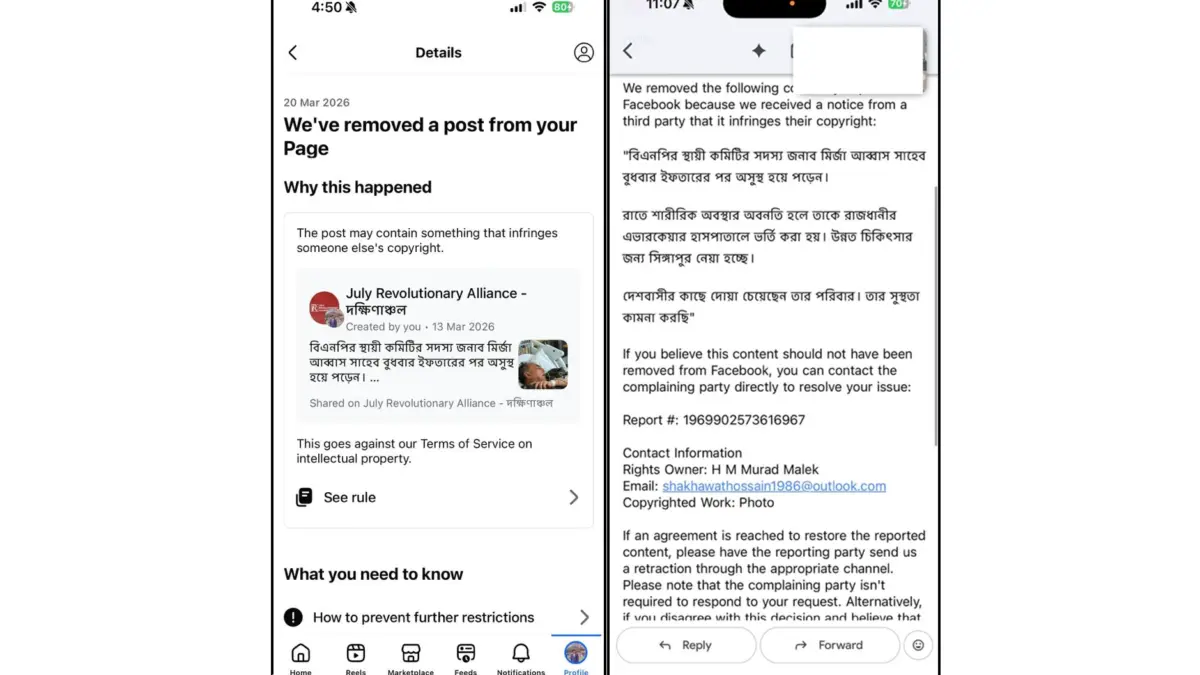
Facebook removed content based on a third-party copyright claim, submitted via “shakhawathossain1986@outlook.com” on behalf of “H M Murad,” concerning a viral photograph of a politician, despite the email address not belonging to him, which concerned a photograph that had also been publicly shared by the politician’s party.
A similar pattern affected The Red July, another self-organized community archivist group formed by survivors of the July 2024 uprising that works to document violations and amplify affected voices. The group lost two of its Facebook pages under comparable circumstances.
Sajib Hossain, an administrator of The Red July, stated during a phone call and later provided supporting documentation via WhatsApp messages that the group’s two primary pages — one with approximately 300,000 followers and the other with 125,000, named “The Red July Production”—simultaneously received between eight and ten copyright strikes. As a result, the pages were suspended almost immediately, leaving administrators with insufficient time to respond or implement protective measures.
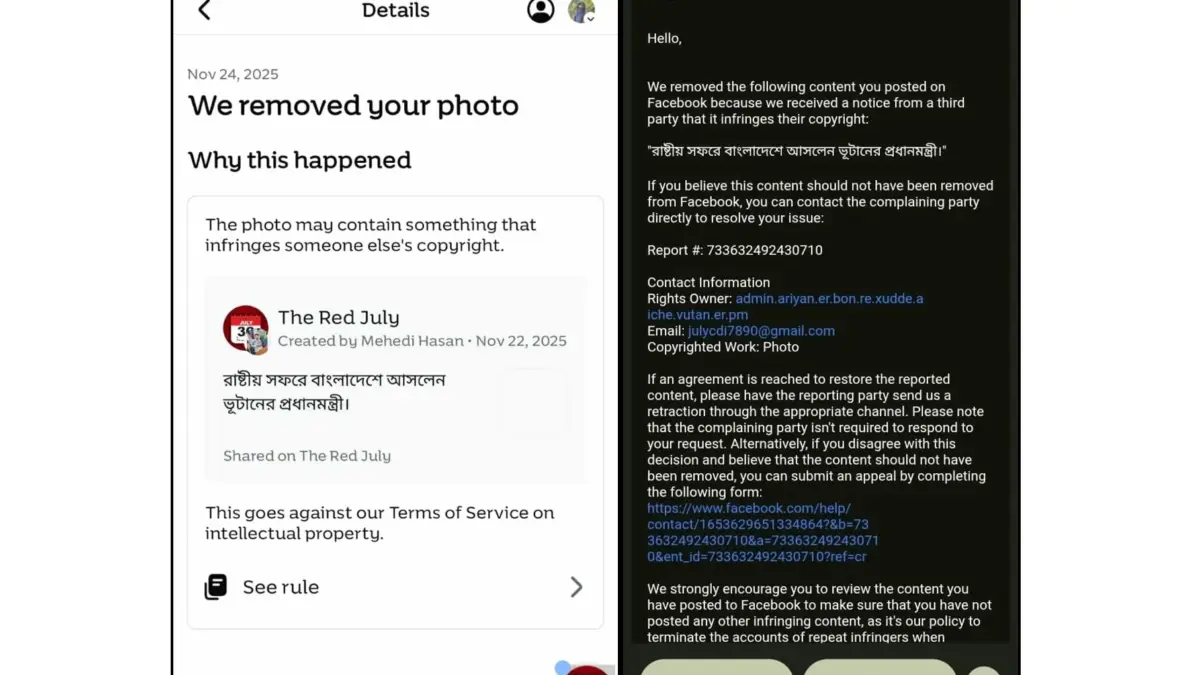
Meta removed a post by The Red July, a photo of Bhutan’s PM in Bangladesh, due to a false copyright claim filed by Slang name id using the derogatory email “julycdi7890@gmail.com.”
Findings from the investigation indicate that these claims do not appear to constitute legitimate copyright disputes. Instead, individuals are seemingly creating fake email accounts and submitting third-party complaints. Meta appears to accept these claims without sufficient verification, resulting in the removal of content, including materials originally published by the communities themselves. Automated appeal mechanisms have so far provided limited effective remedies.
Meta’s failure to safeguard the affected pages
Both organizations report a consistent pattern of targeted harassment. They describe receiving explicit threats from cyber groups aligned with political actors connected to ongoing trials for crimes against humanity. These threats often demand the removal of posts related to political figures, including former Bangladesh Prime Minister Sheikh Hasina.
A Facebook page named “Network-71” publicly declared its intention to remove content from The Red July. Similarly, accounts using the names “Mahir Chowdhury” and “Nadim Chowdhury” issued public threats to take down posts related to the July 2024 uprising.
Shortly after such warnings, waves of false copyright claims are reportedly submitted from anonymous or unverified email accounts targeting the same content. In several cases, individuals publicly announce intended takedowns, issue threats, and later share screenshots celebrating successful removals. See here and here.
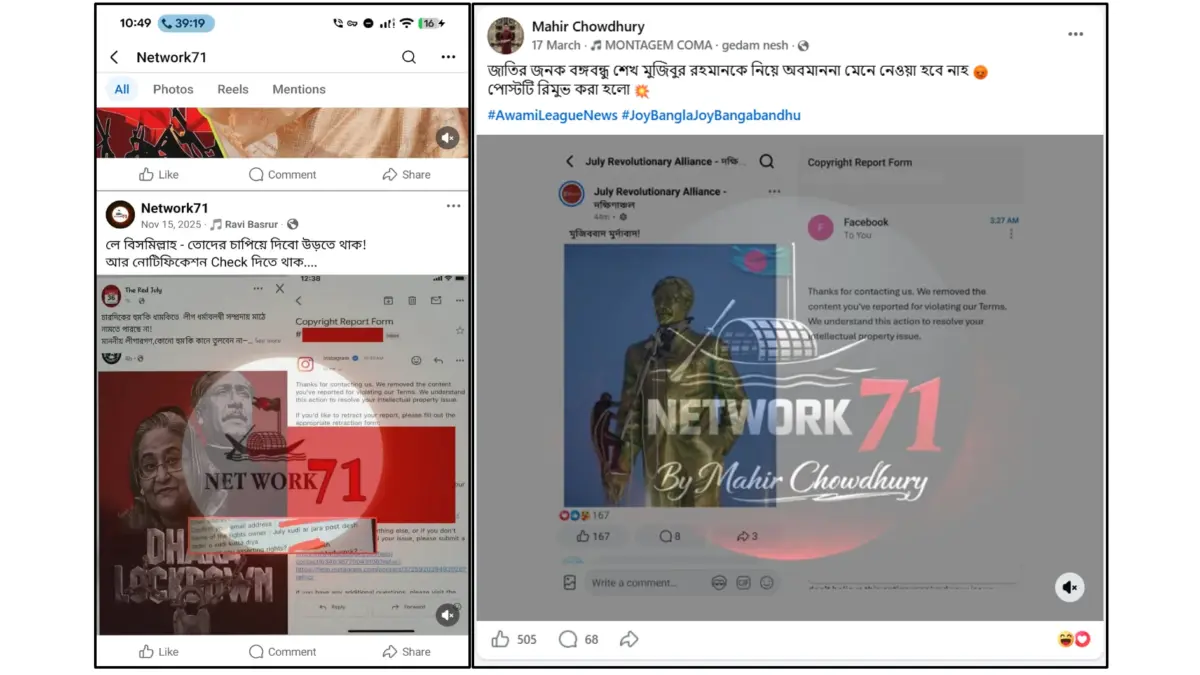
Network 71 publicly admitted to falsely reporting the post that led Facebook to remove activist Facebook groups.
These posts, often accompanied by celebratory or abusive language, suggest deliberate and coordinated misuse of platform reporting systems. Despite these clear indicators, including prior threats and synchronized reporting, Meta has not taken effective action to identify or prevent this pattern of abuse.
Saleh Mahmud Rayhan described how one account sent direct messages warning that specific posts had to be removed or the entire page would be taken down. Within two days, around seven posts were targeted with false claims. Meta accepted the claims, removed the posts, and subsequently suspended the page.
JRA representatives later contacted individuals whose names had been used in the complaints. Those individuals confirmed that they had not submitted any copyright claims, indicating that their identities may have been misused through fabricated email accounts. Rayhan emphasized that these removals resulted in the loss of critical visual evidence documenting human rights violations during the uprising.
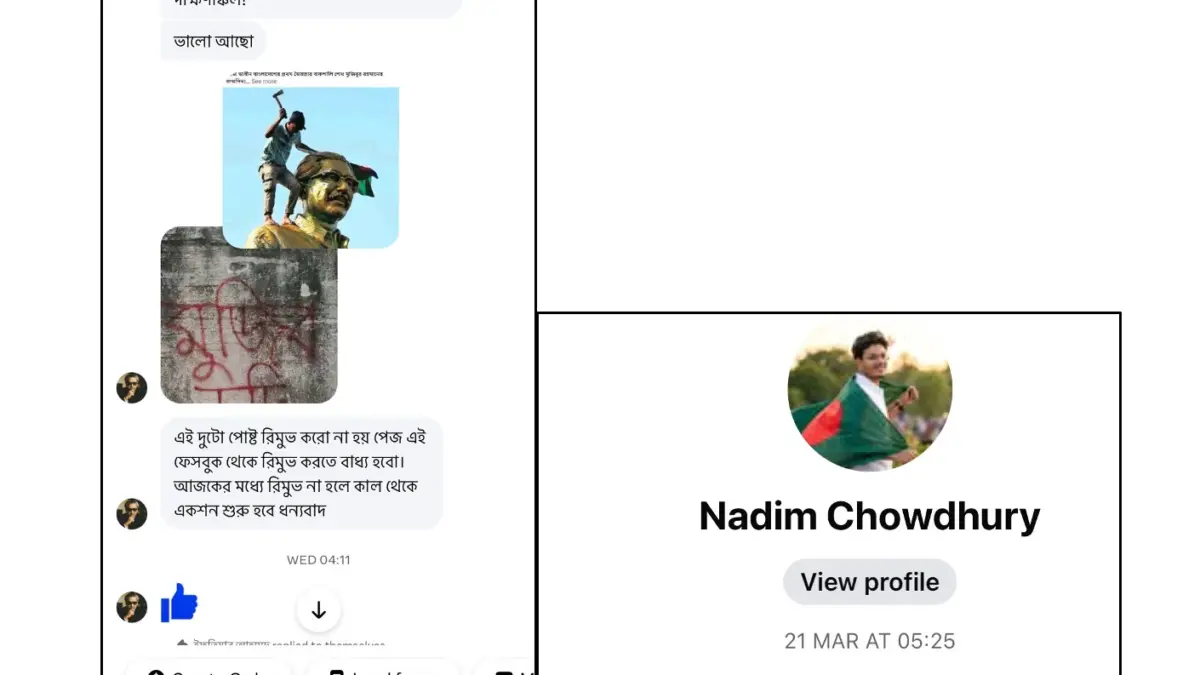
This image, sourced from JRA, illustrates the progression of threats. Initially, there were private demands to remove a post critical of their party; when this was refused, they proceeded to submit a fraudulent copyright claim.
A recurring tactic of digital repression in Bangladesh
The use of copyright claims to suppress political opponents is not new in Bangladesh. Rather, it appears to have become a recurring method used to restrict critical voices online.
In 2022, independent news site Netra News reported that groups linked to the then-Awami League-led government were involved in hacking critics’ Facebook accounts. Around the same period, separate reporting documented how a hacker group took down Amar Desh Online, a media outlet critical of the government, through the use of false copyright claims.
Recent incidents suggest that similar tactics are now being used more broadly: not only against political opponents, but also against human rights groups, investigative journalists, and fact-checking initiatives.
One example involves The Dissent, a Bangladesh-based investigative and fact-checking platform that has been targeted by fake copyright claims. The publication’s editor, Qadaruddin Shishir, stated in an interview that several of their reports, including fact-checks of AI-generated images, were removed from Facebook after being flagged for alleged copyright violations. Despite the content being originally produced by their own reporters, Shishir noted that these complaints originated from unverifiable email addresses but were nonetheless accepted by Meta Platforms, Inc. without meaningful scrutiny.
These fraudulent tactics have affected a broad spectrum of voices, with activists and journalists among the primary targets. The reach of these claims has extended to the former interim government’s official advisory pages, the social media accounts of the Head of Government, and memorial tributes to slain activist Osman Hadi. The system’s lack of scrutiny was further highlighted when original materials, including a journalist’s own photography, were erroneously flagged as infringing and removed from the platform.
In several cases, coordinated groups have openly claimed responsibility for these takedowns. Groups identifying themselves as “Crack Platoon, Bangladesh Cyber Force,” “Dark Cyber Gang,” and “Qawmi Cyber Expert Team” have publicly stated that they use copyright reporting tools to remove pages and accounts, and have shared evidence of these actions online.
Platform failure and an accountability gap
These incidents point to significant weaknesses in Meta’s copyright enforcement processes. The lack of effective verification appears to allow coordinated actors to misuse reporting systems to target activists, archivists, and journalists.
This issue extends beyond routine content moderation concerns. The removal of such content affects the ability to document events, share information, and preserve records that may be relevant to accountability processes.
Without stronger safeguards — including improved verification, greater transparency in decision-making, and accessible appeal mechanisms — these practices are likely to continue, with broader implications for digital rights and public-interest documentation in Bangladesh.
Jobair Ahmad Co-authored this report.