



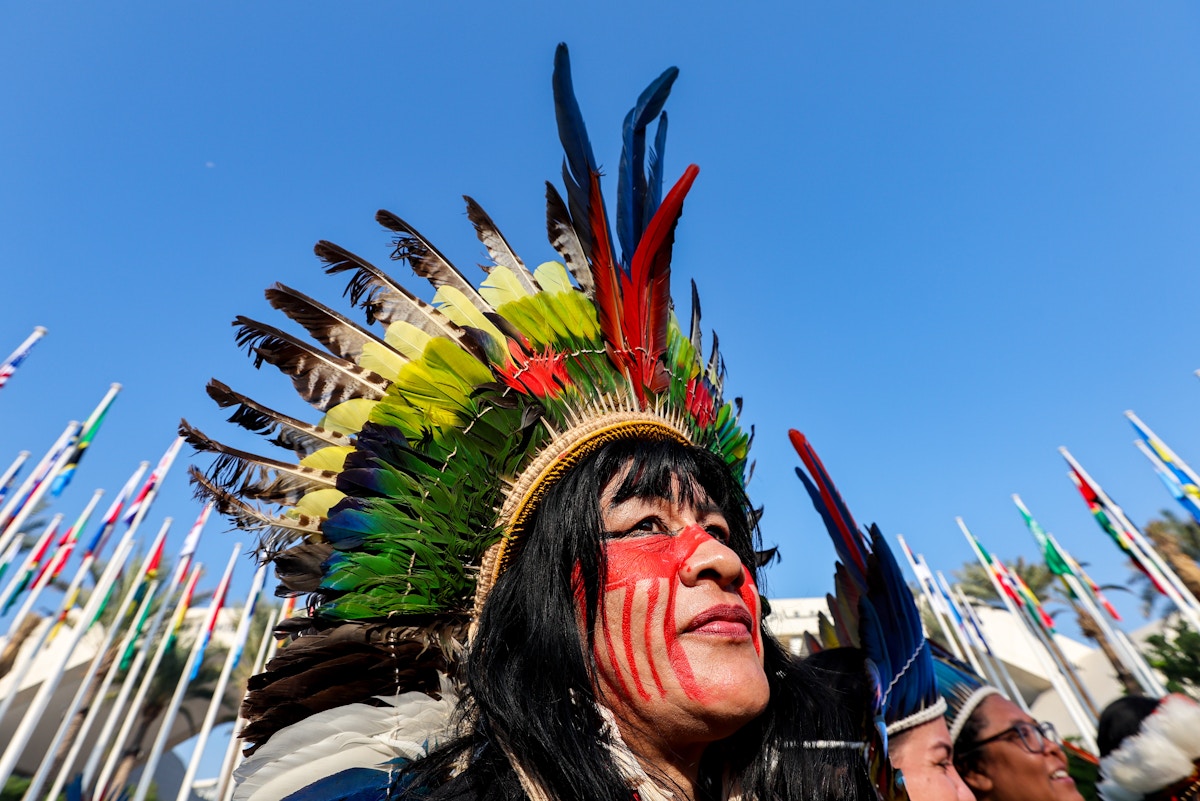
From the 1950s to the 1970s, Indigenous organisations began to take root, such as the Saami Council (1956), the National Indian Brotherhood in Canada (1968) and many more in Latin America. In 1975, Indigenous Peoples convened in Port Alberni, British Columbia, for the first international conference of Indigenous Peoples.
Two years later in Geneva, at the UN International NGO Conference on Discrimination against Indigenous Populations in the Americas, an important recommendation was made to establish a UN mechanism dedicated to reviewing developments in the situation of Indigenous Peoples.
In 1982, the Commission on Human Rights established the UN Working Group on Indigenous Populations, with the mandate to review developments concerning the situation of Indigenous Peoples and to discuss a draft for a possible international standard on their rights.
The annual sessions of the Working Group were an essential platform for the development of the international Indigenous movement. For the first time, representatives of Indigenous Peoples from around the world were able to share information about their situation at the UN, and build alliances and strategies for advocacy.
In the late 1980s, which is when we began producing The Indigenous World, the status of Indigenous Peoples changed from being objects of international law to subjects, beginning with the adoption of International Labor Organization Convention 169 in 1989. Since then, the legal recognition of Indigenous Peoples has swiftly grown, perhaps demonstrated most significantly in the adoption of the UN Declaration on Indigenous Peoples in 2007.
The world appears to be at an inflection point when it comes to multilateral processes, support for human rights, and the re-emergence of Cold War-like global geopolitical tensions. What are the implications of this for Indigenous rights?
Indigenous Peoples and their lands are increasingly being affected by armed conflict and the actions of illegal cartels (as well as the actions to curtail them), among other violent situations. Naturally, they try to take measures to defend their territories. This makes them frequent targets of violence, which can include forced displacement, threats, persecution, sexual violence and even killings.
Military, police and government policies or peace-building strategies are often created and implemented without acknowledging Indigenous Peoples. Excluding them in these processes simply perpetuates the cycle of violence they have had to contend with for generations, and effectively derails any meaningful and genuine process for long-term peace.
Further, states are redirecting budgets from human rights and international protection frameworks, compromising one of the few foundations Indigenous Peoples have, and have fought for for decades, where their rights are explicit and protected. This is damaging to Indigenous Peoples as often, in local and national contexts, they are not mentioned or considered – and if they are, it is done in a token and superficial manner.
In the rush for critical minerals, there is an increasing risk of violations of Indigenous Peoples’ rights. Clean energy technologies will demand huge amounts of the world’s copper and rare earth element reserves, including nickel, cobalt and lithium, within the next 15 years.
More than half of the reserves for these minerals are on Indigenous Peoples’ lands or close to them. Once governments classify these resources as “critical”, their extraction becomes a national security issue. This means they can bypass protections and rights of Indigenous Peoples to grant companies licenses to extract these resources from their lands.
Indigenous Peoples have pushed back against these actions, reminding institutions of protections enshrined in national or international laws. When they do so, they have often been perceived as a hindrance, and their rights as running counter to national interests. Important protocols, such as free, prior and informed consent (FPIC), among others, are simply sidestepped – if they were in place to begin with. This was evident in the 2026 edition’s updates from the Sápmi people of northern Scandinavia, for example.
Indigenous Peoples have also peacefully protested and brought their stories and evidence into international spaces such as the UN. But when they do so, they have been painted as anti-state, and frequently face heightened surveillance and intimidation.
What we are seeing, and what has been reported in this book, is that governments are shifting their budgets and narratives about the green transition. For them, it is now more of an energy security matter than an environmental one, the new focus being the speed at which a government can achieve energy independence.
This translates to the reopening of coal power plants that were shut down or planned to be decommissioned, and an increase in leases for oil and gas exploration, as just some examples.
Again, there is little consideration, acknowledgement, or consulting of Indigenous Peoples in all of this. Their knowledge and lived experiences, which have contributed to the sustainable use and conservation of lands and resources for generations, are being ignored. Rather, models based on extraction and force continue to take their place.
This article was originally published on Dialogue Earth under a Creative Commons licence.