



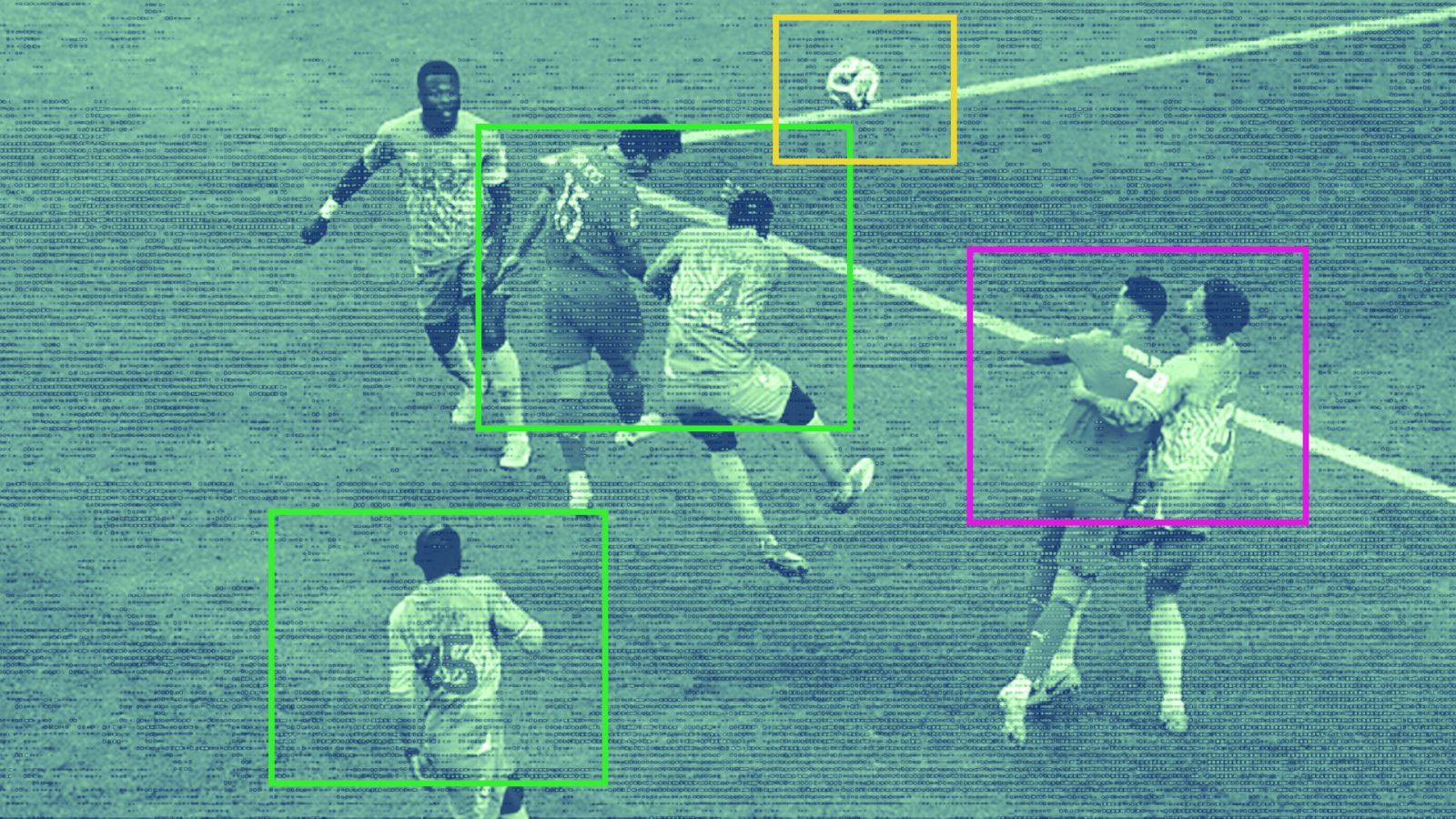
The current edition of the FIFA World Cup features a sensor-fitted ball, real-time tracking, artificial intelligence-assisted offside calls, and an AI assistant for each of the 48 teams. Behind these innovations are data workers in countries including India, Cambodia, and the Philippines, who are essential for the many AI tools in play.
Football embraced data analytics more than two decades ago, and nearly every national team and major club now uses it for recruitment, training, game tactics, injury prevention, player management, and more. The data analytics also feed broadcasters, and the video-game and betting industries.
Teams today may have in-house data analysts and scientists with doctorates in physics, mathematics, or machine learning and AI experience; data vendors whose workers specialize in player tracking and turning raw video into data; and video platforms that record and tag matches, Rafael Grohmann, assistant professor of media studies at the University of Toronto, told Rest of World.
“Football has been relying on this kind of work far longer than the current AI excitement,” he said. “The workers in data value chains are essential to football … and the data value chain has a geography: The high-value data analytic work is located in a handful of wealthy centers, while the data annotation is concentrated in cities across Eastern Europe, Africa, South Asia, and Southeast Asia.”
Side gig for players
The data annotation workers — who are often football players themselves, or have extensive knowledge of the game — are largely in cities such as Manila, Cairo, Chennai, and Ternopil. They include independent contractors hired match by match, and annotators who spend three to four hours on a single game, turning every pass, tackle, and shot into structured data, said Grohmann, who is mapping the workforce in football’s data value chains.
Data work is a popular side gig for many Philippine football league players looking for additional income, according to a player who annotated data for about a year at Packing Sports, the Manila-based unit of German data analysis company Impect. He asked not to be named, as he is not authorized to speak to the media.
Greater American investment “will likely translate into greater investment in data analytics.” Scott Powers, Rice University
The player told Rest of World he watched European league matches and tagged passes, shots, tackles, and other player actions. During major tournaments like the FIFA World Cup and the UEFA European Championship, “the workload is heavier because of higher demand for fast data from teams, analysts, and the media,” he said.
As a player, the tasks also gave him a deeper understanding of the game, he said. “My work helps me notice tactical details and player movements that many people might miss,” he said. “It also makes watching football more interesting.”
Follow the money
Football is big business. The top teams in the English Premier League, Italy’s Serie A, Germany’s Bundesliga, and Spain’s La Liga generate billions of dollars in revenue. American fans — and investors — are increasingly taking an interest.
More than half the clubs in the Premier League are majority-owned by wealthy American individuals or U.S.-based firms. Americans and Canadians control nearly half the Serie A teams, as well as a handful of clubs in La Liga, according to the Forbes ranking of the world’s most valuable football teams. U.S. investors are also buying up teams in lower divisions, and in countries such as Mexico.
Greater American investment “will likely translate into greater investment in data analytics,” Scott Powers, assistant professor of sport analytics at Rice University, told Rest of World. “After all, the Moneyball revolution came from the U.S.,” he said, referring to the book and movie that detail the Oakland Athletics’ effective use of data analytics to build a competitive baseball team on a small budget — a strategy that was quickly adopted by other sports teams.
Today, a small number of companies control the data most football clubs rely on. Advanced technologies enable data generation in real time through a combination of human annotation, computer vision, and AI modeling. Data workers can capture up to 3,000 actions per match.
There is now greater emphasis on the analysis of player tracking data, said Powers, a former data scientist at sports data firm Zelus Analytics.
“These are large data sets that require specialized skills to analyze,” he said. “I’ve seen job postings for sport analytics, performance science, and/or data engineering from 25 of the 30 clubs on the Forbes list.”
The growth of wearable technology such as smart vests, as well as the betting industry and prediction platforms like Kalshi and Polymarket, is also fueling the demand for data workers.
The betting angle
A freelance data annotator in Rio de Janeiro, who tags local football games for a foreign sports data company, told Rest of World “it’s pretty clear that the data I record is for betting.”
The matches he covers are generally small, and sometimes not even broadcast, said the worker, who asked to go by the name Adam, as he is not authorized to speak to the media. The main data points he captures on the company’s app are goals, corners, cards, and penalties. He is paid about 60 euros ($70) per match, plus transportation costs, he said.
“They need real-time data to adjust their odds throughout the match without waiting for the official report, which can sometimes take days. So I cannot send the data late, or I risk losing part or all of the payment,” Adam said.
“The job pays well, considering the duration of a game, and the fact that they pay in euros,” he said. “In this market of betting on lower-visibility matches, I can’t see automation technology being cheaper than labor.”
As technologies advance, analysts are increasingly using computer vision algorithms to automatically detect actions that were previously tagged by data analysts, Powers said. The algorithms are trained on data that is manually labeled by workers.
“I have seen some applications of generative AI … but I haven’t seen evidence that it has revolutionized the game yet,” he said.
This World Cup is expected to generate about $9 billion, making it the most lucrative sporting tournament ever. AI-powered innovations — such as the AI assistant developed by FIFA and Lenovo that uses machine learning and natural language processing to analyze millions of data points — are key to keeping fans, teams, and businesses engaged.
“The World Cup will put football’s data and AI on the largest stage there is,” Grohmann said. “The football we watch runs on their work as much as on the players. None of it would exist without the workforce behind it.”