



There is strong evidence that transitioning from animal to more plant-based diets could improve human and planetary health, but progress has been slow. This is partly due to a misunderstanding of what drives the behaviour of individuals and organizations alike.
If people know these foods can be better for themselves and for the planet, the thinking goes, they should buy and eat more of them. The foods we buy and consume are often discussed as if they are simply a matter of personal choice.
But grocery shopping rarely works that way.
Most people make food decisions while managing a budget, comparing prices and relying on habits built over years. In that setting, good intentions can lose out to price, convenience and whatever products are most visible.
Governments and public health organizations are encouraging people to shift toward more plant-based diets. If the goal is to make sustainable eating more common, we need to understand how people actually shop.
Our recent research suggests two things are especially important: affordability and visibility. Plant-based foods need to be affordable for most people and visible enough to become integrated into their everyday choices.
Price matters, but not in simple ways

THE CANADIAN PRESS/Chris Young
In our study, we analyzed grocery store loyalty card data from more than 29,000 consumers in Finland. We compared how shoppers responded to price changes across plant-based and animal-based foods, including legumes, plant-based beverages, dairy products, meat, fish and eggs.
We found that shoppers were price-sensitive across both groups. When prices rose, people generally bought less. But consumers were less responsive to price changes for plant-based proteins than for animal-based ones.
This may seem surprising. Plant-based foods are often described as expensive or inaccessible. We also found that plant-based proteins were more expensive. Price does matter, but the story is more complicated than saying plant-based foods simply cost too much.
One reason may be that shoppers often have fewer choices of brands and products in plant-based categories. If there are only a few brands or products on the shelf, consumers who want or need plant-based options have fewer alternatives when prices rise. For people who are vegan, vegetarian or trying to avoid animal products, switching away may not feel like a real option, even when prices seem high.
Affordability is an equity issue
We also found that income and education shaped how people responded to prices. Lower-income consumers were generally more sensitive to price changes. However, the gap between lower- and higher-income consumers was much larger for animal-based proteins than for plant-based ones.
A similar pattern appeared when we tested grocery data from more than 58,000 consumers in Canada. The results pointed in the same direction: price matters differently depending on the food category and the consumer.
This has practical implications. Policymakers and retailers cannot treat all consumers or all plant-based foods the same. Discounts, promotions or even taxes on different protein foods may have a larger impact on lower-income households, especially when budgets are tight.
But affordability is only part of the story.
Visibility changes what people buy
THE CANADIAN PRESS/Sean Kilpatrick
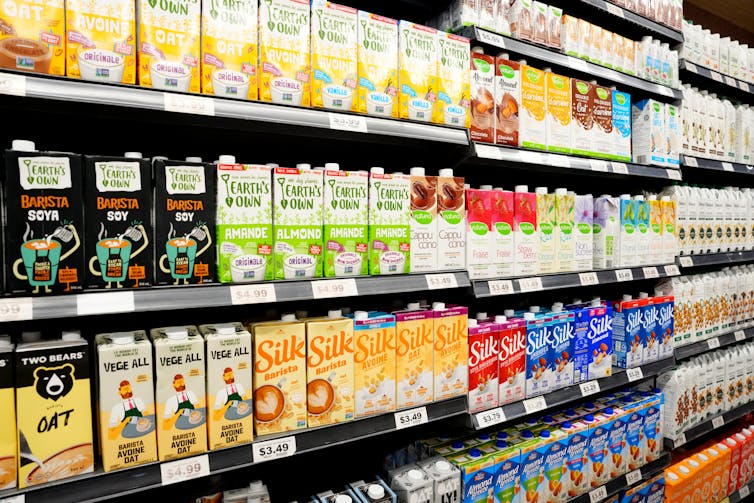
In another study, we examined plant-based beverage purchases across 242 grocery stores in Québec. We looked at how flyer, mobile app and in-store promotions affected demand.
The most effective promotions were flyer promotions. These were visible before and during shopping: in paper flyers, digital flyers and on store shelves. Mobile promotions also increased demand, especially when they offered bonus loyalty points. In-store promotions had a smaller effect.
The lesson is not that one type of promotion always wins. Timing and visibility matter. A product is more likely to be bought when it is brought to mind before the shopping trip and remains visible on store shelves.
This matters because many consumers are still forming habits around plant-based foods. People may be open to buying them, but forget them in the store, miss them on the shelf or default to familiar animal-based products.
Promotions can help overcome the “out of sight, out of mind” problem. But frequent promotions can also train consumers to wait for discounts. That may increase short-term sales while making shoppers more sensitive to regular prices later.
For retailers, this means selling plant-based products should not rely only on temporary discounts. They should also make products easier to find and consistently affordable for shoppers.
Equity should be central to sustainable food policy. A sustainable food transition that ignores affordability risks becoming a project for people who can already afford to choose differently.
Plant-based eating is not just about changing minds. It is about changing the conditions in which food choices happen: the prices people face, the products stores carry, the promotions shoppers see and the everyday habits that guide what goes into a consumer’s basket.