



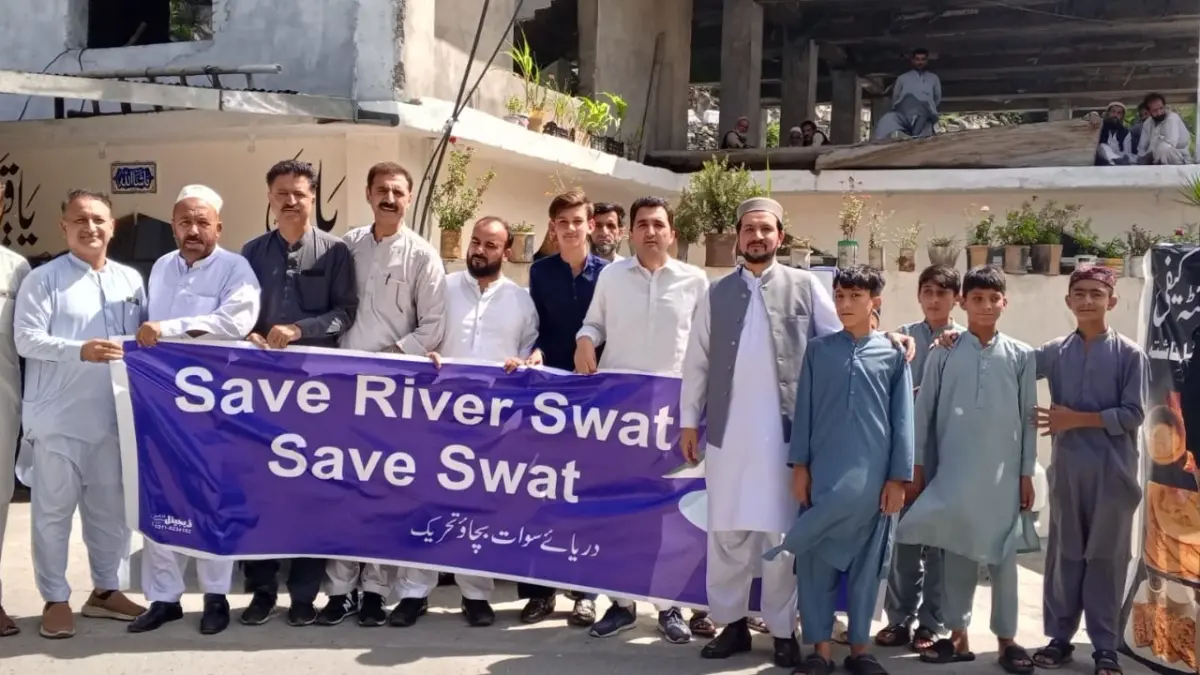
Image by the author. Used with permission.
This post is part of Global Voices’ May 2026 Spotlight series, “Global crisis, local solutions.” This series will offer stories of resistance and successful climate action, insight into how communities in the Global South are fighting back against the crisis, analysis of what this might mean for future generations, and more. You can support this coverage by donating here.
For the Indigenous Torwali community living in the Swat valley, in northern Pakistan, rivers are not a “resource.” They are not just “water.” They are the heartbeat of their nation, a sacred presence, the manifestation of the goddess Dara connecting them to their ancestors. But under the justification of the “electricity crisis,” in the past few years, the Pakistani government has been pushing a new wave of hydroelectric projects that are threatening this river system, along with the ecosystems and cultural systems tied to it.
For the Torwalis, losing a river means losing history, livelihoods, identity, and imagination. This is why, since 2023, they have been leading a fierce resistance to save the Swat River and halt the construction of the 207 MW Madyan hydroelectric project, one of at least 18 schemes planned between Madyan and Kalam in the Swat District of Khyber Pakhtunkhwa, Pakistan. The project is part of the World Bank-funded Khyber Pakhtunkhwa Hydropower and Renewable Energy Development project, approved in 2021 for a total of USD 450 million.
On April 4, 2026, the movement celebrated a victory: The provincial cabinet approved its withdrawal from this project. However, it is not yet clear whether the project proponents will challenge this decision or seek equally devastating alternatives, and there have been no comments from the World Bank so far. For the Torwalis living in the valley, the struggle is not over yet.
The Torwalis know well what happens when large-scale dams interrupt the free flow of their rivers. For them, the Daral Khwar Hydropower project is a lesson written in water. The project was initially funded by the Asian Development Bank, which withdrew after public pressure. The authorities, however, sought other funding sources to advance the project, making false promises and dividing communities to silence dissent.
In the town of Bahrain in the Swat district of the province of Khyber Pakhtunkhwa, Pakistan, where the Daral merges with the Swat River, the local community used to describe their land as a paradise. In the summer, children were playing in the river’s cold pools, women were collecting fresh water from its springs, and orchards were thriving along its banks. Today, though, the powerhouse controls the river’s flow like a tap, leaving long stretches of riverbed dry. Mosquitoes breed along its banks well into autumn. Sudden water releases from the tunnel with little warning, causing a drowning hazard for children. This loss has taught the Tarwali a painful truth: once a river becomes a machine, everything connected to it — culture, ecology, economy, identity — unravels.
With this memory still fresh, the Torwalis have formed the Save River Swat Movement (Darya-e Swat Bachau Tehreek) to mobilize against the Madyan project. In August 2024, they submitted a formal complaint to the World Bank, demanding a review under its environmental and social safeguard policies. They have exchanged hundreds of letters with the Bank; held meetings in Peshawar, Islamabad, and online. They also informed international bodies, including UN institutions, and engaged local authorities. Meanwhile, jirgas (a gathering of elders) were held from Madyan to Kalam. A massive demonstration took place on August 23, 2024, in the town of Bahrain; youth marched again a month later. Press conferences in Swat and Islamabad generated national attention, and even children have written petitions to the prime minister.
According to international law and the UN Declaration on the Rights of Indigenous Peoples, no project can proceed without Free, Prior, and Informed Consent (FPIC). Yet, the Torwalis have complained about rushed hearings, inaccessible documents, procedural shortcuts, and bureaucratic coercion — none of which constitute real consent.
And their opposition was clear from the start. Already in July 2023, when the Pakhtunkhwa Energy Development Organization PEDO and the provincial environmental authorities held the first “public hearing,” people attended in large numbers. Yet, a “No Objection Certificate” was issued, despite attendees’ protests.
There have also been a series of threats and intimidation against community members opposing the project. Local authorities and government staff have threatened activists and local village officials with possible imprisonment and surveillance of their family members. Some activists were framed and accused of working against national interests. As a result, in the affected villages, there is a climate of fear, and some are choosing to avoid voicing their concerns out of fear of being targeted.
Additionally, the World Bank has failed to recognize the indigeneity of the Torwali peoples, leading to flawed impact assessments and a lack of information disclosure in the local Torwali language. As a result of the movement’s sustained efforts, in June 2025, the World Bank commissioned a new screening to determine whether the Torwali qualify as Indigenous people under its policy, an unprecedented step in this region. Almost a year later, however, it has not shared the findings with the community.
But for the Torwalis, there can be no doubts about their indigeneity. Their identity is inseparable from the mountains they inhabit, the rivers they honor, the pastures they graze, and the ancestral systems they still practice. Their language — Indo-Aryan with some pre-Aryan and Gandharan elements — is shaped by their interaction with the landscape: there is a word for every cliff, rock, ravine, stream, meadow, and pass. Even today, Torwalis living in the cities of Karachi, Hyderabad, or Rawalpindi continue to call their region watan, a word deeper than “homeland.” A proverb expresses this bond: “tu watan ge ke bedu, watan ma wad.” It means “your body may reside elsewhere, but your heart belongs to the homeland.”
Whether or not the movement to save the Swat River will ultimately prevail, this movement has already achieved something profound: it has reaffirmed that Indigenous rights and environmental justice are inseparable; that rivers have rights because communities have relationships; and that development must be accountable to those who bear its consequences.
As the Pakistan poet Allama Iqbal reminds us, “A drop of dew is enough to make this soil fertile again.” The resistance of the Torwali people is that drop of dew: an act of dignity, unity, and courage in the face of imposed development. And as long as the Swat River flows, they will continue to defend it.