



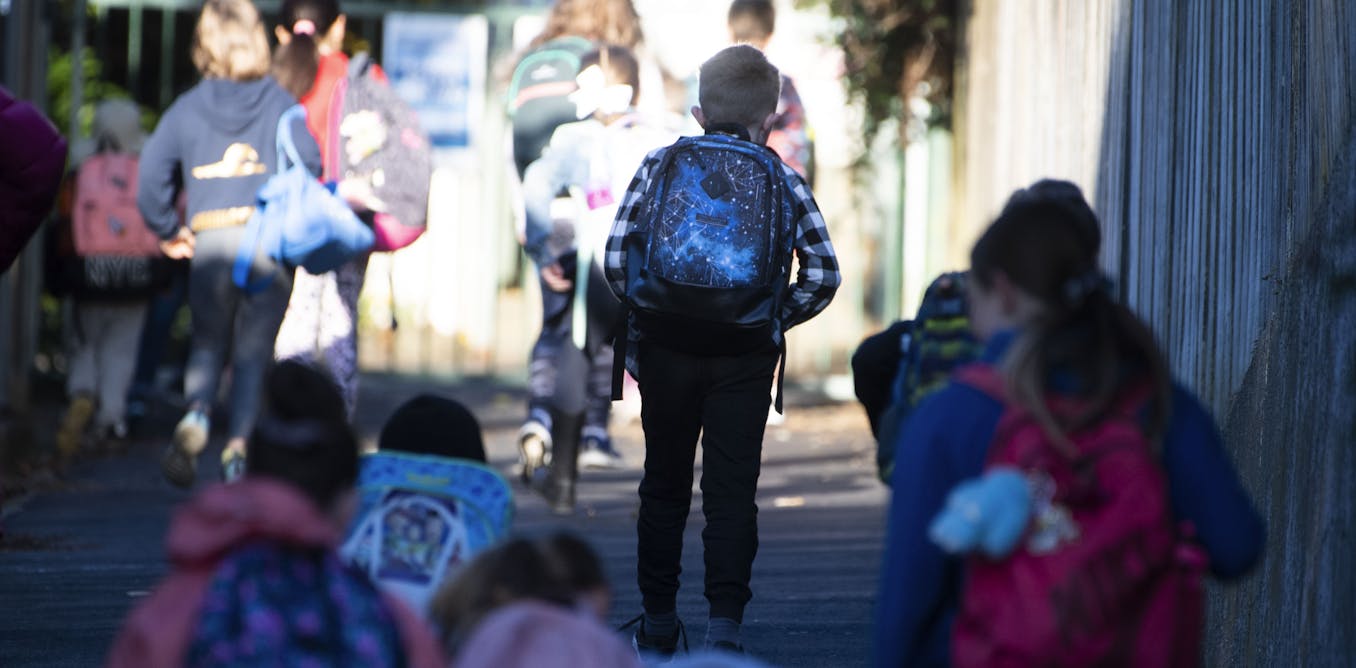
Each morning, thousands of parents across New Zealand make the same tricky judgement call: is their child well enough to go to school?
There are now concerns this decision might become yet more difficult, as a government drive to lift attendance puts schools under greater pressure to address absenteeism.
Under new targets, 80% of students are expected to attend school more than 90% of the time by 2030. Schools are also now required to have attendance management plans, with increasingly intensive responses as students miss more school.
This makes attendance more something to be measured, monitored and managed, using data, reports and rewards.
But as schools improve across these areas, are they also getting better at understanding why children are away in the first place?
What does absenteeism really tell us?
It’s easy to understand why attendance has become such a focus for the government.
A Ministry of Education analysis of pre-pandemic data suggests children who attend school more regularly generally achieve better educational outcomes and report higher levels of wellbeing.
The wider evidence, however, is more nuanced. Most studies show that attendance and achievement move together, but far fewer can determine how much of that relationship is directly caused by missing school.
One recent review found little evidence that missing school explains why chronic health conditions are linked to lower academic achievement. Where researchers have managed to pin-point a causal effect, data show that even extended absences have made only very minor differences to test scores.
Broadly, the relationship between attendance and academic achievement is not a simple straight line. Some children with poor attendance may still do well, while others who attend almost every day can struggle. This means absenteeism should be treated as a potential signal that something may be wrong, rather than a problem in itself.
Children may be absent because of illness, anxiety, bullying, family hardship or disengagement, while others miss school for entirely appropriate reasons, such as important family events or cultural obligations. Treating all absences as equally undesirable places unnecessary pressure on families without improving outcomes.
When it comes to managing sick students, meanwhile, public health advice is unequivocal. Adults who are infectious should stay home to avoid spreading illness and Health New Zealand advises parents to do the same with children who are unwell.
Yet attendance policies can send a different message. International research has found children commonly attend school while unwell, harming their own health and learning while increasing the spread of infectious disease. For this reason, the US Centers for Disease Control and Prevention discourages perfect attendance awards.
Schools, naturally, do not want sick children in the classroom. Yet they are finding themselves needing to respond to government expectations to improve attendance. If attendance remains the dominant measure of success, some families may inevitably feel pressure to send unwell children to school.
Who carries the cost?
The government’s latest targets come on top of concerns about the way in which attendance is already often managed in many New Zealand schools.
Perfect attendance may be celebrated, while students whose attendance falls below a threshold can be excluded from sport, camps or even school balls. Even justified absences may continue to count against those thresholds, with weekly reports and traffic-light systems signalling concern regardless of why a child was away.
Attendance targets can also have unintended consequences. Some children face barriers to regular attendance that are beyond their control. Larger households, financial pressure, unstable housing and chronic health conditions can all make getting to school harder.
The Education Review Office has found absenteeism is more common among children facing multiple forms of disadvantage, and that effective responses need to be tailored to individual circumstances. Blanket penalties risk falling hardest on these same children, denying them the very opportunities that build belonging and encourage them to engage with school.
Of course, none of this means schools should ignore attendance.
The more important question, arguably, is how they respond when children are absent. There is a world of difference between telling a child “your attendance is worrying” and asking “we noticed you weren’t here and we missed you, is everything okay?”.
The first message is about compliance. The second is about belonging. It recognises that children are missing more than lessons when they are absent. They are missing friendships, play, opportunities to learn, and the everyday experiences that make school somewhere they want to be.
Ultimately, attendance is an important measure. But, for our school system, there is a risk in mistaking what is easiest to track for what matters most.
If New Zealand seeks to lift academic achievement, its goal should never be perfect attendance. It should be schools where every child feels safe, supported and that they belong.