



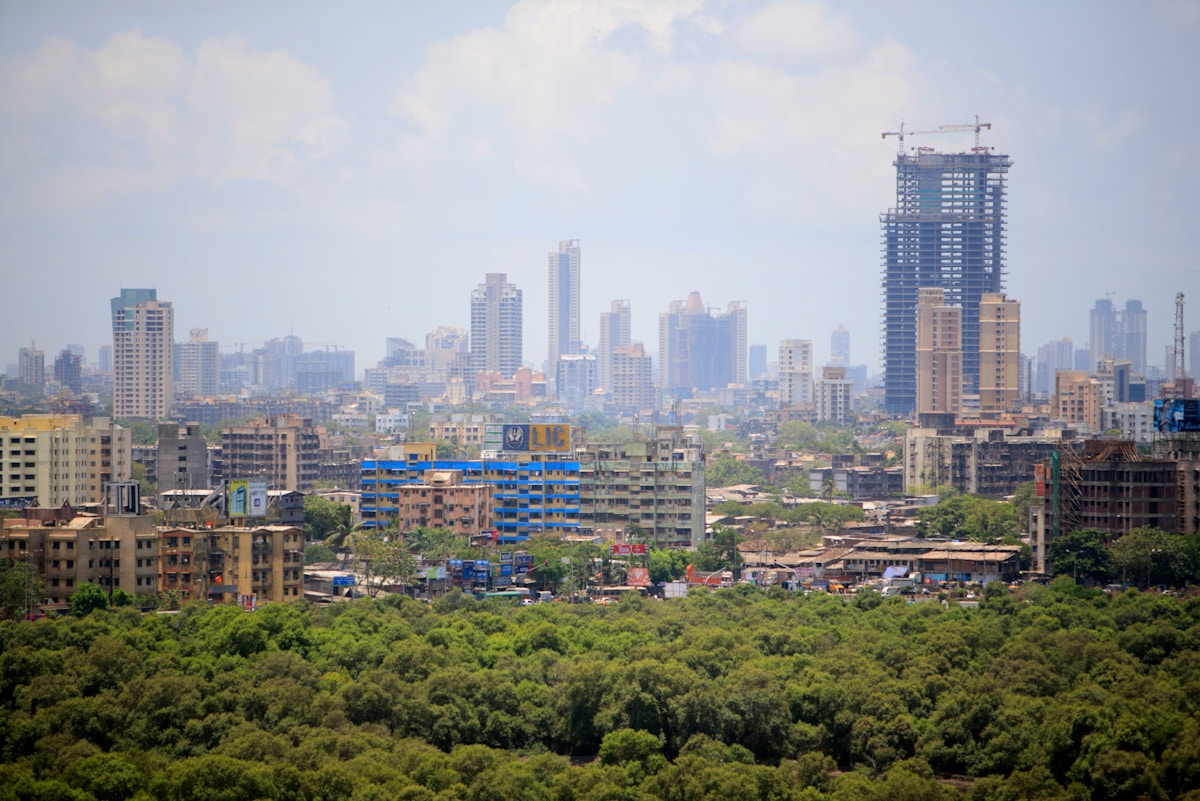
In areas like Charkop and Gorai, located a few kilometres apart, mangroves stretch deep into the creeks. The air is thick with the sounds of birds and crabs. They move through the mudflats and tangled roots, exposed as the tide recedes.
Several fishers in Charkop, including Manohar and Sanjay Bhandari, say they first learned about the mangrove felling on social media, primarily through the citizens’ group Save Mumbai Mangroves. The group has been collecting geotagged footage of mangroves being felled along the route. Barricades have been installed around the mangroves, so members film from above in their apartment buildings.
The BMC’s submission to the high court in Mumbai reveals around 60,000 mangrove trees are within the project’s zone of influence, and therefore may be “affected/destroyed”. It states around 9,000 trees are to be destroyed in the areas occupied by the bridge and road construction. Nearly 37,000 mangroves in a 68-hectare zone will be “temporarily diverted and affected” during construction, before being subject to a detailed restoration plan.
The court has directed another 36,925 mangroves to be planted on land that will become available following construction. This will be carried out by the Mangrove Cell of the state of Maharashtra, a government unit dedicated to mangrove protection, conservation and management.
Fishers also allege that mangrove trees are being felled late at night, only to be discovered when they fish near the creeks in the daytime. They question the BMC’s intent: “Why hide it?” asks Manohar. “Why not let us see?”
Dheeraj Bhandari, president of the local Charkop Koliwada Society fishing association, says fishing communities and villagers are often the last to be informed of infrastructure projects.
According to Stalin Dayanand, director of the Mumbai environmental group Vanashakti, fishing communities in the project sites were not even informed while the first phase was being planned. “They only found out when their jetties were taken over, access was restricted, and their boats were removed,” he claims.
“Informing them is what an ethical government should do,” says Stalin. “[The fishing communities] always have to fight back, and then some settlement is reached.”
Dialogue Earth has contacted the Mangrove Cell of Maharashtra but not received a response.
Fisherfolk associations from the Koli fishing village of Worli Koliwada petitioned the high court of Mumbai in 2019. They challenged aspects of the coastal road project, and alleged a lack of consultation and adequate surveys when assessing potential impacts on fishers’ livelihoods and marine life. Though the high court ordered a halt to the work, the supreme court eventually allowed the project to continue, with certain restrictions.
The Coastal Regulation Zone framework, established under the Environment Protection Act, regulates development along India’s coasts. Under this framework, state governments are required to form district-level committees to enforce it and monitor projects. The committees must include at least three representatives of local traditional coastal communities, including fisherfolk.
“However, in Maharashtra state government projects, representation in actual decision-making processes is often missing,” Stalin claims.
He adds that Scheduled Tribes and other traditional forest dwellers are granted statutory rights under the 2006 Forest Rights Act. But fishing communities do not have equivalent comprehensive and national rights-based legislation. “They should be treated on par with tribal communities, because they are Indigenous people who depend on the land and the water for their livelihood,” Stalin says.
Malvani village is located in the central stretch of the project. In early April, around 30 members of the Koli community gathered near their fishing grounds here, protesting the construction of a boundary wall enclosing the site. Pradeep Koli, a fisher, alleges the work began without residents being consulted.
Villagers claimed the construction work meant access to traditional fishing grounds was being restricted. “This land belongs to us. We were never asked,” says Koli. “We have come here to protect our existence, to save our lifeline.”
Livelihoods and cultural ties at stake
Mangrove systems, such as those the road is expected to cut through, serve as rich breeding grounds for marine life. During high tide, fish and crabs spawn in the shallow, nutrient-rich waters. Fishers tell Dialogue Earth they sustain local fisheries that have been depended on for generations.
“If you cut down these mangroves and damage these mudflats, how will they ever grow back?” asks Dheeraj of the Charkop Koliwada Society. “The plan must be changed. We cannot destroy natural resources.” Fishers and campaigners consulted by Dialogue Earth say the loss of mangroves is not just ecological or economic but deeply cultural.
Mangroves have long been part of the communities’ everyday life. Their wood and branches have traditionally been used to build homes. The mangrove ecosystems have shaped daily life, knowledge systems and traditions, notes Stalin, who has been studying the ecology of Mumbai.
Fishing communities have historically used mangroves sustainably and long played a role in protecting them in and around Mumbai, Stalin says: “Even for firewood, they would take fallen branches. Cutting mangrove trees is not part of their practice.”
Mohit Ramle, Mumbai president of the All Koli Community and Culture Preservation Association, has been raising awareness about mangroves and their key role in Koli life using social media.
Standing near Versova Beach, he tells Dialogue Earth how mangrove resources were used in folk medicine for snake bites and insect bites: “Leaves and bark helped treat wounds. Some leaves, when crushed, release a smell that repels mosquitoes. This knowledge comes from our ancestors.”
Mangroves have always held importance in Koli traditions, too. This is reflected in oral traditions and folk songs passed down through generations. These include stories of the sea, nature and spirits believed to inhabit these landscapes, Ramle notes, such as the goddess Holika.