



Executives are facing pressure from boards, employees, regulators and consumers to either defend or abandon diversity, equity and inclusion initiatives. Many are retreating from their DEI commitments. But in the rush to respond to political headwinds, a more fundamental question is going unasked: Is inclusion a moral imperative?
As marketing scholars who study consumer ethics and corporate responsibility, we have spent years examining how companies treat the people they serve and what that treatment says about their values.
Our recent research, published in the Journal of Public Policy & Marketing, argues that inclusion is about ethics, not just strategy – and that three of the oldest traditions in moral philosophy make the case.
Political and financial pressure
A few years ago, many companies were competing to show their commitment to diversity: hiring more broadly across race and gender, tackling discrimination at the office, running diverse ad campaigns and designing products for people who had long been ignored.
That trend has reversed sharply. Faced with the threat of federal investigations, loss of government contracts and lawsuits challenging diversity-conscious hiring, many companies have scrapped DEI programs, renamed initiatives to avoid political scrutiny or gone silent.
Beyond political and legal pressures, some have retreated to an economic argument: that their primary obligation is to maximize profits, so inclusion programs that don’t clearly boost the bottom line are a distraction at best and a liability at worst.
But this political and financial framing treats inclusion as purely a strategic bet, one that can be placed or withdrawn depending on the political and economic returns. What it misses is the moral dimension. Businesses are not just economic machines. They are part of society, making choices that affect real people’s lives – which, we argue, makes them moral actors too.

AP Photo/Bebeto Matthews, File
Duty: Rules that apply to all
The first philosophical tradition we examine is deontological ethics, associated with the 18th-century philosopher Immanuel Kant. The core idea of deontology is simple but exacting: Some actions are right or wrong in themselves, regardless of their consequences. People have inherent dignity and must be treated as ends in themselves, never merely as a means to someone else’s goal.
Applied to the marketplace, this means companies have a duty to respect the rights of every person they interact with. A bank that denies loans based on race, a tech platform that designs its interface only for hearing users, or a retailer that stocks clothing only in small sizes – these are not just bad business decisions; they are moral failures.
Kant proposed what he called the “categorical imperative”: Act only according to rules that you would be comfortable making into universal laws. In other words, rules worth following would still make sense if every person followed them. What if every company ignored the needs of disabled consumers? What if every employer hired only from the same narrow demographic? A world where those ideas are applied universally would be one many Americans would consider plainly unjust.
Inclusion is not always simple. A mobile app built to be affordable for low-bandwidth rural users, for example, might have to sacrifice features that blind users need. Kant’s point is not that inclusion is free of conflict. Rather, it is that the commitment to try to consider all people can be universally applied. Some things are simply right or wrong to do, regardless of what they cost.
Character: Who do you want to be?
The second philosophical tradition is virtue ethics, rooted in Aristotle. Where deontology focuses on duties, this school focuses on character virtues, such as fairness, courage and wisdom. It asks not “What rules should I follow?” but “What kind of person – or organization – should I be?”
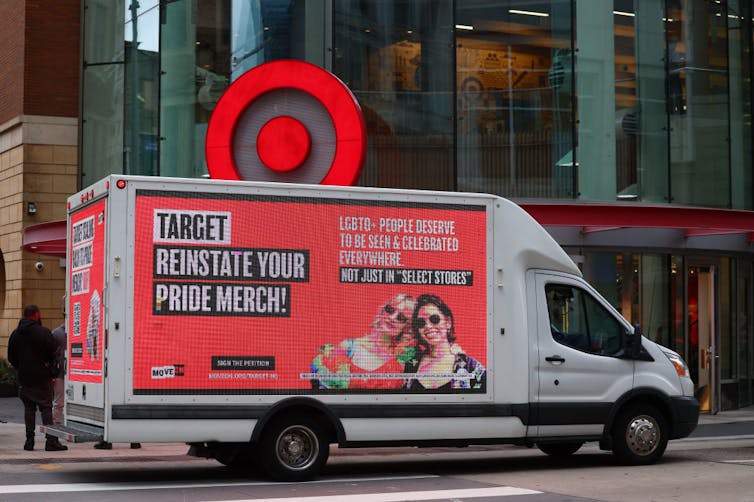
Think of Target, which spent years running inclusive campaigns, stocking gender-neutral children’s clothing, expanding its Pride collection and featuring diverse families in its advertising. In recent years, facing backlash, it pulled back Pride merchandise and scaled back diversity commitments.
Criticism was swift. For people boycotting Target, its rollbacks reflected on the company’s character: If inclusion disappears the moment it becomes costly, it was never a value; it was a marketing strategy.
Adam Bettcher/Getty Images for MoveOn PAC
Inclusion practiced only when convenient is not inclusion but performance. And performance, unlike character, is fragile. A company that practices inclusion consistently embeds it as part of organizational character, leading to more satisfied employees, sustained customer loyalty and the ability to weather political controversy.
Welfare: Helping the most
The third philosophical tradition is utilitarianism, developed by John Stuart Mill in the 19th century. It holds that the right action is the one that produces the greatest overall well-being for everyone affected.
At first glance, this might seem to work against inclusion. If the majority is already well served, why divert resources toward a smaller group? But this reading misses something important about how welfare actually works.
Benefits follow the law of diminishing returns. Adding a tenth feature to a product that already meets a consumer’s needs produces far less new value than giving an excluded group access to the product for the first time. The biggest gains come from bringing new people in.
Moreover, inclusive services for a minority produces spillover benefits for other consumers. When Netflix added closed captions, it was primarily an accessibility measure for deaf and hard-of-hearing viewers. Surveys found that a significant share of hearing viewers also use captions regularly, such as in noisy environments or while learning a new language. When cities introduced curb cuts – small ramps at intersections, originally designed for wheelchair users – cyclists, delivery workers and parents with strollers all benefited, too. And audiobooks, invented for blind people, are now a US$9 billion global industry, driven overwhelmingly by listeners who can see.
In a corporate boardroom, the utilitarian argument is often the most familiar language: showing the aggregate benefit, identifying the spillovers and demonstrating that addressing underserved needs is not charity but good allocation of effort.
3 frameworks, 1 conclusion
Deontology, virtue ethics and utilitarianism approach morality from different starting points. One focuses on duties, one on character, one on outcomes. Yet, we argue, they converge on the same conclusion: Inclusion is an ethical obligation.
This convergence matters because different audiences respond to different arguments. A legal team may be most persuaded by the language of duties and rights. Employees and consumers who care about corporate character may respond more to the virtue ethics framing. Policy discussions and investor presentations often run on utilitarian logic. Managers who understand all three frameworks can meet each audience on its own terms.
The deeper point is this: Companies that treat inclusion as something to adopt when convenient and abandon when threatened misconstrue their actions. They are not just managing a policy; they are actually making a moral choice. And moral choices, these three traditions remind us, do not bend to whoever holds power at a given moment.