



After the mainstream parties suffered big losses in Britain’s local elections in May, they might be wondering how they can win back voters in left-behind parts of the country. Labour’s Pride in Place scheme – £5.8 billion to be shared between some of the UK’s most deprived communities – doesn’t seem to have won the government much support. From coastal towns to rural poverty, urban areas and post-industrial cities, we spoke to experts to find out what these communities need.
Tourism won’t fix Britain’s coastal towns
Stefania Fiorentino, Associate Professor in Planning and Urban Regeneration
Entire generations in some parts of the UK have never seen municipal wealth. In
some former mining towns and coastal towns, socio-economic decline has been
entrenched. Rising discontent and eroding trust in institutions have influenced recent electoral results. Mainstream parties are losing support and Reform UK has made gains in places marked by long-term decline. This has begun in coastal constituencies such as Clacton in Essex – the constituency of Reform UK’s leader Nigel Farage – and is now spreading inland.
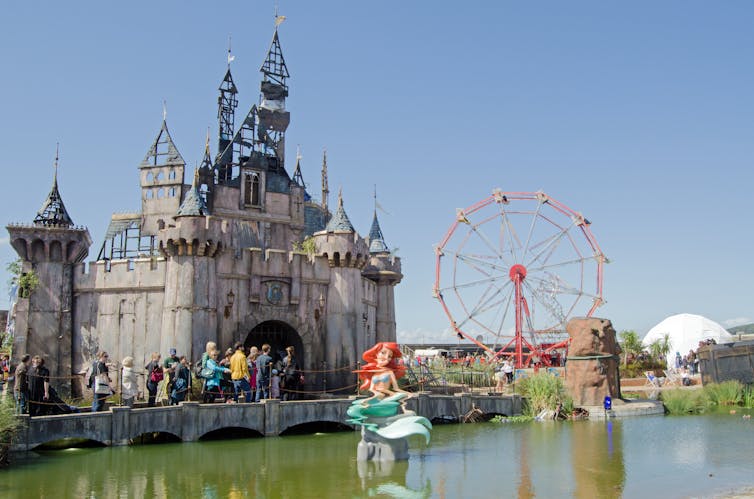
Regeneration efforts have seen limited success in these places. One reason for this is that they remain focused on physical ribbon-cutting projects. Examples include the now-closed £11 million harbourside college development in Newhaven in East Sussex, or Weston-super-Mare’s Tropicana lido, which fell into disrepair and was turned into a temporary dystopian art park called Dismaland by artist Banksy in 2015.
These strategies are too fragile to withstand political instability and frequent policy reform, reliant on tourism and often rooted in nostalgia for an industrial or decadent past. Seaside resorts like Blackpool and Great Yarmouth have haemorrhaged visitors for decades, shrinking tax bases and eroding local services.
BasPhoto/Shutterstock
Then there is climate change. Almost 50% of the British coastline is at risk of
disappearing by 2050. The Department for Environment, Food and Rural Affairs (Defra) and the Ministry for Housing Communities and Local Government (MHCLG) still do not collaborate enough. Places like Sunderland and Jaywick, near Clacton, declared a state of climate emergency in 2019. Yet a decade of austerity policies has taken its toll, reducing the capacity of local governments, limiting cross-border cooperation, and eroding trust in local institutions. So, even the most recent pioneering approaches to their local plans, testing some climate-led regeneration measures, have not been enough to turn the tide.
The Pride in Place scheme is, by name, meant to address the “intangible” dimensions of the crisis. In practice, it offers more ribbon-cutting projects and imposing top-down regeneration under the guise of local responsibility. Even the label seems to blame communities for their doom loop, suggesting it is up to them to regain pride.
Pride in Place won’t fix Britain’s left-behind towns on its own. What’s needed is
coordinated action at national, regional and local levels, alongside tailored measures that rebuild institutional trust, restore basic services and meet everyday needs.
Invisible poverty in Britain’s rural areas
Helen Carr, Professor of Property Law and Social justice
Recent research into the overlooked problem of rural homelessness confirmed what academics have consistently argued – that rural poverty is real but hidden.
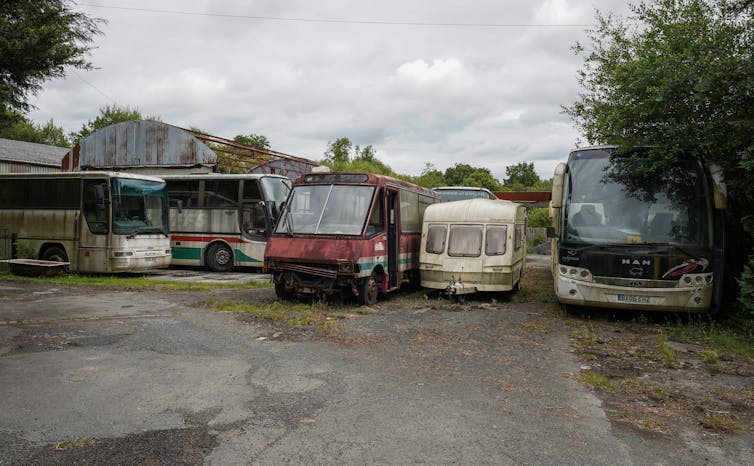
Despite the apparent idyll of the rural, there is extensive poverty. But in contrast to urban deprivation, it is invisible, widely dispersed and somehow unexpected and therefore out of place. Many of the causes of rural poverty are structural and long-standing, but social policy and the lingering consequences of COVID have exacerbated and entrenched inequality. For instance, employment is often low paid and seasonal, with limited opportunities for advancement. Lower wages in rural areas are also impacted by what might be described as a rural premium – the additional costs of energy, transport and housing and lack of access to affordable shopping.
WildSnap/Shutterstock
Moreover, this premium has been inflated by the cost-of-living crisis. More than a decade of austerity has affected rural areas disproportionately as local government cuts were more severe in these areas, eliminating services and further reducing limited transport links. Welfare cuts, particularly to housing allowances, have pushed already-expensive housing out of reach for those relying on a rural wage. COVID delivered a particular shock to rural economies significantly dependent upon hospitality and tourism.
Policy ideas to avoid these areas being left behind include welfare programmes which take account of rural conditions. So, for instance a top up for rent in recognition of the limited availability, improved work opportunities for rural residents via business subsidies, and increased incentives to build housing that is genuinely affordable, energy efficient and close to public transport.
Moving away from ‘the high street’ in urban areas
Steven Millington, Professor of Place Management
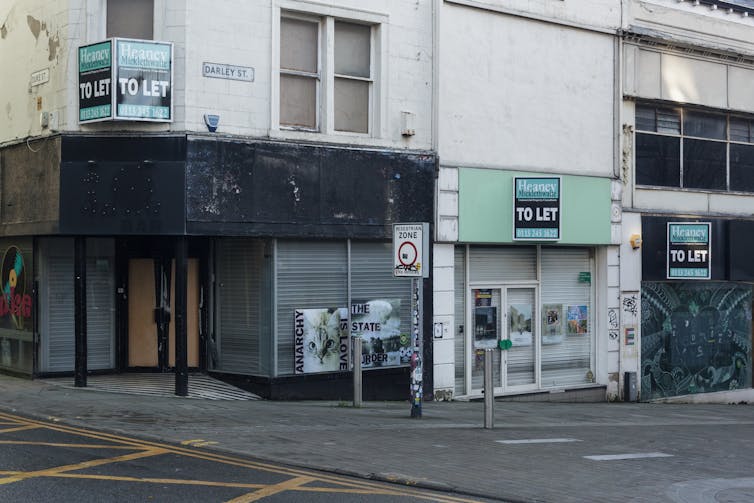
The left-behind narrative relies on a monolithic trope of dying high streets, but evidence reveals a far more diverse reality. Decades of out-of-town retail, online shopping and economic shocks have undoubtedly fractured town centres. Yet the problem isn’t simply retail decline, it is an outdated dependency on it.
The primary challenge isn’t a lack of commercial potential, but a deficit in local capacity. One-size-fits-all policies fail because they ignore local social infrastructure and networks. Our analysis of 700 UK locations shows that towns with a multi-functional offer recovered much faster after COVID lockdowns.
Richard Coomber/Shutterstock
Our evaluation demonstrates that strong, collaborative partnerships between local government, businesses, and communities are the actual mechanisms of transformation. Many places are growing footfall by repurposing former retail assets into community and health hubs. Some are changing perceptions of the high street, such as Barnsley’s Health on the High Street project, South Yorkshire.
Central government must move beyond devolution rhetoric and stop forcing councils into costly, short-term bidding wars for funding pots. It’s vital to build long-term local capacity and invest in training people to manage their own town centres, providing shared frameworks to measure town centre vitality, and securing the multi-year funding required to transition traditional high streets into resilient community assets.
Post-industrial areas: high costs, no jobs
Richard Bull, Deputy Dean in the School of Architecture, Design and Built Environment
Net zero looks different when we strip away the jargon and talk about poor-quality housing, health and jobs. As an example, the Makerfield by-election pits Labour against Reform UK with Energy Security Secretary Ed Miliband’s net-zero policies caught in the middle. Is Reform right in claiming that net zero is crippling the economy? Four years ago, my colleagues and I explored the opportunities the net-zero transition could bring to overlooked East Midlands and northern economies.
Bolsover, in Derbyshire, was typical of a post-industrial northern town and is still ranked among the most deprived areas in the UK in terms of education, skills, training, employment and income. It’s not dissimilar to Makerfield. Both also have high unemployment and are classified as deprived with poor health outcomes.
Alan Edwards/Alamy
In its recent report, Better Warmer Homes, Innovate UK (the UK’s national agency to support business-led innovation in all sectors) noted three fundamental facts.
First, data from the 2021 census estimates 12.7 million homes in the UK are below an Energy Performance Certificate rating of C (C is increasingly recognised as the benchmark energy-efficiency rating for healthy and affordable homes).
Second, the typical cost in energy bills to households of poor performing buildings is £400 a year. And third, the estimated cost to the NHS for treating illness directly related to cold, damp and dangerous homes is £1.4 billion.
In 2024, the estimated size of the green skills gap was as many as 200,000 workers. In the East Midlands, the Combined County Authority is investing in clean energy which it is projected will create tens of thousands of jobs.
But at the moment, there’s a skills gap. Our research shows the green skills gap presents both a substantial risk to the UK’s net-zero ambitions and a major opportunity. In construction alone, for example, the UK’s commitment to reducing greenhouse gas emissions and Labour’s pledge to build 1.5 million homes within five years highlight the need for a rapid increase in green construction skills. We now need to see this translated into jobs.
So what do the people of post-industrial areas need from government? What we all need: healthy and affordable homes with meaningful work.