



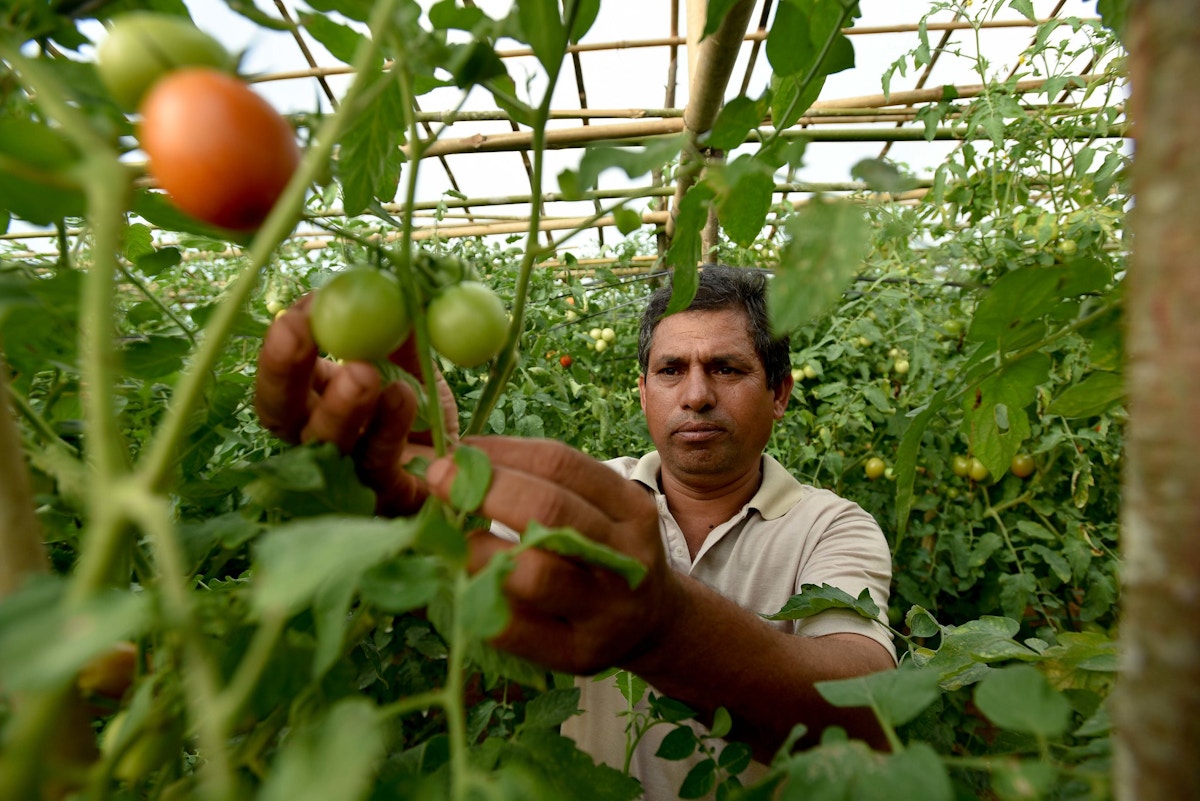
Dhruba Prasai, a farmer from Sarlahi district in Nepal’s southern plains, says he’s exhausted from lack of sleep. Every year, nilgai antelopes, wild boars, deer and Asian elephants raid his fields, and if left unguarded at night, they not only feed on standing crops, but also stored harvest.
“There is a forest to the west, and our fields are right next to it,” Prasai tells Mongabay. “The nilgai eat the maize, and the deer can’t even stand the sight of wheat and oat grass, they eat it all. If people stay up at night to guard the fields, they run away; otherwise, they come and destroy everything.”
Farmers such as Prasai across Madhesh province, considered the country’s breadbasket because of its fertile land, are struggling with growing crop losses from wildlife, but complex procedures and policy gaps make access to relief, which is already limited, difficult.
From mid-July 2024 to mid-July 2025, 14,821 cases of ‘human wildlife conflict’ were reported in Madhesh, according to government figures. A total of 134 people and 457 animals lost their lives.
Last year, a wild boar ate three tand (storage racks) of maize stored in Prasai’s house. Although forest authorities told him to get a recommendation letter from the local municipal ward office to apply for relief, he didn’t do it.
“I haven’t done it; we simply don’t have the time,” he says. Even those who did fill out the forms around the same time have yet to receive relief, he adds.
“
When wildlife damages crops planted on unregistered land, they don’t even get that relief. This unfairly penalizes poor, marginalized farmers engaged in informal farming.
Bhola Bhattarai, researcher, Nepal Participatory Action Network
In Nepal, it’s illegal to harm or kill any wild animal. Those declared as pests, such as wild boars and rhesus monkeys, may be chased away, but even they can’t be killed or harmed intentionally.
When candidates running for national parliament came to Prasai’s home in March seeking votes, they promised to simplify the relief process. But Prasai says he doesn’t believe them.
“I was afraid to tell them this to their face as they come with their cadres and supporters,” he says. “It would be easier if they asked us, ‘Do you have any questions? What are your problems?’”
It’s not just in Sarlahi. Wild animals pose a serious challenge for farmers across all eight districts of Madhesh province. Paras Yadav, in Parsa district, says their only demand to the government is an end to losses caused by wild animals.
“Nilgai eat the wheat and rice crops, wild boars and elephants come, eat, trample, and ruin everything,” he says. “During elections, leaders say they will solve the problem, but they never do.”
Bechan Mahato, an information officer at the Forest Directorate in the provincial capital, Janakpurdham, says relief is provided to all who apply. “If the allocated money is not enough, we provide relief by requesting additional funds through the forest ministry,” he said
Sajan Chaudhary, another officer from the directorate, says as incidents of forest fire surge during the dry season, wild animals move out of the forests for safety and encroach into human settlements for food. He says his office is also working on controlling forest fires in addition to providing relief to farmers.
According to official figures, the directorate has distributed 4.82 million rupees (about US$31,500) for the loss of life and property caused by wildlife in fiscal year 2024-2025, and 3.22 million rupees (about US$21,000) in the current fiscal year, 2025-2026. Out of the 101 people who received relief in these two fiscal years, only one person received it for damage caused by a wild boar. The rest of the funds were distributed for the loss of life and property caused by elephants and tigers.
Problems with the guidelines
The relief guidelines, introduced three years ago, currently govern the distribution of relief for harm, loss and damage caused by wild animals. The guidelines, according to officials, were introduced to make the process of distributing relief for the loss of life and property by wildlife simple, easy and systematic.
However, they have some limitations. The guidelines don’t incorporate a provision for full compensation for harm, loss and damage caused by wildlife.
It states that authorities shall provide relief only when wild animals damage crops planted on land with proper ownership documents. Similarly, in the case of grain damage, authorities sanction a maximum of 10,000 rupees (US$65) based on assessment of damage. For standing crops, a maximum of 10,000 rupees can also be given, but that’s limited to one time per seasonal crop. A person can obtain relief no more than two times a year.
To claim relief, farmers need to present 12 different types of documents, and recommendations are required. Only damage caused by 16 specific animals is covered: nilgai, monkeys, elephants, rhinos, tigers, bears, leopards, snow leopards, clouded leopards, wolves, dholes, wild boars, wild buffalo, mugger crocodiles, pythons and gaur cattle. Residents of Madhesh have long urged the government to add deer, peacocks and parrots to the list.
A study report prepared by the National Human Rights Commission mentioned that the guidelines aren’t citizen-friendly and ignore the participation of victims. In its recommendation, the commission called for an amendment to the guidelines to allow relief even if crops planted on traditionally used, unregistered land, especially those belonging to Indigenous people such as the Chepang, are damaged.
Parliament’s Public Policy and Delegated Legislation Committee commissioned a study last year on policy problems related to national parks. It also highlighted problems in relief, concluding that lack of official land titles shouldn’t pose a hurdle for receiving relief if the land concerned was not obtained by encroaching upon forest and has no pending legal cases over it.
It recommended the federal government make legal arrangements to sign agreements with companies through a competitive bidding process to provide insurance coverage to farmers.
Shankar Chaudhary, the Madhesh provincial minister for forests and environment, says he’s actively working to ensure farmers get relief for all damages caused by wildlife. He said the province has requested the federal government simplify the relief process.
“I sent the secretary all the way to the field to understand how we can prevent this,” he says. “This year, the budget had already been prepared by the time I became minister. Now, even if it means having the rules amended, I will arrange provisions to provide relief to farmers. I will allocate the necessary budget.”
The ruling party’s commitment
Political parties, including the victorious Rastriya Swatantra Party (RSP), committed through their manifestos ahead of elections in March to minimise human-wildlife conflict.
However, their manifestos failed to include any plans to simplify the cumbersome administrative process farmers must endure to receive relief after wildlife damage, nor did they guarantee farmers would actually receive this relief.
The RSP said it would develop scientific management, strengthen the relief system, and build early-warning and prevention structures to minimise the growing conflict between wildlife (mainly monkeys, elephants and tigers) and residents in settlement areas.
“Especially because the terror of monkeys is creating a compulsive situation where entire villages have to migrate, severely affecting daily life, we will free communities from this problem by adopting all measures for monkey control — ranging from sterilisation, forest gardens, assisting in planting alternative crops that monkeys cannot damage, constructing electric fences, all the way to relocation,” the RSP said in its manifesto.
Since taking office, however, the RSP government has yet to take any concrete measures.
Environmentalist Niranjan Shrestha says it’s crucial to simplify the damage verification and payment system for farmers, as well as make the administrative process more practical.
“Ordinary citizens cannot gather 12 types of documents just for a small amount of relief,” he says. “The relief guidelines must be amended to make them simple and practical.”
Forestry researcher Bhola Bhattarai says the situation of having to navigate a tedious process just to get 10,000 rupees in relief must end.
“The system is such that the relief money is spent just traveling back and forth to the offices. The process should be designed so that farmers receive payment right where the problem occurs,” he says. “When wildlife damages crops planted on unregistered land, they don’t even get that relief. This unfairly penalises poor, marginalised farmers engaged in informal farming.”
This unfairly penalises poor, marginalised farmers engaged in informal farming.”
RSP lawmakers Tek Bahadur Shakya and Pramod Kumar Mahato, both representing districts in Madhesh province, say they’ve raised the issue of wildlife destroying farmers’ crops in parliamentary committees and sessions.
They say lawmakers are discussing how to effectively control animals such as monkeys, nilgai, wild boars and porcupines, to provide relief to farmers, but acknowledge that no concrete conclusions have been reached yet Buddhi Sagar Poudel, director of the Department of National Parks and Wildlife Conservation, also says discussions are ongoing to amend the Wildlife Relief Directive to provide faster relief.
This story was published with permission from Mongabay.com.