



With less than five weeks until kickoff, and hundreds of thousands of visitors expected, Vancouver is preparing for the FIFA World Cup 2026 following British Columbia’s worst measles outbreak in years. Unlike Ontario, where public health officials released a detailed Hazard Identification and Risk Assessment flagging measles and other infectious diseases as risks at mass gatherings, B.C. has not yet provided comparable guidance.
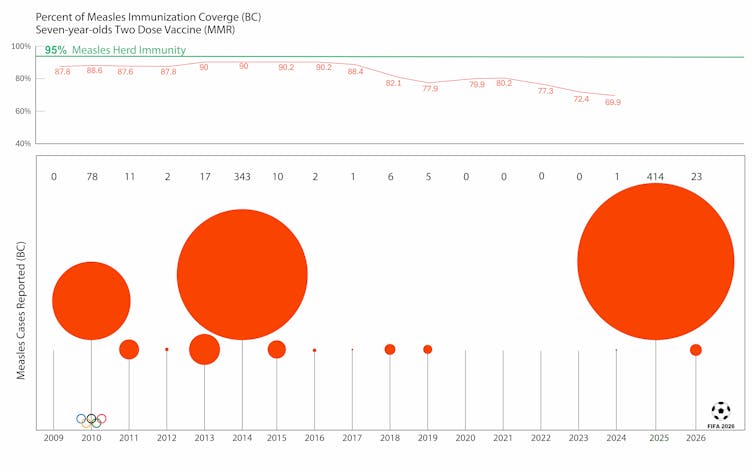
Public health experts say preparation is critical for mass gatherings, particularly for contagious diseases such as measles. Vaccination rates in many parts of B.C. have fallen below the approximately 95 per cent coverage needed to prevent sustained transmission of measles, and last year’s outbreaks have exposed pockets of vulnerability.
In crowded settings such as FIFA World Cup venues, where visitors arrive from other provinces and countries with varying vaccination coverage, even a single imported case can spread rapidly beyond stadiums. That risk is not theoretical; past sporting events in Vancouver have shown how quickly measles can take hold.
Lessons from past international sporting events
The 2010 Winter Olympics in B.C. provides precedent. Following the Games, imported measles cases spread after the crowds dispersed.
In preparation, public health surveillance systems were in place, including daily health watch reports.
“At the time, what seemed like the biggest potential threat was actually the pandemic influenza H1N1 virus,” said Jennifer Gardy, PhD, deputy director of disease modelling at the Gates Foundation, who was a lead investigator at the B.C. Centre for Disease Control in 2010, by email.
But measles proved difficult to track, with officials relying largely on clinical case detection. “You had tens of thousands of people congregating indoors at event venues and then mixing with each other out in the community,” Gardy said.
The outbreak was not confirmed until the virus had spread beyond Olympic venues, infecting 82 people across Greater Vancouver as well as in the interior and northern regions of B.C.
Measles is uniquely risky at mass gatherings
Mass gatherings act as biological mixing bowls. The measles virus, one of the most contagious human viruses, can easily spread among unvaccinated individuals. When infected individuals return to schools, day cares and offices, transmission can amplify.
(Qurrat Ul Ain), CC BY
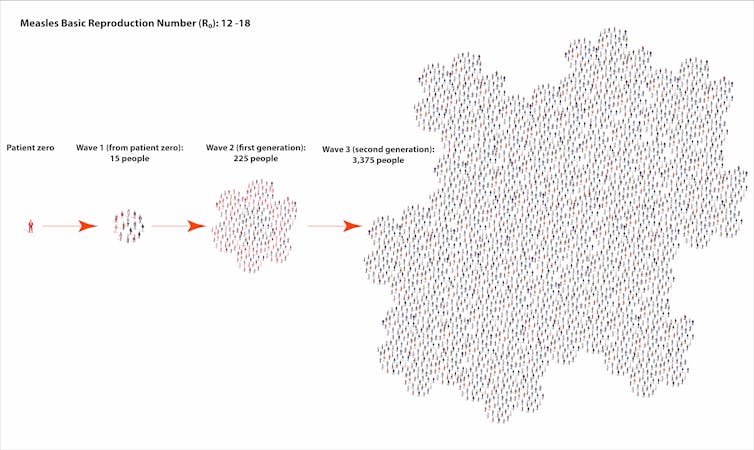
The measles virus survives in airborne droplets and only a tiny trace of the virus can start an infection. These characteristics give it a high basic reproduction number (R₀, or “R naught”), referring to the number of people infected after exposure.
Read more:
Measles is highly contagious, but vaccine-preventable: A primer on recent outbreaks, transmission, symptoms and complications, including ‘immune amnesia’
For measles, the R₀ ranges from 12 to 18 (whereas the common cold ranges from two to three). So even modest dips in vaccination rates for measles, mumps and rubella (MMR) — or uneven coverage across communities — means a single case can spread rapidly.
(Qurrat Ul Ain), CC BY
Outbreaks require both an introduction and low vaccination coverage, said Caroline Colijn, PhD, by email. Colijn is chair in mathematics for evolution, infection and public health at Simon Fraser University. She noted that some communities remain vulnerable even when overall coverage is high: “We may, in some communities, have low enough vaccination rates that there could be outbreaks.”
Is Vancouver prepared this time?
Sixteen years after the Winter Olympics, as the province prepares to welcome sports fans again, public health conditions have changed.
Immunization rates among B.C. school-age children have steadily fallen since at least 2016 and B.C. reported more than 400 measles cases in the past year, reflecting uneven vaccination coverage.
Yet the level of preparedness for the World Cup remains unclear.
The B.C. Centre for Disease Control has completed a provincial public health risk assessment with Vancouver Coastal Health and shared it with the host city, according to Dr. Mark Lysyshyn, deputy chief medical health officer for Vancouver Coastal Health, in email correspondence.
A spokesperson for the City of Vancouver Host Committee said a “Know Before You Go” campaign is planned, but the website does not currently include guidance on measles or other infectious diseases.
According to Dr. Lysyshyn, Vancouver Coastal Health will rely on current monitoring systems. It is unclear whether existing systems can detect threats quickly enough, and a recent assessment warns that Canada’s health-care system may lack the capacity to manage a surge in demand during the World Cup.
What ideal preparation looks like
Effective preparation embeds public health into event planning well before visitors arrive. The 2024 Paris Olympics reinforced medical networks, expanded multi-source surveillance and improved diagnostic testing capacity.
Preparation should also involve transparent risk communication and community engagement. Equally important is ongoing public communication and co-ordination to respond to emerging threats quickly and continuously after the event.
“Because measles can take from one to three weeks for symptoms to appear, the critical thing will be to continue monitoring cases well after the final Vancouver match,” said Gardy. “If an outbreak does occur, we might expect transmission to continue for weeks or even months after.”
The experience of the Vancouver 2010 Olympics suggests that even well-planned systems can miss early transmission, reminding us that pathogens do not respect closing ceremonies.
