



One Nation’s smashing victory in Farrer fires up the insurgent party, and casts fresh doubts over the future of the Liberal Party.
The result could not be a more devastating rebuff for Liberal leader Angus Taylor, who has been found wanting after only months in the job. This puts him under even more pressure for next week’s budget reply.
The result will raise more doubts about whether, or for how long, Taylor will survive as leader, given Andrew Hastie, a political freelancer, waits in the wings.
Taylor said after the result, “For too long, we have been a party of convenience, not of conviction, and that must change”, and again defaulted to his immigration lines. He repeated his slogan, “If the vote sprays, Labor stays”. In Farrer, it was less a matter of spraying as deserting.
One might say deposed Liberal leader Sussan Ley extracted her ultimate revenge in triggering the byelection. Once she announced she was quitting the seat, it was always potentially bad news for her successor and her party.
Ley, overseas and invisible for the campaign, re-emerged on Saturday night with a statement rejecting the argument Taylor has been making about the impact of the Coalition bust ups. She also declared: “On the day the leadership spilled in February, the new leader said the Liberal Party needed to ‘change or die’. Three months later, the result in Farrer demonstrates that statement to be far truer today than it ever was then.”
The Liberal vote has collapsed to an extraordinary low. Last election Ley received a primary vote of about 43%. This time, on Saturday night’s numbers, the Liberals were polling about 12%.
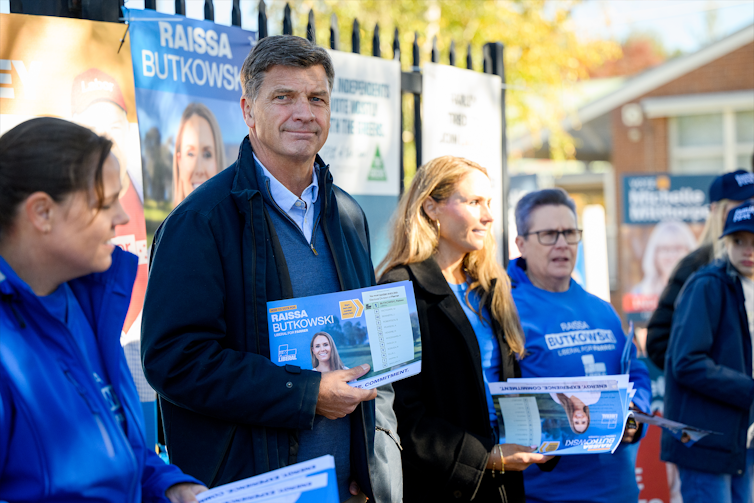
The Liberals had a weak candidate in Raissa Butkowski. One reason was the local party was in no state to throw up a strong contender.
The Nationals, able to be in the field for the first time in a quarter of a century, were polling just behind the Liberals (about 10%) on Saturday night. Their leader Matt Canavan, in contrast to Taylor, was conspicuous by his presence in the campaign, figuratively and often literally camped in the electorate.
Bianca De Marchi/AAP
This is the first time One Nation has won a House of Representatives seat.
The result is a case study of the wider mood of disillusionment and anger in the Australian electorate. The “parties of government” are on the nose, and their situation will likely only get worse. Commentators were noting the comparison with the United Kingdom, where Labour was taking a towelling in local elections.
One Nation had a scratchy campaign towards the end, after revelations that its candidate, David Farley, had previously wanted to be a candidate for Labor and in the 2025 election embraced independent Michelle Milthorpe, his opponent at this election, as a “straight shooter”. He also had slip ups in his public comments.
The voters didn’t care. Their mood was sour; their eyes were on Pauline Hanson, who articulated their grievances.
The Farrer seat tells a tale of two electorates – Albury, the urban area and about a third of the voters where Milthorpe did extremely well in 2025, and the sprawling scattered areas of small towns and rural holdings.
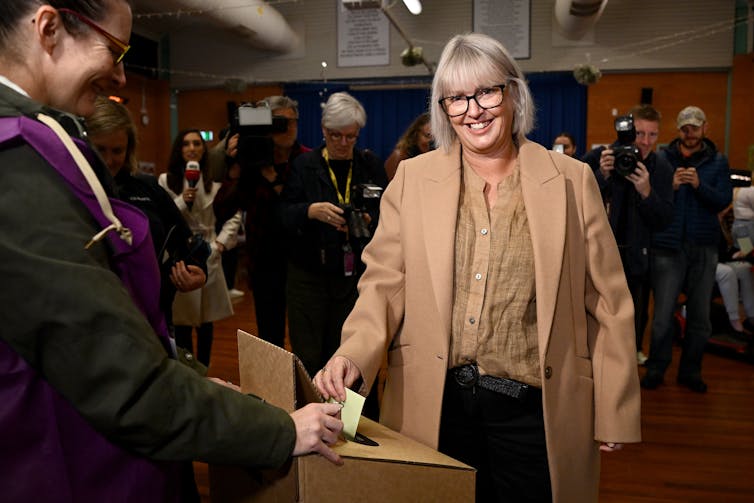
Milthorpe, who has had a swing of about 8% to her, could not lift her vote to catch the One Nation surge, which had a swing to it of 34% (having polled under 7% last time). Labor’s decision not to contest the seat did not give Milthorpe the assistance that might have been expected.
Milthorpe’s primary vote is about 28% to Farley’s 40%. On a two candidate basis Farley leads Milthorpe about 59-41%.
A year ago the time suited Milthorpe, when Farrer voters wanted to give a slap to its Liberal MP. This year, the voters wanted to take an axe to the system.
One Nation’s victory in Farrer follows a successful result in South Australia, where the party snatched four lower house seats and three in the upper house.
On Saturday night Hanson was ecstatic, projecting the vote to a much wider success:
“This is a journey that we’re going to go on, that we are going to look forward to in the future and the people out there who may be watching this – we’re coming after those other seats. If they have not represented you, you are not going to be the forgotten people anymore”.
The Farrer triumph comes before the crucial Victorian poll in November. The state Liberals, despite retaining Nepean in last weekend’s byelection, will be unnerved by the Farrer result. Many regional areas appear to be for the taking, given Victorians’ desire to rid themselves of the Allan government but their apprehension about the Liberals’ state of unreadiness. One Nation will present a vehicle for a primal political scream.
Bianca De Marchi/AAP
Federal Labor knows that while One Nation is presently the Coalition’s problem, it could become Labor’s too. At the raucous One Nation function on Saturday night, Barnaby Joyce declared, “Western Sydney here we come”. It might be hubris of course, but if the community mood doesn’t change, some outer suburban Labor seats could become vulnerable.
Helen Haines, the community independent who holds the Victorian seat of Indi across the Murray from Farrer, declared the result was “the end of business as usual in Farrer”.
We might say it’s also the end of business as usual for the Liberal Party, whatever that will mean.