



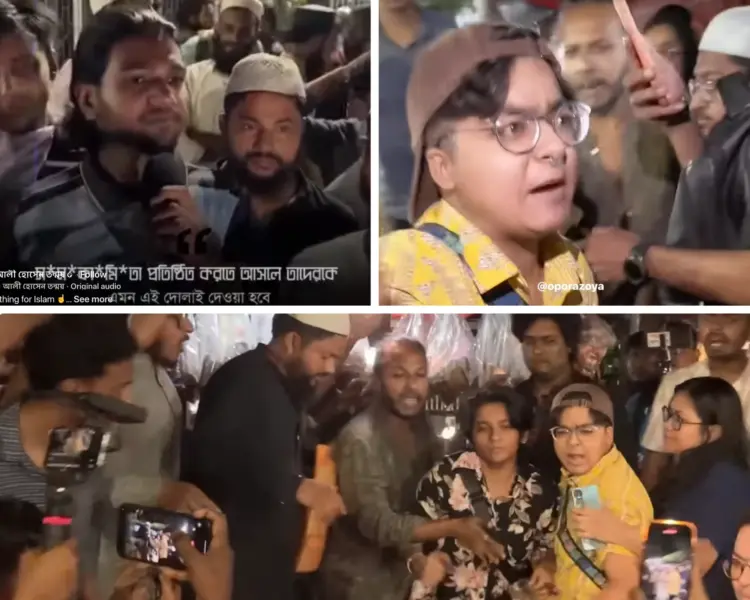
Screenshots from videos circulating on social media showing a mob attack on assumed transgender and homosexual individuals in Shahbag, Dhaka. Image credit Ali Hossain Tonmoy, Oporazoya and Somoy TV. Fair use.
This post is part of Global Voices’ June 2026 Spotlight series, “Gender Diversity.” This series offers insight into gender diversity and how it is being threatened, protected, and preserved around the world. You can support this coverage by donating here.
Eight Hijra and trans women casually gathered in Shahbag, Dhaka, were harassed by a group claiming to practice “mobile journalism” on April 3, 2026, exemplifying the unjust treatment that gender diverse people can face in Bangladesh. They were filmed without consent, asked offensive questions, sexually harassed, and, when they protested, were physically prevented from leaving the area. All eight were then arrested and taken to the Shahbag police station. They were denied access to lawyers for two days, held in inhumane conditions, and ultimately forced to pay fines and sign documents admitting wrongdoing to secure their release. No criminal activity had been alleged. The police were not bystanders. They were participants.
A week later, on the evening of April 10, the same location saw a larger mob attack. Under the banner of the “Azadi Movement,” a crowd brutally assaulted a group of people after labeling those present as “homosexual” and “transgender.” University teachers and citizens were beaten. The violence included sexual harassment of women. A statement signed by 387 citizens — academics, journalists, lawyers, doctors, and activists — condemned both attacks and named the perpetrators: the “Azadi Movement,” backed by Bangladesh Khilafat Majlis, a conservative Islamic political party. The ruling Bangladesh Nationalist Party (BNP) government made no response.
What happened at Shahbag is not an isolated incident. It is the result of a crisis building since August 2024, when Bangladesh’s mass uprising ended fifteen years of Awami League rule and opened a period that has proved, for the country’s LGBTQI+ community, one of the most dangerous in recent memory.
A new political landscape
The uprising that forced former Prime Minister Sheikh Hasina to flee was genuinely historic. It was a student-led movement that brought down an authoritarian government at enormous human cost.
For LGBTQI+ activists, their hopes around the movement were complicated from the start. Many had feared extremist groups would fill the vacuum; some chose not to participate at all. Those who did believed the uprising’s anti-discrimination language extended to them. However, within days of the new government’s formation, the student leaders who had driven the uprising began posting openly anti-LGBTQI+ content on social media.
Islamist groups, emboldened by the transition, intensified attacks on gender and sexual minorities. One early documented incident was an assault on the hijra community in Chak-Andharia, Sherpur, in September 2024. The same month, a mob led by a group of men physically assaulted a hijra individual in Cox’s Bazar, Bangladesh.
As the abovementioned Shahbag incident showed, “transgender” and “homosexual” have since become labels deployable against any designated enemy, be it political opponents, inconvenient journalists, or anyone a mob decides to target.
The betrayal of the revolution
During the internet blackout of July 2024, as students faced live ammunition in the streets, Muntasir Rahman used his personal connections to arrange safe houses for student coordinators who would later become the founding leadership of the National Citizen Party (NCP) — among them Rifat Rashid, Mahin Sarker, and current MP Hannan Masud. Muntasir took a direct personal risk to keep the people who would build the new Bangladesh alive.
Months later, when those same leaders formed the NCP, Rahman was appointed Joint Member Secretary. Within hours of the announcement, his identity as a gay man was exposed online, and his appointment was revoked. The party’s senior leadership clarified that no one associated with the LGBTQI+ community held a position in the NCP. By May 2025, the party’s Chief Organizer for the Northern Region was publishing statements on his verified Facebook page describing LGBTQI+ people as “mentally ill” and “cancer to society.”
The men whose lives he helped protect did not defend him. Not one. Rahman’s name appears among the 387 signatories of the civil society statement condemning the Shahbag attacks, the same document that demanded accountability from the government that had expelled him.
Muntasir’s expulsion triggered something wider: posts targeting queer activists flooded social media with names and home addresses of individuals and organizations. In response, many LGBTQI+ organizations were forced to take down their websites and close community Facebook groups that had existed for years. Decades of community infrastructure were deleted.
This is not simply a story about one man’s exclusion. The political formation most associated with the uprising’s democratic aspirations chose, under pressure from religious conservatives, to make its position explicit and public. Hate speech against queer communities has not merely persisted in post-uprising Bangladesh. It has become politically mainstream.
The cost of visibility
On June 10, 2025, Shakil Ahmed, a final-year student at the Faculty of Fine Arts at the University of Dhaka, died by suicide in his home village of Manikganj, following months of targeted harassment. Shakil, a closeted gay man, had been falsely accused of blasphemy due to a Facebook comment he made, which he deleted shortly after posting. A college peer took a screenshot and circulated it, branding him an apostate. By early June, he was receiving direct death threats. Despite issuing a public apology, a post was circulated announcing a public “Shariah-based” trial scheduled for the following morning. He did not survive that night.
The government made no statement on his death. No arrests were made. Law enforcement classified it as unnatural death rather than abetment of suicide. The distinction matters because abetment demands investigation. To describe what happened to Shakil as suicide alone is to ignore the organized campaign of incitement that preceded it.
Silence from the state
Exclusion in Bangladesh rarely comes through explicit legislation. It comes through institutional silence — the meeting never scheduled, the report that omits an entire community, the police station that detains victims and charges them with trafficking, while the mob waits outside. According to activists who requested anonymity, LGBTQI+ groups made repeated attempts to engage the interim government on issues affecting gender-diverse communities, including discussions around the long-pending Transgender Person Rights and Protection Bill 2023. Those meetings were never granted.
The Women’s Affairs Reform Commission, which might have offered a natural vehicle for including gender-diverse voices, released a report containing no mention of LGBTQI+ concerns. For a community already living under a colonial-era law criminalizing same-sex relations, the silence carried a clear message: this government would neither protect nor engage them.
The retreat of development actors
What makes this moment distinct from previous periods of hostility is what is happening alongside the politics. International readers often assume NGOs function as stable allies for LGBTQI+ communities. The reality is increasingly complicated.
Multiple activists in Bangladesh, speaking to Global Voices face-to-face on the condition of anonymity, describe a quiet but significant shift: organizations that previously maintained visible programs on gender and sexual diversity are reducing that visibility. Public advocacy has softened. Institutional language has grown more cautious. Several activists said they had lost employment when fiscal partners chose to drop the LGBTQI+ component of joint projects, not through formal termination, but through the gradual defunding of anything that could attract negative attention. The organizations themselves have not disappeared. They have simply stopped showing up. One interviewee said:
We have been left alone. They will say they are with us when they see us. But they will not call us. And if we call them, they will hardly come. They fear to be seen with us publicly.
The calculus is not difficult to understand. Organizations that depend on government registration and local partnerships cannot afford to be seen as politically inconvenient by an administration whose tolerance of civil society is already uncertain. The ecosystem adjusts. The space contracts. And the community that relied on that ecosystem finds itself more exposed, with fewer institutional buffers between itself and an increasingly hostile public discourse.
The funding crisis
The retreat of NGOs is inseparable from a parallel collapse in international funding.
In 2023, USAID partnered with Bangladeshi organizations to launch the SHOMOTA project, a five-year initiative to support trans and hijra communities across eight cities, planned to directly reach 8,700 people through 2028. When US President Donald Trump froze US foreign aid in January 2025, the project was canceled. The human cost was immediate. The Noboprobhaat Foundation in Rangpur, which provided HIV testing, job skills training, and legal support to rural LGBTQI+ people, was forced to lay off half its staff and close its offices. By late 2025, the foundation expected to halt roughly 70 percent of its activities.
The crisis extends well beyond US policy. The Global Philanthropy Project estimated that at least USD 105 million in donor government aid for LGBTQI+ rights was at risk globally, with anticipated cuts from the Netherlands and Britain. Corporate sponsors worldwide also withdrew in response to the backlash against diversity, equity, and inclusion (DEI) programs. The point is not simply that money is disappearing. It is that these cuts land hardest on communities where international support was not supplementing a strong domestic base, but substituting for one.
What comes next
In October 2025, a 23-year-old trans activist named Sahara Chowdhury Rebil stood alone in the rain at Shahid Minar in Dhaka, on hunger strike, demanding marriage rights for LGBTQI+ people. It may have been the first such public protest in Bangladesh’s history. By the next afternoon, as hostility mounted, fellow activists persuaded her to end her fast to avoid physical attack. But before retreating, she released a 178-page Bangladeshi Queer Manifesto (linked in the QR code below), the first of its kind in a nation of 172 million people.
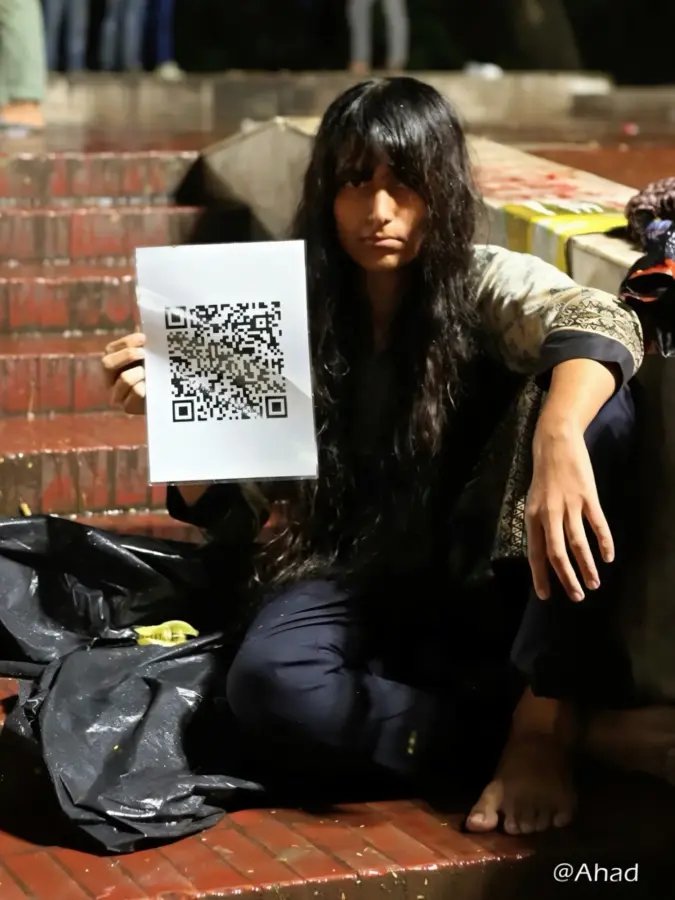
Sahara Chowdhury Rebil started her hunger strike at the Central Shahid Minar in Dhaka. Image by Ahad taken on October 10, 2025. Used with permission.
That image of one person starving in the rain, declaring their rage in writing, is not a story of defeat. It is a story of a movement doing what movements do when institutions fail them: going back to basics. Documenting. Naming. Insisting on existing. In 2024, of 70 documented incidents of violence against LGBTQI+ people in Bangladesh, only 13 were officially recorded as criminal cases. The community documents anyway. Because documentation, even without institutional consequence, is its own form of resistance.
The 2016 murder of LGBTQI+ rights activist Xulhaz Mannan was a brutal warning directed at Bangladesh’s progressive civil society. Nearly a decade later, Shakil Ahmed’s death signals that the same forces remain intact, only now operating with greater coordination, technological reach, and state apathy. This crisis did not begin in 2024. The uprising accelerated it.
Bangladesh’s queer movement is not facing a single enemy. It is facing a convergence: a political class performing religious credibility, an international funding architecture in freefall, an NGO sector recalibrating toward self-preservation, and a colonial-era law that still criminalizes their existence. Each force alone is manageable. Together, they are designed to exhaust. Until Bangladesh reckons with the impunity that runs beneath all of this, the movement will keep surviving in spite of the state rather than with its protection. The bitter truth here is that surviving is not the same as being free, and the July 2024 uprising did not happen merely to survive.