



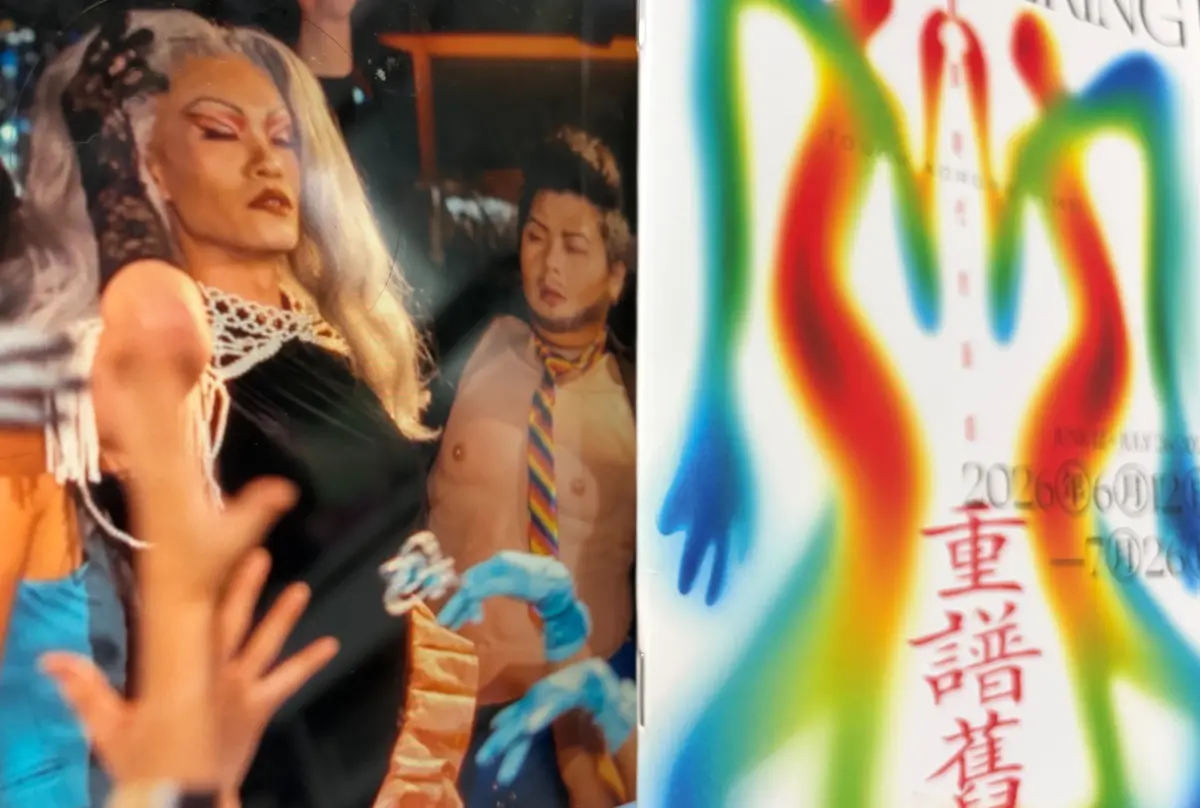
Hong Kong’s Pride Month activities are taking place at the Eaton Hotel this month. Photo taken by Oiwan Lam. Used with permission.
This post is part of Global Voices’ June 2026 Spotlight series, “Gender Diversity.” This series offers insight into gender diversity and how it is being threatened, protected, and preserved around the world. You can support this coverage by donating here.
Hong Kong civil society has faced increasing challenges in recent years, including arrests and political prosecution, the disbandment of NGOs, shrinking funding sources, the erosion of the right to protest and assembly, and more, since the enactment of the National Security Law (NSL) in 2020.
LGBTQ+ activism has also been negatively affected. Since 2023, the city’s Pride Parade has been forced to move indoors, as organizers could not find public venues where they could freely celebrate. The venue issue also forced the Gay Games 2023 to scale down and the Pink Dot carnival to move indoors. LGBTQ+ advocacy groups have faced drastic reductions in government-related and charity funding.
To find out how the city’s LGBTQ+ communities are affected by the post-NSL political environment, Global Voices conducted a face-to-face interview with Peregrine (a pseudonym), a nonbinary activist who discussed the challenges they faced, their survival strategies, and their hopes for the future.
GV: How do you account for the clampdown on LGBTQ+ rights in recent years, especially since the enactment of NSL in 2020?
Peregrine: LGBTQ+ [people] used to be part of the Hong Kong democracy movement, as the community’s earliest campaigns were along the legal and judicial fronts, which included the enactment of the Bill of Rights and the decriminalization of homosexual acts between consenting adults in 1991 and judicial reviews against the government’s discriminatory policies towards legally married same-sex couples.
Many human rights lawyers who acted on behalf of the LGBTQ+ community were affiliated with the democratic movement, and hence the two movements often went hand in hand.
Before the introduction of the National Security Law in 2020, some pro-establishment groups, even the pro-China Federation of Labor Union, had expressed support for LGBTQ+ rights. However, after the passage of the National Security Law and the subsequent mass arrest of the 47 pro-democracy activists, the attitude of the pro-establishment [groups] changed.
Hence, I see that the clampdown on LGBTQ+ rights is part of the crackdown on the pro-democracy sector. I don’t think many pro-establishment figures see LGBTQ+ activities like the 2023 Gay Games or Pride Parade as a threat; they just do not express support because LGBTQ+ rights used to be a pro-democracy agenda. I also suspect that many of them want to align with Beijing’s position and dare not express their view for fear of making a political mistake. As a result, very few extreme conservative voices become representative of the whole establishment.
Another issue is that the city law enforcement now opposes public gatherings which are connected to social and political agendas. The whole civil society is muted, and LGBTQ+ [organizations] can’t be exempted from the chilling environment.
GV: Can you elaborate further on how the new political order affects the internal dynamics within the LGBTQ+ community?
Peregrine: Since no one knows where the red line is, our views are more divided. The marriage right campaign, as an example, Jimmy Sham, while he was still in jail for the 47 activist case, had to withstand internal pressure from a few conservative voices accusing his judicial review for equal marriage rights of being too aggressive. Then, as the court of final appeal handed down its ruling in favor of the same-sex partnership framework, some were satisfied with the result, while a few insisted on pushing for equal marriage rights. That’s why we did not have any public D-day celebration.
The irony was that after all the legal hustle to push the government to introduce a same-sex partnership registration framework, the legislative council voted down the government bill in September 2025.
GV: How do you navigate the “red lines”?
Peregrine: It is very difficult to navigate red lines under the current politicized environment. Even the pro-establishment does not know where they lie. One example is the 2023 Gay Games. The event was endorsed by the Hong Kong Tourism Board to promote the city as a diverse and open society. However, the Games eventually had little government support and had to rely on school venues to host many sports competitions. Another example is the annual Pink Dot outdoor carnival, which is considered too commercial within the LGBTQ+ community. Yet even such a mild event has faced abrupt venue cancellations in the past two years.
After the 10th anniversary of the carnival in September 2024, Pink Dot was abruptly denied permission to operate an outdoor event by the West Kowloon Cultural District Authority in 2025 and by Link REIT in 2026, forcing the carnival to move online and indoors, respectively.
Peregrine: What we are facing now is also a global backlash against LGBTQ+ people. For example, last year in Kazakhstan, they passed a law to ban so-called ‘LGBTQ+ propaganda,’ and they considered any positive display of non-mainstream sexual orientation ‘propaganda.’
As for the authorities in Hong Kong, they just want to fulfil the minimum human rights standard laid out by the United Nations, which means they allow the community to exist but prefer them not to come out in public. That’s why we could not find public venues for our activities.
International Day Against Homophobia, Biphobia and Transphobia (IDAHOT) has remained a publicly visible LGBTQ+ activity, with LGBTQ+ rights NGOs setting up street booths in Causeway Bay to advocate for sexual minorities’ equal rights, thanks to the support of Consulates from European Countries.
GV: How does the venue issue affect the city’s LGBTQ+ movement in Hong Kong?
Peregrine: An important front of the LGBTQ+ movement is encouraging the community to come out with pride through parades and rallies, which also provide us with opportunities to meet each other face-to-face, discuss important issues, and build consensus. Those who have not reconciled with their sexual orientation and gender identity need to see each other to resolve their inner conflict. Moreover, our coming out in sexy outfits or as drag queens can inspire the mainstream to embrace inclusion. But we don’t have the space to do that now.
In 2023, the government-funded Radio Television Broadcast also cut its “We are Family” program, which was launched in 2006 to educate citizens on sexual diversity.
GV: There are many media reports about LGBTQ+ NGOs suffering from funding cuts. Do you have any insider views on the situation?
Peregrine: In the past, aside from direct funding from public institutions such as the Equal Opportunities Commissions, resources for LGBTQ+ community building also came from the advocacy front of major NGOs and Charities, which appropriated health and social service grants for advocacy work, such as community empowerment. In the past few years, most of these institutions have cut their advocacy front for fear of losing government support for their work.
GV: What spaces remain for LGBTQ+ activism?
Peregrine: I foresee LGBTQ+ activism becoming highly individualized. In fact, on social media platforms, particularly on Threads, there is no shortage of positive LGBTQ+ content, and when dialogues emerge, we can see clusters of like-minded people in the networks. I would name such clusters ‘queer spaces.’ However, thanks to the algorithm, they are less visible to those outside of the circle.
You can say that we are being forced into a semi-underground mode, and we have to keep expanding the underground spaces by digging our own virtual and physical ‘rabbit holes,’ so that we can build an urban tribe for mutual aid, like the New York ballroom culture in the 19th and 20th centuries.
GV: Do you have any hopes for the future of Hong Kong’s LGBTQ+ movement?
Peregrine: Even before the decriminalization of homosexuality in Hong Kong in the 1990s, the LGBTQ+ community had found ways to survive. Currently, the public acceptance of sexual diversity remains high, and there are still private venues available for us to host smaller-scale activities such as LGBTQ+ film festivals. What we need is for every individual to take responsibility for defending the space by attending LGBTQ+ events and donating to advocacy groups. We can’t be free-riders anymore.
Although the authorities want to further marginalize the LGBTQ+ community, they can’t deny our existence. Even in China, despite the heavy-handed crackdown on the LGBTQ+ community, the country launched its first transgender clinic in 2024, allowed the organization of Diversity Week in Beijing to mark the International Day Against Homophobia, Biphobia and Transphobia (IDAHOT) in 2025, and gave single women access to artificial insemination. If Hong Kong wants to remain an international city, it has to be far better than that.