




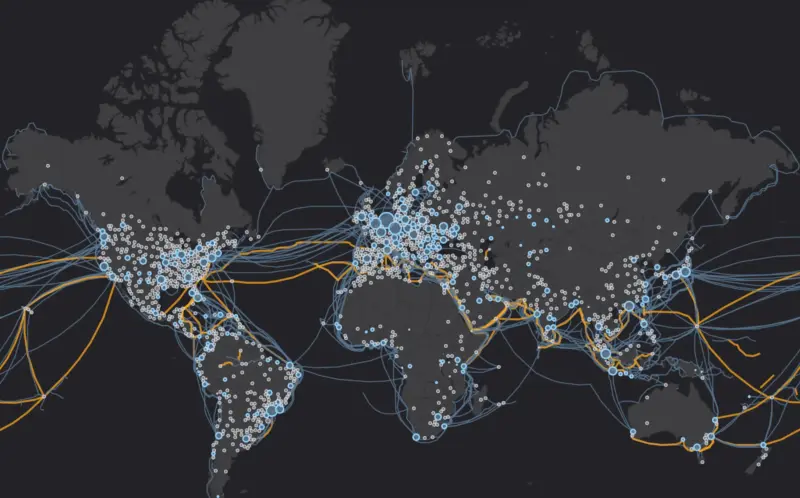
Screenshot of the Internet Infrastructure Map in 2026, from kmcd.dev. Fair use
By Alli Armijo
This post is part of Global Voices’ October 2026 Spotlight series, “Big Tech and Authoritarianism.” In this Spotlight, we explore how Big Tech facilitates and hinders authoritarian governments and practices, and how these choices influence the Global South. You can support this coverage by donating here.
The internet has always been illusive. Stretching bodies of water, screens, and time zones, it exists in a plurality increasingly shaped by big tech. And the cables mediate this; the cables are its nervous system.
With over 600 active and planned underwater internet cables spanning over 1.5 million kilometers around the globe, the majority of subsea infrastructure is predominantly owned and operated by US tech monopolies, namely Google, Amazon, Meta and Microsoft.
This infrastructure is largely laid on trans-Atlantic slave ship and oil extraction routes, algorithmically bound by a legacy of colonial violence and exploitative labor practices.
Subsea cables
Three years after the internet was made accessible to the public, the US government passed the Telecommunications Act of 1996, which incentivized independent companies and communications services to compete in the global market. Relaxed regulations and an end to the cap on radio station ownership created more opportunities for media conglomerates — the majority of which are funded by private tech companies — to own, operate, and influence public-facing content.
This is still true today, as Google, Amazon, Meta and Microsoft currently own roughly over 75 percent of subsea cables around the world. These companies control where information physically flows and the platforms through which this information, this data, circulates.
The growing importance of subsea cables in military and economic policy for major world powers like the US, Israel, and Saudi Arabia offers an entry point into understanding the corrosive, yet dependent, relationship between AI and oil infrastructure.
Earlier this year, the Federal Communications Commission (FCC) announced the Communications and Technology Transparency Act as an update to the Secure and Trusted Communications Networks Act of 2019, expanding the “malicious technology and equipment from foreign adversaries” on the FCC’s control list to include China, Russia, North Korea, and Iran. This comes in response to Iran restricting access through the Strait of Hormuz, a crucial point for global oil shipping and subsea cable infrastructure in which the US has invested a significant amount.
AI and oil Infrastructure
We have not seen this kind of surge in subsea cable investment since the internet went public in 1993, effectively shifting the digital sphere from a privatized space for military communications into a public playground. Around this time, companies like Amazon and eBay came online alongside chatrooms, search engines, independent news outlets, and, in turn, the digital sphere entered the homes of those who could afford it.
Today, internet infrastructure policy is increasingly a topic of discussion in military strategy and policy decision-making. China has supposedly asked Iran to help defend against Houthi attacks along the Red Sea coast and around the Bab el-Mandeb Strait, as Saudi Aramco oil exports, in which it has invested USD 4 billion, remain vulnerable. Chinese and US-based companies Alibaba, Amazon, IBM, Google, and Microsoft maintain some of the largest investments in the Gulf Cooperation Council (GCC), with Saudi Arabia and the United Arab Emirates (UAE) having the most data center and cloud projects.
This internet infrastructure is deeply tied to oil infrastructure, as the natural gas systems increasingly used to keep data centers in America running are optimized by AI, effectively pillaging the physical and digital platforms through which local communities connect and express themselves. At the atomic level, crude oil is made almost entirely of hydrocarbons, which AI has been used to optimize in the form of wellbore drilling tools and environmental assessments.
AI in the Gulf
In 2025, US President Donald Trump signed a $600 billion investment commitment in technological and defense systems with Saudi Arabia. In the same month, Saudi Arabia’s Public Investment Fund (PIF) launched HUMAIN, a vertically integrated AI company developing an Arabic-first language learning model, with full computing infrastructure located in Saudi Arabia.
In March 2026, HUMAIN announced a partnership with Turing, an American AI cloud lab helping Fortune 500 companies scale and deploy AI agents. This move clarifies Saudi Arabia’s positioning as an AI exporter rather than strictly a consumer, reinforcing the feedback loop of US control over and investment in global AI infrastructure, specifically in the Gulf region.
And just 10 miles away sits the largest recipient of US foreign aid since cables first began being used strategically in warfare, in World War II. This colonial project hosts data centers owned and operated by Amazon, Microsoft Azure, Google Cloud, and Oracle, companies that secured the $9 billion Joint Warfighting Cloud Capability (JWCC) contract with the Department of Defense (DoD).
Infrastructure of occupation
Israel historically relies on oil imports, and the biggest resource they stole is the Leviathan Natural Gas field, the largest natural gas reservoir in the Mediterranean off the coast of the Gaza Strip. In this way, the colonial project’s energy policy is contingent on its ability to sustain US-backed AI infrastructure, and by extension, access to natural gas resources pillaged from land stolen from the Palestinian people.
Because jurisdiction over data belongs to the hosting country in which that data is located, the Palestinian people are constantly killed and robbed of not only their land, but their data and digital footprint. Heavily and forcibly reliant on Israel’s digital infrastructure, which is in turn heavily funded and supported by US interests, Palestinians are frequently left out of global conversations and decisions impacting their livelihood or killed with US-funded weapons before they get the chance.
On September 24, at the UN General Assembly in New York, Palestinian Authority President Mahmoud Abbas spoke to the council from his office in Ramallah, after being denied entry into the country for the second year in a row. He spoke about the devastating effects of Israel’s ongoing genocidal war in Gaza, calling on the rest of the world to hold them accountable for their actions and end the ongoing occupation.
“We will not leave our homeland. We will not accept displacement. And we will not allow anyone to decide our future on our behalf.”
Alli Armijo is an artist, writer, and journalist based in New York City, USA.