




Small and medium-sized enterprises (SMEs) account for more than 95 per cent of businesses in emerging Asia and generate around 40 per cent of the region’s economic output. Across developing economies, they provide roughly 80 per cent of employment, yet many lack access to the banking and insurance services they need to navigate the climate transition.
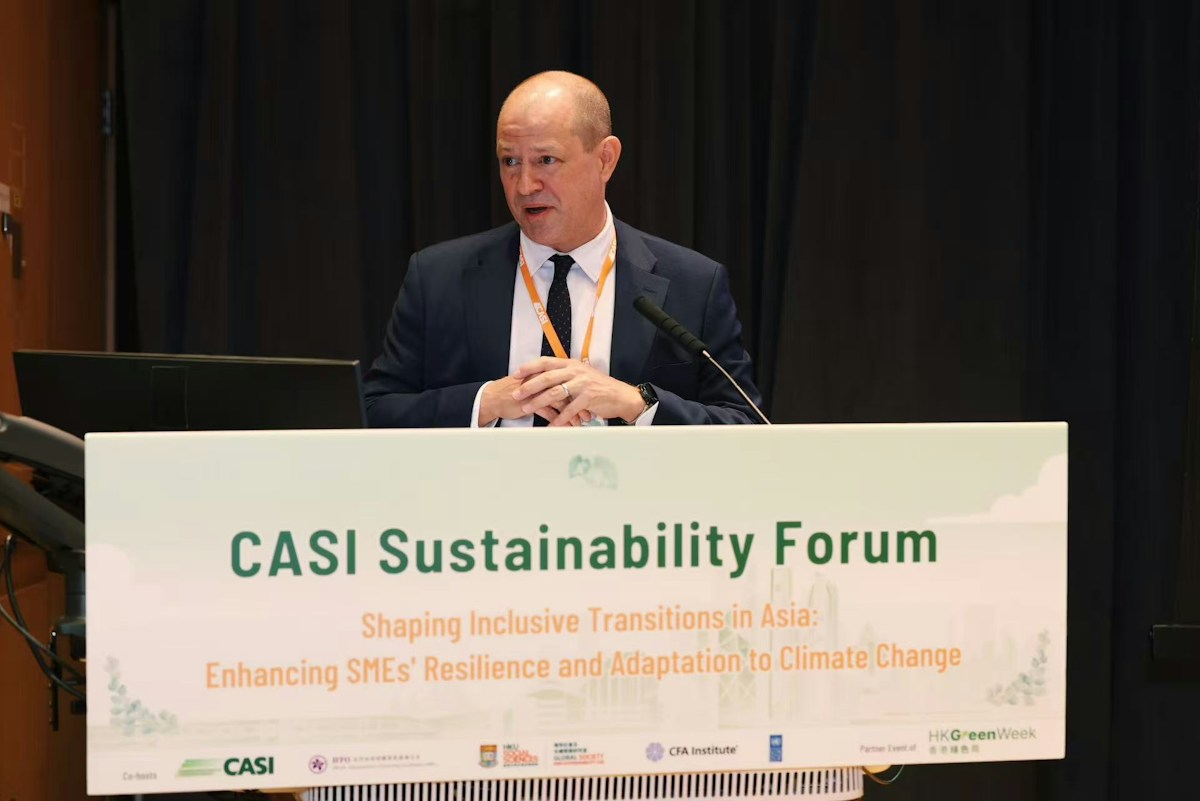
Tom Beloe, Director of the Sustainable Finance Hub at the United Nations Development Programme (UNDP), works across public finance, debt, insurance and development finance to mobilise capital for sustainable development. Eco-Business spoke to him in Hong Kong, where he addressed the CASI Sustainability Forum during Hong Kong Green Week last month.
This interview has been edited for length and clarity.
What does your work at UNDP’s Sustainable Finance Hub involve?
UNDP is the main development institution in the UN system with a focus on emerging markets and developing economies. We operate in 170 countries with a mandate around the Sustainable Development Goals (SDGs).
My job is Director of the Sustainable Finance Hub is to align and leverage all sources of finances for the SDGs. The spans reforms on budgets, fiscal and tax reforms, debt instruments, and work with insurers and development finance institutions.
The aim is to bring more finance to sustainable development, particularly in the poorest countries.
Why is transition finance so difficult to get to SMEs?
It is the scale of the challenge.
SMEs form the bedrock of the economy, especially in developing countries. But many micro and small enterprises are invisible to the formal financial sector. They may have no ledges, or health and safety certifications, so banks do not recognise them as being bankable.
Making these businesses visible is a first step.
There’s also a huge agricultural sector base among SMEs, and agriculture is vulnerable to climate change and supply chain disruption. That can be catastrophic for employment and for economies at large, so there’s an important role to play in providing access to financial products beyond finance itself, such as insurance.
A UNDP report found that around 95 per cent of SMEs and micro, small and medium-sized enterprises struggle to access climate insurance. What is behind that gap?
There are many factors, not all are SME-specific.
Many emerging markets don’t have insurance industries at the scale required, often because policy and regulation haven’t enabled the industry to deploy the right instruments. If the regulatory environment isnt’ there, insurers will go elsewhere.
There is also a mismatch between the products small businesses need and what markets are ready to offer. Parametric insurance for example, can release funds quickly when a particular event occurs. Speed matters – if an SME waits months to access finance from a claim, it may already have folded. Regulators need greater awareness of these instruments, alongside the capacity to support them.
UNDP works with the World Bank and the insurance industry through the Insurance Development Forum. We bring grant finance and industry partners together to address policy and regulatory barriers. The solutions exist; the challenge is taking them to scale.
Asia Pacific faces some of the highest sea level risk risk globally. Could parametric insurance scale across Asia Pacific, and who would need to make that happen?
It could, but this would require partnerships across sectors.
Larger businesses need to recognise that their supply chains become more reliable when SMEs within these chains are insured. That means understanding it’s worth putting in seed finance to get the instruments deployed.
The insurance industry needs to go the extra mile initially. If they don’t, the instrument never takes root and the market cannot grow. Governments have to enable this through policy and regulatory reform, while development institutions such as UNDP can bring the parties together.
Is there an example that could offer lessons for Southeast Asia?
There are insurance instruments for coffee supply chains in Africa that I see as a model for Southeast Asia as well. Lavazza, the Italian coffee company, recognised that a more climate-resilient supply chain would help it maintain access to quality coffee. It partnered with insurer Generali, which saw an opportunity to expand into a market such as Ethiopia.
The incentives can work for everyone: Lavazza gains a more stable supply chain, Generali develops a market, and smallholder farmers gain protection that can help them sustain and grow their businesses. I can see a model like this applying in Southeast Asia.
Bringing it back to Hong Kong and its role as a gateway to upstream global supply chain in China, what has the potential to scale here?
It’s been inspiring to be here for Hong Kong Green Week and the CASI Sustainability Forum.
During Hong Kong Green Week, I heard about initiatives that bring financial institutions together with organisations providing capacity development and technical assistance. The Green Accelerator, launched this week, focuses on developing a pipeline of bankable green projects and improving access to finance.
These coalitions can help SMEs and micro-enterprises participate in the green economy. With COP31 approaching, the emphasis is on implementation. Initiatives that turn policy into practical support and finance are what we need now.