




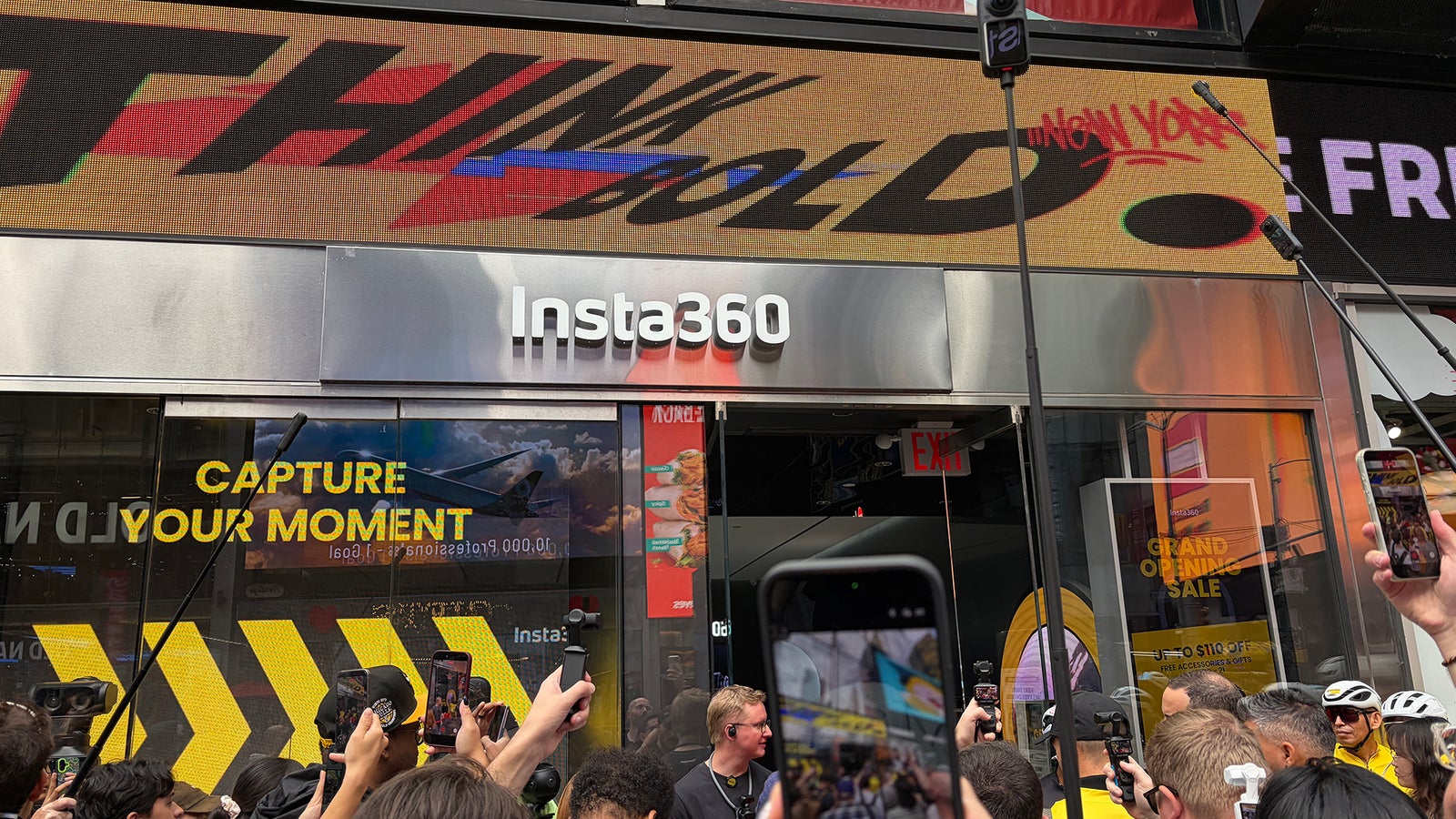
On a Saturday morning in September, dozens of people lined up in New York City’s Times Square to check out pocket-sized cameras made by Chinese camera maker Insta360. YouTubers flew in to promote the products. As part of the marketing campaign, cyclists prepared to bike around the city in bright yellow shirts emblazoned with the Insta360 logo.
The Shenzhen-based company was opening its first flagship store in the U.S., a high-profile push to market its smart cameras to content creators, travelers, and sports enthusiasts. It was also a statement of confidence in a market where Chinese technology companies are facing growing scrutiny.
There are restrictions, but it’s better to have a clear no than maybe in business.”Chris Pereira, founder of consultancy iMpact
“The U.S. is a super high potential market for us,” Max Richter, Insta360’s co-founder, told Rest of World at the store opening. The U.S. accounts for 30% to 40% of the company’s revenue, he said. “You have an amazing outdoor sports community, you have a huge influencer economy, and I think Insta360 really gathers both of these audiences.”
Insta360’s optimism and U.S. expansion stand in sharp contrast to the experience of DJI, the dominant Chinese player it’s trying to challenge in the global drone and handheld camera market. DJI dominates the global civilian drone market, while Insta360 last year announced a separate company to make drones. In handheld smart cameras, DJI accounted for 73% of the global shipments, while Insta360 accounted for 20%. California-based GoPro, the pioneer of action cameras, has been largely pushed out of the market.
Washington has increasingly treated DJI as a national security risk. The U.S. Department of Defense has labeled DJI a Chinese military company, a decision the company has been fighting for years. The Federal Communications Commission has blocked DJI from selling new drones as well as cameras in the U.S. In the meantime, Insta360 is racing to win American consumers.
Both companies are based in Shenzhen, but they took different paths to becoming rivals. DJI was founded in 2006 and quickly became the global leader in consumer drones, with most of its sales coming from overseas. It expanded into handheld stabilized cameras in 2016.
Insta360 was founded in 2015 as a camera company. Its early success came from 360-degree cameras, which capture a panoramic view, before the company expanded into stabilized cameras and microphones. Its founder JK Liu had said the company aimed at the global market from “day one,” with a particular emphasis on America. Richter, a German native, first moved to China with a German company. He then worked for DJI before joining Insta360.
Arrival of Antigravity
Insta360 recently entered the drone business. The company announced the launch of an independent drone brand, Antigravity, in 2025, which it said was incubated in collaboration with third parties. The move could help insulate Insta360’s camera business from any future restrictions targeting Chinese drones, Chris Pereira, founder of consultancy iMpact, which helps Chinese companies sell abroad, told Rest of World.
The FCC has banned new foreign-made drones from entering the U.S. market, though companies can apply for waivers if they plan to move manufacturing to America. Antigravity obtained FCC’s approval for its drone, A1, just before the rule took effect.
Viola Zhou/Rest of World
Michael Shabun, the Los Angeles-based chief executive of Antigravity, told Rest of World at the store opening that the company was planning to move its manufacturing from Asia to the U.S. in the coming years.
Antigravity is positioning the A1 drone, with a 360-degree camera, firmly as a consumer-facing product. Shabun said the company stores all U.S. user data locally and has designed the drone so that it cannot carry more than 50 grams of additional weight, a restriction intended to prevent misuse of the drone for purposes beyond leisure. “They’re built for fun; they’re built for content creation; they’re built for exploration,” he said.
DJI drones have been widely used by commercial operators and law enforcement agencies, making their potential cybersecurity and data-security risks a particular concern in Washington.
“People in the U.S. are more excited about our product than any other region. And the drone market in the U.S. is very sophisticated and developed,” Shabun said, adding that the A1 would be put on the shelves of the Insta360 store.
Lure of the American consumer
Even as the U.S. government ramps up scrutiny of Chinese businesses, Chinese companies are eager to bring their products to America, especially at a time of slowing consumer spending and rising competition at home. Over the past two years, New York City has seen a number of Chinese brands open new shops, from clothing brand Urban Revivo to bubble tea chain Mixue. DJI opened a store on Fifth Avenue in 2024.
In China, DJI and Insta360 have fought a fierce price war over their handheld camera products. The rising costs of memory chips have weighed on their profitability. In the first half of 2026, Insta360’s net profit dropped by 94% compared with a year ago. The two companies have also sued each other over intellectual property infringements.
In the U.S. market, Insta360 might enjoy an advantage. Pereira said the first batch of Chinese companies to gain prominence in America, such as telecoms equipment maker Huawei, social media platform TikTok, and DJI, had attracted intense scrutiny.
One of the big deciding factors was availability. I can go into a store and buy [Insta360].”Lars Kappler, a real estate consultant in San Diego
He said the “second wave” of Chinese brands — like Xiaomi and Xiaohongshu — enjoyed more clarity. “There are restrictions, but it’s better to have a clear no than maybe in business,” Pereira said.
DJI can still sell its existing drones and cameras in the U.S., but its future in the market is unclear. The 2024 National Defense Authorization Act passed by Congress required the FCC to add communications and video surveillance equipment made by DJI and another Chinese drone maker, Autel Robotics, to its Covered List, effectively barring the agency from authorizing new products from the companies. The FCC has not approved new DJI products since November.
In an email to Rest of World, an FCC spokesperson said DJI’s products were banned in accordance with 2024 law, while Insta360’s products were not added to the Covered List.
Insta360 has been able to register new products with the FCC while DJI is blocked. Asked whether the company could avoid the pressures facing DJI, Insta360 co-founder Richter said he was confident it would be able to stay in America. “There is no sensitive technology,” he said. “We fully comply with all regulators. There’s nothing to hide.”
Some of DJI’s loyal American users are already switching sides. Lars Kappler, a real estate consultant in San Diego, has been using a DJI camera for a year. He told Rest of World he recently bought three Insta360 cameras and a microphone for his social media videos, because DJI’s latest products were not released in the U.S. “One of the big deciding factors was availability,” Kappler said. “I can go into a store and buy [Insta360].”
Michael Alvarado, an auto-body technician in Minnesota, also recently switched from DJI to Insta360’s latest handheld vlogging camera, Luna Ultra, to film his everyday life and family trips. He liked Insta360’s new features, such as the detachable screen, and was also worried about DJI’s long-term prospects in the U.S.
“As much as I’m pissed about the whole ban,” Alvarado told Rest of World, “I’m going to focus on who has the win right now, and unfortunately that’s Insta360.”