



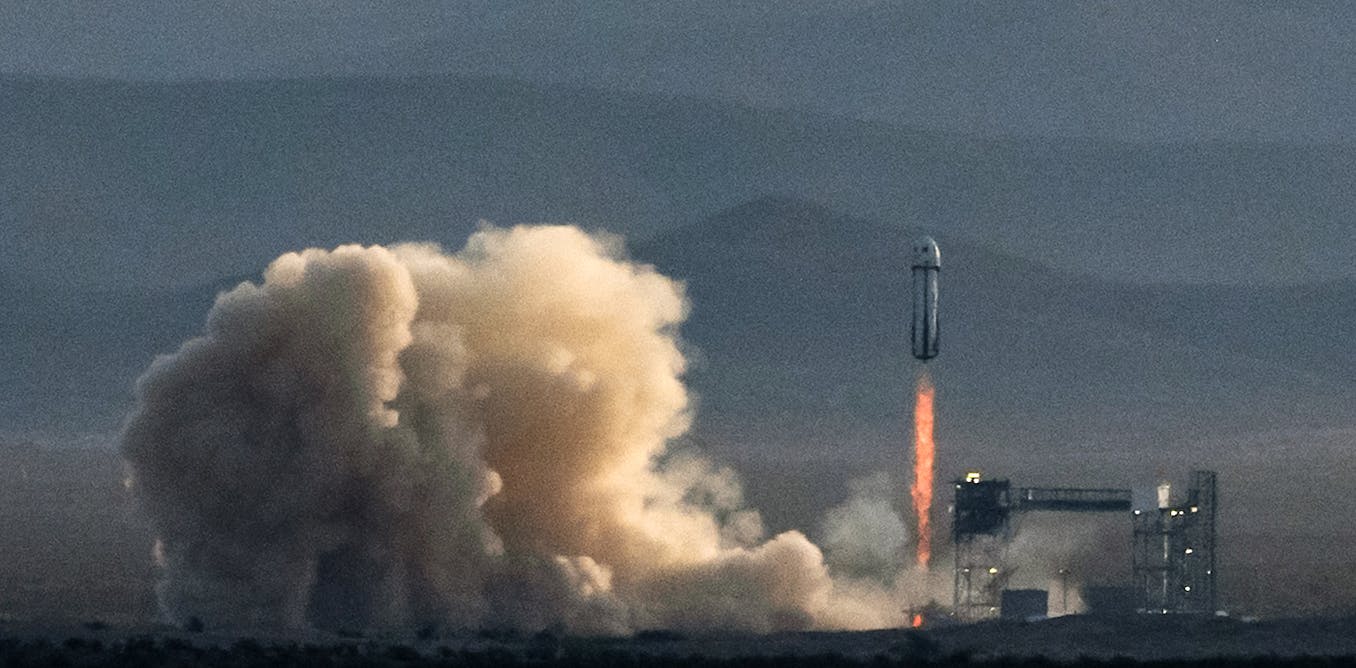
Private commercial operators are launching more rockets into space, carrying more people and pursuing more ambitious missions than ever before.
Space tourism is part of this growth, with 140 paying tourists taking off since American entrepreneur Dennis Tito took the first tourist flight to the International Space Station 25 years ago.
The industry is driven by private companies, including Blue Origin, whose recent rocket explosion was a reminder that commercial spaceflight remains a risky business.
Despite the industry expansion, international space law still relies on treaties drafted in the 1960s and 1970s for a very different era of state-led exploration.
The result is a widening gap between the rapid growth of the sector and the fragmented frameworks overseeing its risks, responsibilities and accountability.
Spectacle, risk and a legal vacuum
US singer Katy Perry’s Blue Origin joyride on board a ten-minute all-female mission in April 2025 received considerable backlash despite its claims of feminist empowerment.
Other celebrities questioned whether a billionaire-backed space hop for famous passengers could seriously be marketed as progress for women or humanity.
However, the criticism was not only about celebrity culture. It exposed a deeper problem. At present, space tourism offers spectacle with little meaningful legal accountability.
The 1967 Outer Space Treaty states outer space must be used “for the benefit and in the interests of all countries” and describes it as “the province of all mankind”.
It also makes states responsible for space activities carried out by private companies and requires them to continually supervise activities launched from their territory.
As of June 2026, the treaty has 118 ratifying states parties. While it is legally binding on those states, it does not provide a dedicated enforcement authority or automatic sanctions. Compliance therefore depends largely on principles of state responsibility and diplomatic pressure.
The rules were drafted for the Cold War era, not for celebrity passengers, billionaire branding exercises and luxury trips to the edge of space.
Gaps in space regulation
For example, the Federal Aviation Administration licenses launches and re-entries in the United States. But US Congress has repeatedly prevented the agency from introducing new passenger safety rules for commercial human spaceflight. This moratorium now extends until 2028.
The gap widens further once a mission reaches orbit, where operations fall outside the aviation administraion’s jurisdiction altogether. As a result, one of the world’s fastest-growing prestige industries remains governed largely by launch licences, informed-consent waivers and a striking absence of binding safety rules for those on board.
This light-touch regulatory environment is particularly striking given the exclusivity and commercial scale of the industry. Blue Origin does not publicly advertise a ticket price for New Shepard, but aspiring customers must lodge a refundable US$150,000 deposit merely to enter the process. The first seat on its inaugural crewed mission reportedly sold for US$28 million.
Virgin Galactic reopened seat sales in March 2026 at US$750,000 per passenger.
Orbital missions are even more exclusive. Axiom’s private astronaut flights to the International Space Station have cost more than US$55 million per seat, with some recent missions reportedly priced in the US$60-million range per customer.
This is not democratised access to space – it is luxury consumption for the ultra-rich, softened only by a few symbolic exceptions.
This matters both legally and politically. Although the Outer Space Treaty does not prohibit commercial activity or require equal access, there is an obvious tension between describing space as “the province of all mankind” and building an industry effectively reserved for the ultra-wealthy.
Scholars have increasingly warned that if benefit sharing remains little more than rhetorical, commercial space activity will deepen global inequality rather than deliver benefits to all countries.
What should change
The environmental cost of commercial space flight is also currently minimised.
Blue Origin presents New Shepard as a reusable, hydrogen-fuelled system whose engine emits water vapour rather than carbon during flight. But this does not make it harmless.
Scientists have warned that rocket launches and re-entries release pollutants into the upper atmosphere, where they can affect the climate and delay ozone recovery. Researchers also found rocket soot can warm the atmosphere far more effectively than the equivalent soot produced by aircraft or ground-based sources.
A 2025 study went further, estimating that suborbital space tourism can generate 400 to 1,000 times more carbon dioxide per passenger per hour than commercial aviation.
So, what needs to change? States should adopt binding passenger-safety rules to replace the current reliance on informed consent.
Regulators also need clear authority over commercial activity in orbit, because the current legal gap is hard to justify in a market where private missions now extend well beyond launch and re-entry.
Environmental review must also move beyond local noise and land-use concerns to confront upper-atmosphere pollution, ozone impacts and the cumulative effects of increasing launch rates.
States should take the Outer Space Treaty seriously by developing clearer rules on transparency, equity and benefit sharing. If private companies profit from outer space, they should have to show that its use benefits more than the wealthy elite.
Space tourism is an industry with real consequences for safety, for the environment and for the legal promise that space belongs to everyone.
Without these reforms, space tourism will remain exactly what the New Glenn explosion and the Perry backlash exposed: a risky, weakly regulated luxury industry selling transcendence while evading responsibility.