



How do we remember Canadian authors after they’ve died?
My new book, Literary Life After Death: Commemorations of Writers in English-Speaking Canada, studies national, provincial, municipal and community-led actions that contribute to the creation and preservation of the historical memory that underpins Canadians’ sense of identity. I show that commemorations take many forms.
After many years of researching and teaching Canadian literature, I find it remarkable to witness a resurgence of discussion about Canadian cultural nationalism and how this relates to stories and literature, along with a shared desire to protect what could be lost.
Here, in time for Canada Day, I share some modes of commemoration for authors, and ways that these commemorations reflect readerly engagement and public history.
From postage to podcasts
As technologies and institutions shift, longstanding forms of national commemoration like postage stamps and material currency wane.
The impact and visibility of conventional national gestures — like the 2024 loonie that marked the 150th birthday of L.M. Montgomery — or a quotation, for example from Roch Carrier’s The Hockey Sweater on the $5 bill, also diminishes.
But much commemorative activity occurs at the local level as a result of community effort, and sharing circulates too through digital media.
We can think, for example, about a podcast devoted to the late Stó:lō author Lee Maracle not long after her death in 2022.
Or consider a self-guided tour created by historian Natasha Henry-Dixon that traces the footsteps of publisher and writer Mary Ann Shadd Cary in mid‑19th century Black Toronto.
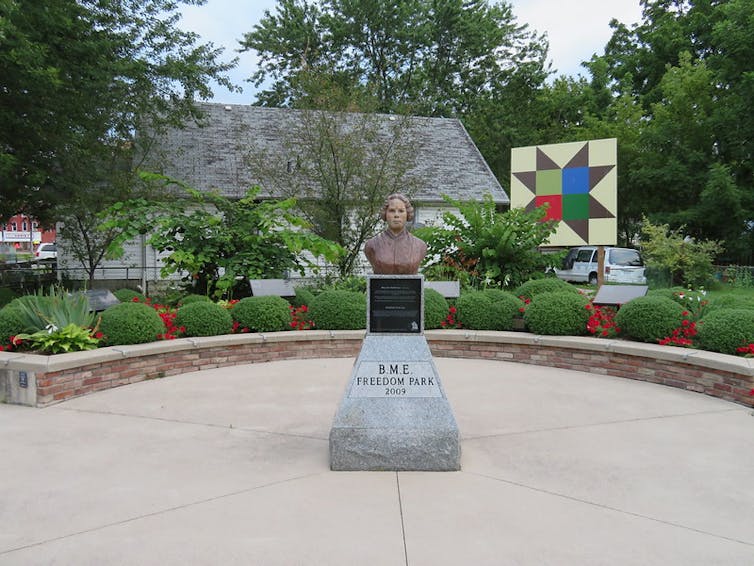
(Sean Marshall/Flickr), CC BY-NC
Memorials to Shadd Cary also include a postage stamp, a statue in Windsor, Ont., and a bust in Chatham, Ont., among her many honours.
Such localized public memorials like statues (Al Purdy in Queen’s Park, Toronto) are especially tangible, visually highlighting writers. The same is true for benches (Timothy Findley in Stratford, Ont.) and murals (Leonard Cohen in downtown Montréal).
Read more:
Daring reads by the first generation of Canadian Jewish women writers
Items on public display
Admirers also like to view items on public display. Across the country, items are sometimes held in writers’ former homes which are maintained as museums that welcome visitors — something to consider as summer approaches.

THE CANADIAN PRESS/Frank Gunn
The performance dress belonging to Pauline Johnson (Tekahionwake), the late-19th century poet of Mohawk and English descent, is held in the Museum of Vancouver. Chiefswood Historic National Site, at Six Nations of the Grand River, in Ohsweken, Ont., is the birthplace of Johnson and the Johnson family home.
Read more:
The real truth about stories: Book recommendations from the Indigenous Literatures Lab
The typewriter used by Gabrielle Roy to compose Bonheur d’Occasion (The Tin Flute) can be seen at Maison Gabrielle Roy in Winnipeg, the author’s childhood home.
However, compared to other countries, Canada possesses relatively few house museums that anchor a writer’s presence in the national narrative. Countries that emphasize the significance of writers in the construction of national identity often foster dedicated organizations with associated websites.
The largest is France’s Fédération des Maisons d’Écrivain et des Patrimoines Littéraires, which includes more than 360 literary sites, offering tour itineraries and school programs.
In the United States, the American Writers’ Museum lists more than 80 affiliated house museums.
Fortunately, Canada’s lack of such a centralized resource is now being met by Concordia University Library’s map of literary house museums.
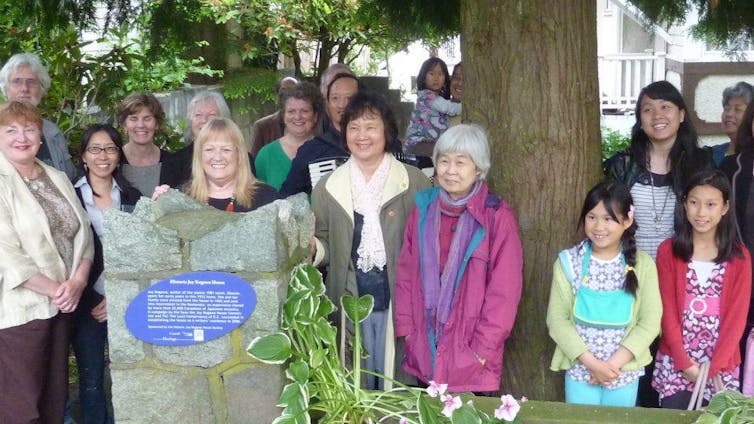
(Vancouver Heritage Foundation/Wikimedia), CC BY-SA
Connecting writers with readers
Joy Kogawa’s family home in Vancouver commemorates the injustice of Canada’s Second World War internment of Japanese Canadians (chronicled in Kogawa’s Obasan); Margaret Laurence’s house in Neepawa, Man., recalls her fictional town of Manawaka (A Bird in the House); Emily Carr’s home in Victoria informs her memoirs (The Book of Small).
Read more:
Canada’s exile of Japanese Canadian citizens: A shameful 80-year anniversary few remember
These preserved residences of female writers are often childhood homes that figure significantly in their major published works, connecting writers with their readers.
Several male writers earned enough from their writings to fund a stately residence now maintained as an historic site, notably Thomas Chandler Haliburton in Windsor, N.S., and Stephen Leacock in Orillia, Ont.
Literary events and sites
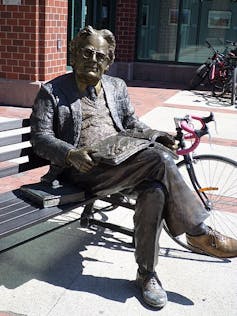
(Ashoola/Wikimedia), CC BY
Some writers’ names are invoked with bustling literary festivals or conferences (for example, the Austin Clarke, Black Studies and Black Diaspora Memory Conference at Toronto Metropolitan University in Toronto); the bilingual Frye festival in Moncton, N.B., named for Northrop Frye; or awards or lectures.
However, there’s a risk in naming events and sites after people. In later years, controversies can emerge, related to political reckoning, revised historical public records and personal revelations.
Read more:
The Gothic horror of Alice Munro: A reckoning with the darkness behind a feminist icon
Most infamous with regard to revisiting writerly colonial legacies is poet Duncan Campbell Scott, whose role in administering the residential school system has resulted in the deletion of his name from the titles of several awards, the removal of the plaque from his former residence in Ottawa and other revised commemoration.
Montgomery’s many sites
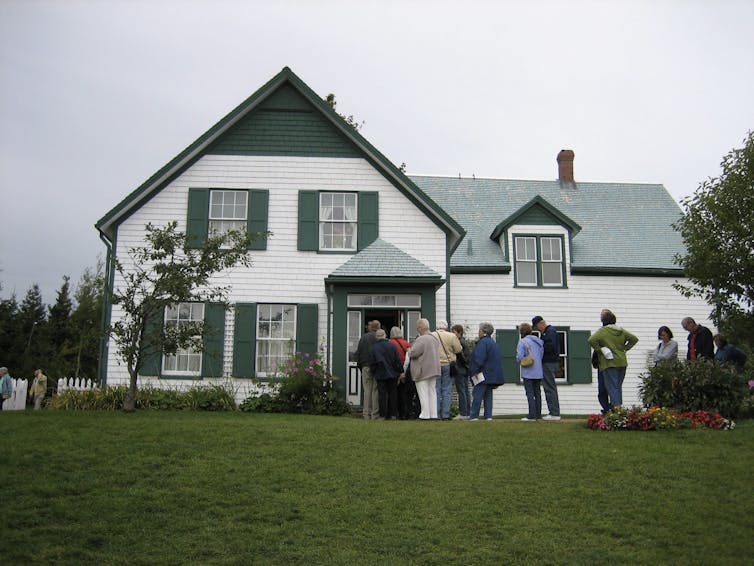
L.M. Montgomery enjoys the greatest number of memorial sites, highlighting her life and career in virtually every place that she inhabited or visited. These are now documented in the interactive map maintained by the L.M. Montgomery Institute at the University of P.E.I., and visitors to Prince Edward Island are invited to follow tours of her “inspired places.”
(AP Photo/Jamie Stengle)
She is the only author with two homes designated as national historic sites: “L.M. Montgomery’s Cavendish,” which includes the remnants of her childhood home (as well as Green Gables Heritage Place), and the Leaskdale Manse in Ontario, where she resided from 1911 to 1926.
Some preserved birthplaces have little to do with the author’s actual life and are essentially used for additional historical and cultural activities, such as McCrae House in Guelph, Ont. The birthplace of the author of “In Flanders Fields” now serves primarily as a museum about the First World War.
Other preserved authors’ houses enrich our cultural future by privileging local literary events and offering residencies.
When we keep our authors in memory and in public view by commemorating their lives — especially as we gather to celebrate Canada Day — we acknowledge their significance in configuring and expressing their own and their communities’ stories, shaping and illuminating our Canadian culture and preserving its nuanced distinctiveness.