



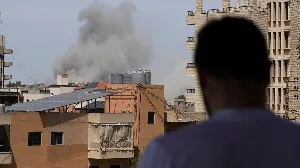
Recent Israeli air strikes in southern Lebanon have resulted in at least 41 fatalities, raising concerns over ongoing hostilities despite a declared ceasefire.
Israeli air strikes conducted on Saturday targeted southern Lebanon, leading to the deaths of at least 10 individuals. This attack raises the overall toll to 41 fatalities in just 24 hours, amidst a conflict that has seen a total of 2,659 deaths since hostilities intensified on March 2, 2026. Approximately 8,183 others have sustained injuries.
According to Lebanon’s Ministry of Health, the latest air strikes occurred in various locations, including the town of Shoukine in the Nabatieh district, where three people lost their lives. Earlier in the day, a strike on a vehicle in the village of Kfar Dajjal resulted in two deaths. Further casualties were reported from an attack on a residential building in Lwaizeh.
The recent assaults come despite a ceasefire that had been declared on April 17 and subsequently extended. Lebanon’s National News Agency indicated that Israeli strikes violated this temporary arrangement, which many in the region regard as largely ineffective.
Israeli officials claim the bombings aim to target Hezbollah, a pro-Iran group, although many of the victims have been civilians. The conflict has led to over one million individuals being displaced throughout Lebanon as fighting has escalated.
In response to the ongoing situation, Hezbollah asserted that it would persist with attacks against Israeli forces within Lebanese territory. The group reportedly targeted multiple Israeli military positions in the southern region, employing artillery and drones. Their drone operations have included strikes against Israeli tanks and vehicles, marking a shift in their approach to combat.
The conflict between Israel and Hezbollah reignited earlier this year following a series of attacks and counter-attacks, with Israeli forces conducting extensive airstrikes, resulting in ground incursions into southern Lebanon. Journalistic reporting indicates that the ceasefire, in theory, is not reflective of the on-ground reality, with continued hostilities marking the everyday situation in southern Lebanon.
Rory Challands, an Al Jazeera correspondent based in Beirut, remarked that the ceasefire appears to exist merely as a nominal agreement. “Essentially, it’s a diplomatic construct. The reality is that, certainly down in the south, the war continues, and, in fact, it is expanding,” he reported.
In the backdrop of the violence, regional diplomacy has struggled to keep pace with the escalating military operations. China’s envoy to the United Nations highlighted the lack of a genuine ceasefire, labelling the situation a “lesser fire”. Fu Cong emphasised the need for Israel to cease its bombardment of Lebanese territory.
Amidst the rising tensions, Israeli Prime Minister Benjamin Netanyahu faces increasing pressure from public and military factions to abandon the ceasefire. Reports indicate a significant segment of the Israeli populace, alongside military leadership, advocates for a more robust military engagement against Hezbollah. Discussions are ongoing regarding the potential resumption of wider conflict, amid concerns for Israeli soldiers facing threats from Hezbollah’s new tactics.
As the situation evolves, the humanitarian impact continues to deepen, with many civilians caught in the crossfire of an escalating conflict that shows no sign of resolution in the immediate future.