



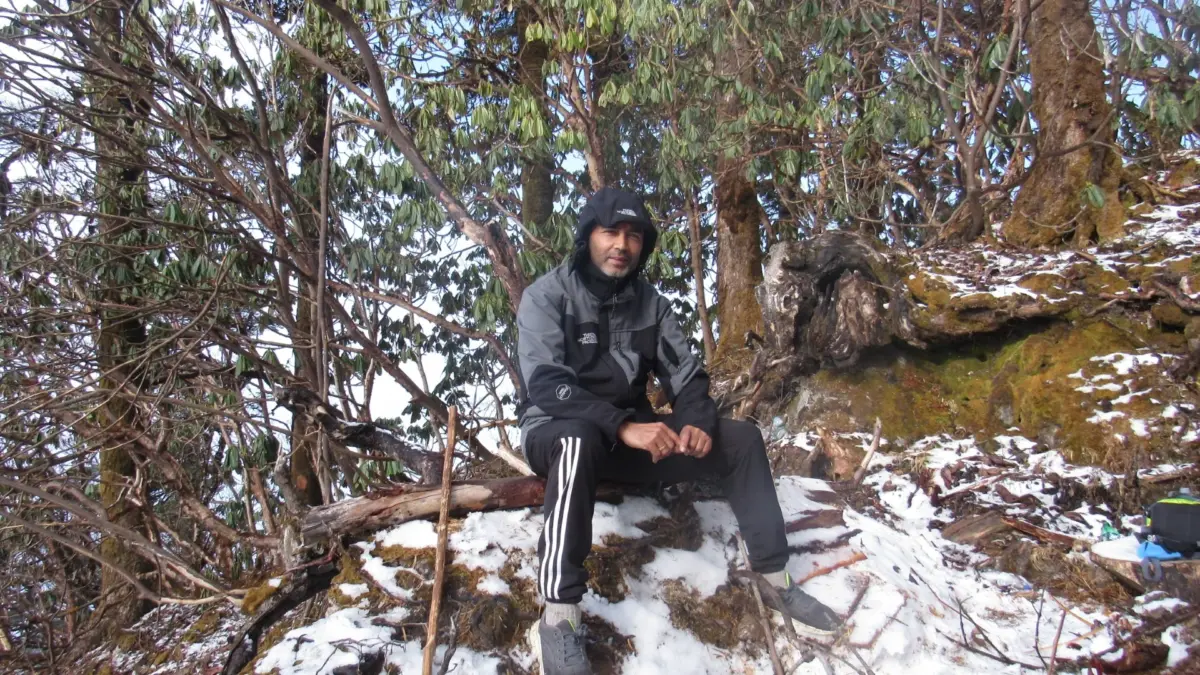
Anil Adhikari in a forest in Pathivara, eastern Nepal. Image provided by Anil. Used with permission.
Anil Adhikari is a Nepali conservation educator, author, and journalist dedicated to promoting grassroots environmental awareness. For more than two decades, he has developed school-based programs across Nepal, using storytelling, illustrated books, and community engagement to teach children about wildlife, forests, and ecosystems. His work connects conservation education with community resilience, helping young people understand their role in protecting natural resources in the face of the climate crisis.
He is the founder of the non-profit organization Teka Samuha Nepal, which implements the Community-Based Snow Leopard Conservation Program (CBSLCP) in the Himalayas. He has also served as an editor of The Snow Leopard Magazine and received the World Wildlife Fund (WWF) Nepal Conservation Award in 2024. Anil has authored several conservation education books that emphasize climate resilience and adaptation through storytelling and extracurricular activities.
Sangita Swechcha of Global Voices interviewed Anil Adhikari via email to learn more about his work in conservation education, his efforts to engage children and communities in environmental awareness, and the role of grassroots initiatives in building climate resilience in Nepal.
Sangita Swechcha (SS): Nepal is increasingly affected by climate change — from shifting weather patterns to impacts on forests and wildlife. How do you see conservation education contributing to climate solutions at the community level?
Anil Adhikari (AA): Climate change is already affecting Nepal’s protected areas and biodiversity. For example, unseasonal snowstorms in 2018–2019 across the Himalayas caused the loss of thousands of livestock and likely affected wildlife as well. This phenomenon may have led to shifts in wildlife habitats. From 2012 to 2014, during our annual snow leopard scouts’ monitoring camps in Namu pastureland (4,300 m) in the Annapurna Conservation Area (ACA), our project team — together with students, field rangers, and local stakeholders — regularly observed hundreds of blue sheep, along with clear signs of snow leopards. However, in 2024, we found neither blue sheep nor any signs of snow leopards in the same area. Such changes may be linked to shifting weather patterns and habitat disturbance.
In response, our conservation team, working with schools and local partners, promotes conservation education among students in both Himalayan and lowland regions. Through extracurricular activities, we teach the causes and impacts of climate change, preparedness, and practical adaptation measures. Students learn these topics through conservation education books that I have written. We expect them to act as messengers, sharing these ideas with their families and communities, which can support local climate solutions. However, one key challenge remains: ensuring that this knowledge is effectively transferred from students to the wider community.
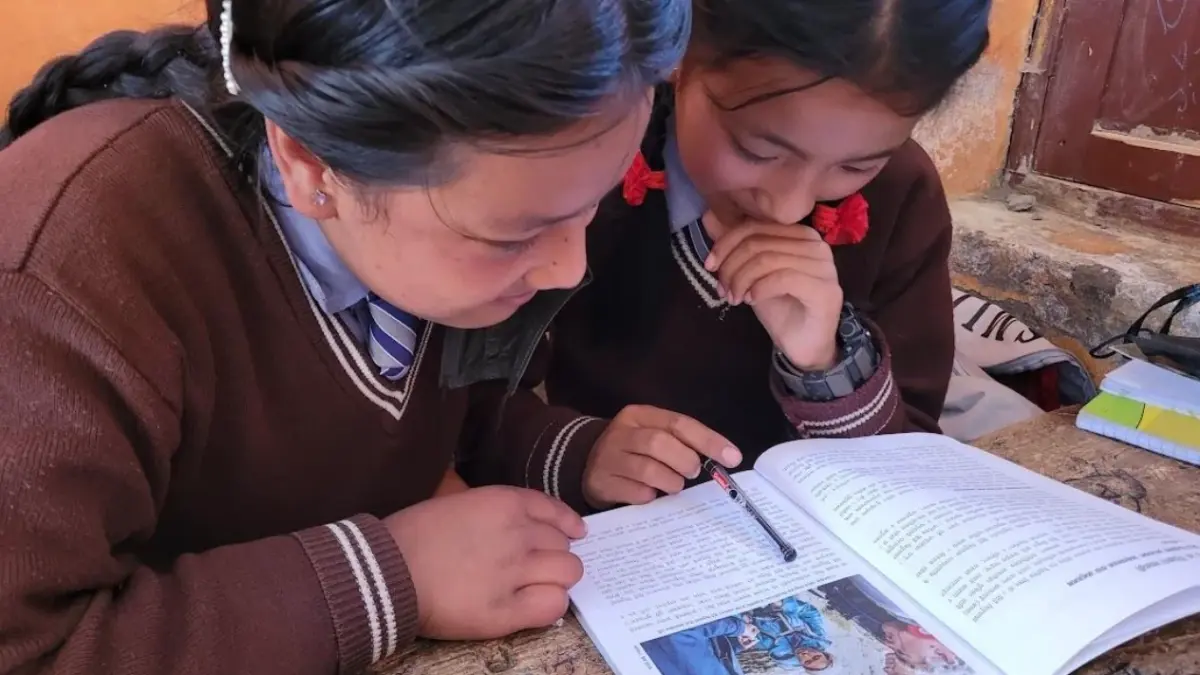
Photo by Anil Adhikari, Students of grade 6 at Janabahal Secondary School reading renowned wildlife biologist Dr. George Schaller’s story. Used with permission.
SS: Your work focuses on children and schools. Why is it important to engage young people early when it comes to building climate awareness and resilience?
AA: Engaging young people early is important because they are part of the community today and the future caretakers of biodiversity. When they understand the link between nature, climate, and their daily lives, they begin to value coexistence and responsible behavior.
In my conservation education books, I use stories, critical thinking exercises, group work, community–school collaborative activities, and games to teach climate awareness and resilience. This approach makes learning simple, practical, and easy to remember. For example, students practice rainwater harvesting during the monsoon season, which helps provide water during dry periods. Through their clubs, they also engage in plantation activities.
Students then share these ideas with their families. In this way, education spreads into the community and supports practical climate adaptation and resilience.
SS: You emphasize locally led education. How can communities and local governments play a stronger role in linking conservation efforts with climate adaptation?
AA: Locally led education becomes most effective when communities and local governments take ownership. In the Community based Snow Leopard Conservation Project (CBSLCP), we supported local governments in including snow leopard conservation in school curricula and textbooks. So far, two out of five local governments have adopted this content. This helps institutionalize conservation education, making it more sustainable and locally relevant.
When local governments integrate such topics into education, it creates a strong link between conservation and climate adaptation. Students learn not only about wildlife but also about changing environments and how to respond.
In a book I authored for the Department of National Parks and Wildlife Conservation (DNPWC) / World Wide Fund for Nature (WWF) Nepal, I included a best-practice story on climate change adaptation, highlighting how students in the Himalaya operated simple weather stations to record daily temperatures and observe changes. They shared this information with their communities, helping farmers adjust their harvesting practices. In another book I authored for WWF Nepal, which was published and distributed to students’ environmental clubs, I included activities on reducing, reusing, and recycling waste to support climate action.
This kind of locally rooted education connects knowledge with action, strengthens community awareness, and supports practical climate adaptation at the local level.
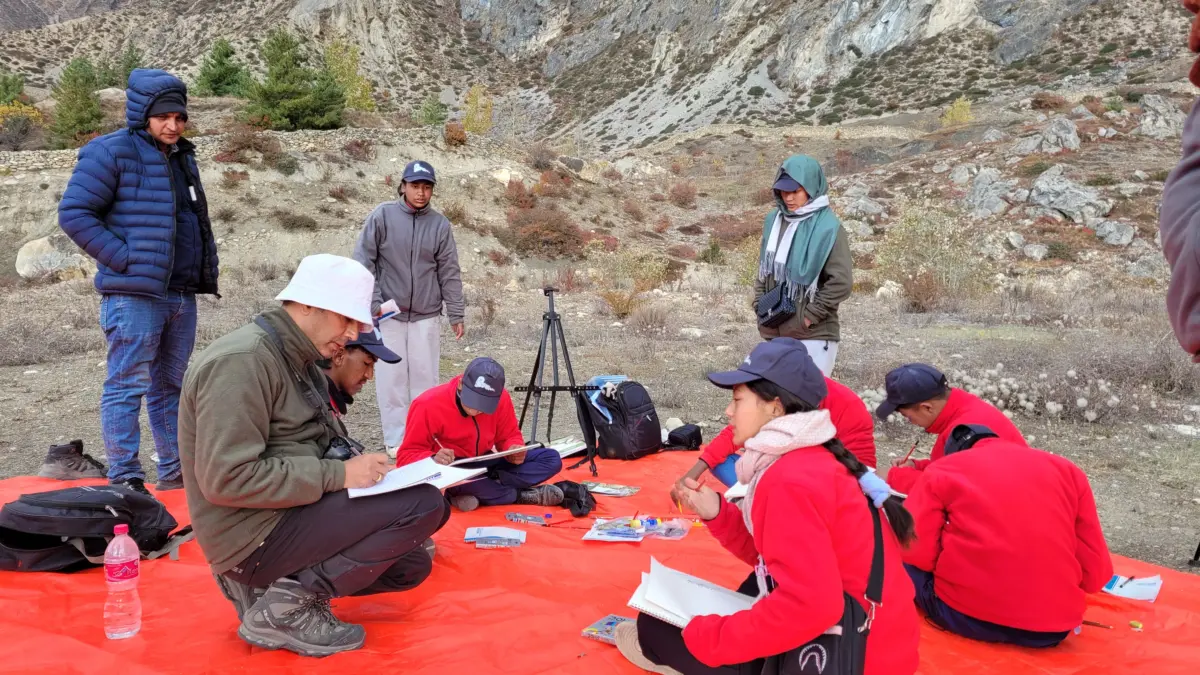
Anil interviews a student in Snow Leopard Scout’s Monitoring Camp in Annapurna Conservation Area (4,000 m), photo provided by Teka Samuha Nepal. Used with permission.
SS: Through your storytelling and school programs, how do you help students understand the connection between protecting wildlife and addressing broader environmental and climate challenges?
AA: Through storytelling and school programs, we help students understand that protecting wildlife is closely connected to environmental and climate health. In our conservation education books, we introduce simple ideas, such as planting trees to maintain ecosystems. Students learn that trees absorb carbon dioxide, while forest fires release gases that contribute to climate change.
In the CBSLCP project, we take students to snow leopard scouts’ monitoring camps and nature tours, where they observe habitats, prey species, and plantation efforts. With guidance from experts and field rangers, they learn how habitats have changed over time due to climate and human impacts.
In addition, students participate in conservation games and storytelling sessions, which make learning engaging and memorable. This combined approach helps them see the direct link between wildlife conservation, healthy ecosystems, and climate solutions, and encourages them to take action in their own communities.
SS: What are some practical changes you have seen in communities or schools that demonstrate how education can lead to real climate action?
AA: In my experience, education has led to very practical climate action in communities and schools. One example comes from a red panda conservation book used by thousands of students, which includes a real story about a red panda affected by a forest fire. In one village community, after reading this story, students became aware of the real impact of forest fires on wildlife and the climate. Schools later reported to me that, following this lesson, such practices were greatly reduced, and students themselves began discouraging forest fires in their communities.
Another example is rainwater harvesting. In response to increasing drought and water scarcity, a local school began collecting rainwater to support water supply during dry periods. This initiative has improved both awareness and practical adaptation to climate change.
SS: What challenges do you face in scaling this kind of locally rooted, climate-focused education across Nepal, especially in remote areas?
AA: The main challenge is ensuring that what students learn is shared and practiced within the wider community. Coordination with local governments and consistently scaling the program across different regions remains another major challenge.