



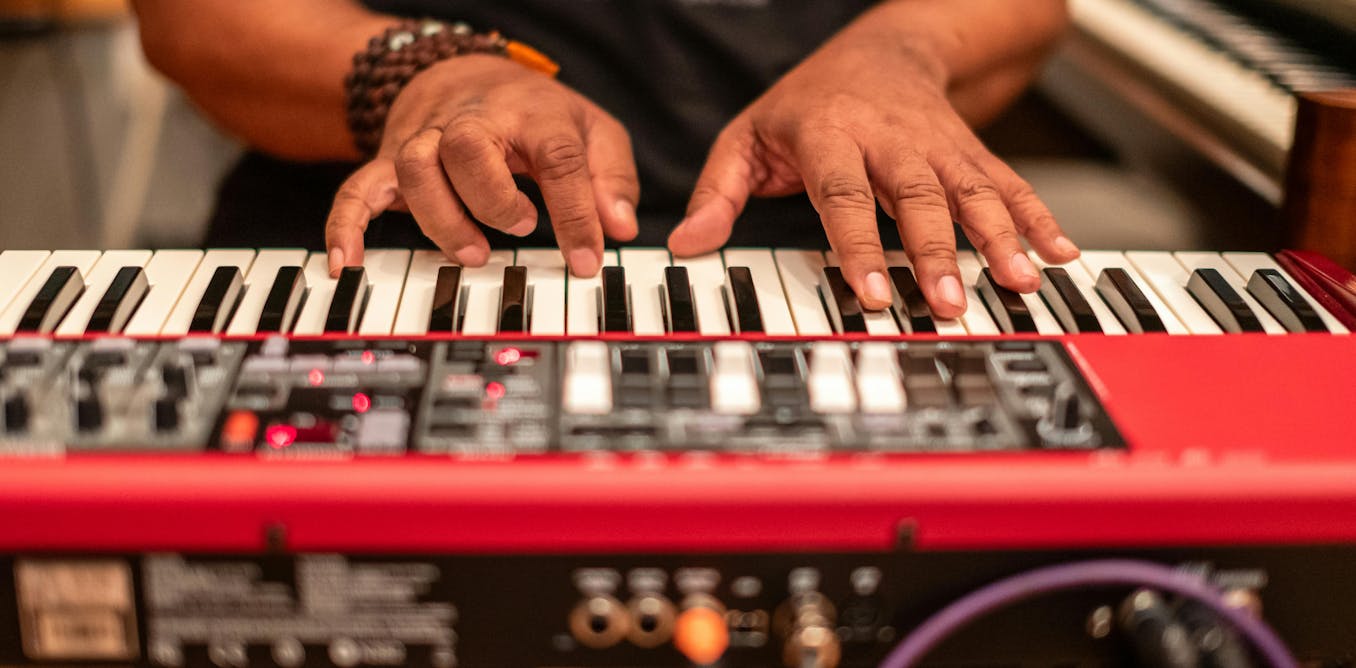
A musician sits on a stage in the middle of the crowd. In front of him is nothing but a keyboard. No laptop, no MIDI controller, none of the pricey drum machines usually tied to electronic music.
Yet, the moment his fingers strike up a rhythm, sub-bass frequencies slam through the speakers, and bodies on the floor begin to sway. The room erupts.
To the untrained eye, a performance powered by Southeast Sulawesi’s Alun Buutuni Sound System — a Southeast Sulawesi’s collective providing massive, custom-built speaker rigs for village celebrations — might look rudimentary. It is easily dismissed as a “budget” take on modern electronic music.
But what if Indonesia’s electronic music scene didn’t start in mega-clubs, but grew from arranger keyboards, homemade speakers and the vibrant pulse of village life — locally known as organ tunggal ( one-man band or a solo keyboard player)
Read more:
Negara mengakui eksistensi ‘sound horeg’: Upaya melindungi atau justru membatasi?
Electronic music has never been just about expensive technology
Throughout music history, some of the most revolutionary sounds have emerged from gear once written off as cheap or commercially unsuccessful.
Take the Roland TR-808 drum machine, an undisputed legend in electronic music. When it first hit the market, it was widely considered a commercial failure. A similar fate befell the Roland TB-303, the very machine that would later lay the foundation for acid house.
But after the market abandoned these machines, young underground musicians in Chicago and Detroit picked them up and forged an entirely new sonic language — one that gave birth to techno and house.
This history of techno and house serves as a reminder that musical innovation rarely springs from cutting-edge technology alone. More often than not, it is born when communities find inventive ways to use whatever gear is close at hand.
A similar phenomenon is unfolding right now in Indonesia’s jedag-jedug — a local sub-genre named after its heavy, pumping bass beats — and funkot scenes.
Rather than relying on complex electronic production setups, many performers treat the arranger keyboard as the absolute centrepiece of their live sets. With just a single instrument, they generate rhythm patterns, basslines, harmonies and transitional build-ups in real time.
In this subculture, the keyboard is far from a temporary placeholder used while saving up for “professional” gear. Instead, it has proven to be the ideal fit for the community’s social and economic realities. It is portable, relatively affordable, easy to repair and fully capable of delivering the raw musical intensity required for collective celebration.
From ‘organ tunggal’ roots to the village rave scene
Research on organ tunggal performances in West Sumatra has shown that the format took off because it met local entertainment needs in practical, highly flexible ways. A staple of weddings, parties and community gatherings across Indonesia, it is essentially a mobile, keyboard-driven party setup.
Armed with just keyboards and synthesizers, solo musicians could replicate roles that once required a full band, creating what scholars dub a “travellling orchestra”.
Today’s jedag-jedug scene operates under that exact same logic.
The difference lies in the sonic output. While the traditional organ tunggal circuit revolves around dangdut (a popular Indonesian folk-pop genre) and party sing-alongs, jedag-jedug pushes into much harsher sonic territory — cranking up the tempo, thickening the bass pressure and locking into a rhythm-driven intensity.
Music as collective experience
Criticism of jedag-jedug often hangs on the lazy assumption that repetitive music is inherently simplistic. Yet, electronic dance music scholarship suggests quite the opposite.
Repetition in club culture should not be dismissed as a sign of musical poverty. Through repetition, listeners experience music as a living process: anticipating subtle shifts, feeling the gradual accumulation of energy, and losing themselves in cyclical grooves.
From this perspective, jedag-jedug becomes compelling not through harmonic complexity, but through its ability to weaponise repetition into physical force. The longer a loop sustains, the more bodies synchronise with the beat.
In this sense, jedag-jedug shares a deep kinship with the history of rave culture. Both subcultures construct collective, sacred spaces using nothing but sound pressure, hypnotic rhythms and a shared, embodied experience.
Sound as a communal anchor
After nearly a decade researching ritual soundscapes in Central Kalimantan, I have found that local communities rarely view sound as an isolated aesthetic object.
In the death rituals of the Indigenous Dayak people along the Katingan River, for instance, the Gandang Ahung gong ensemble delivers far more than mere background accompaniment. Instead, sound acts as a vital conduit — binding people together, shaping the collective atmosphere and breathing life into a shared experience.
Read more:
Tradisi Gandang Ahung suku Dayak: Tak hanya musik tapi juga cara hidup
In my research on the Sasana Kayau oral tradition, ancestral singing performs a similar role. What is preserved is not merely a melody or a text, but the social bonds forged through the very act of singing together.
Read more:
Ritual Sasana Kayau Suku Dayak Kalimantan Tengah: Merawat ingatan melalui sastra lisan
Granted, jedag-jedug belongs to a world away. It is neither a funerary ritual nor an oral literary tradition. Yet an intriguing common thread remains: sound still functions as a catalyst for gathering.
On small stages, at village celebrations, street carnivals and local clubs, jedag-jedug carves out social spaces where people meet, dance and experience a sense of belonging larger than themselves.
Beyond mere Western imitation
Jedag-jedug reveals how global technologies are continually reinterpreted to serve local needs.
Arranger keyboards engineered by multinational giants like Yamaha take on entirely new meanings the moment they enter Indonesian village parties. Homemade sound systems become the driving force of local carnival culture, a reality epitomised by the sound horeg (massive, earth-shaking mobile audio rigs) phenomenon in East Java, massive, earth-shaking mobile audio rigs. TikTok then loops these hyper-local performances into a viral, interregional subculture.
Rather than dismissing jedag-jedug as a derivative clone of Western electronic music, it is far more productive to recognise it as an authentic form of vernacular musical modernity.
Identical technologies can yield radically different cultural practices when they collide with distinct social, economic, and historical realities.
In that light, jedag-jedug is best understood not as an “imperfect” imitation of techno or EDM, but as a masterclass in grassroots ingenuity.
Read more:
“Bayar, bayar, bayar”: Bagaimana musik dapat membentuk identitas sosial dan mendorong aksi kolektif