



SINGAPORE: Singapore motorists may soon have to stop looking for ERP gantries and start looking out for blue road markings instead.
The Land Transport Authority (LTA) has begun testing key features of its upcoming ERP 2.0 location-based charging system, which will replace the current gantry-based setup, from January 1, 2027.
About 1,000 motorists are taking part in the pilot, including a Channel NewsAsia (CNA) journalist, Justin Ong, who is also a Singaporean, to test-drive the new system on the road. According to CNA, the trial test is to gather feedback before the nationwide rollout.
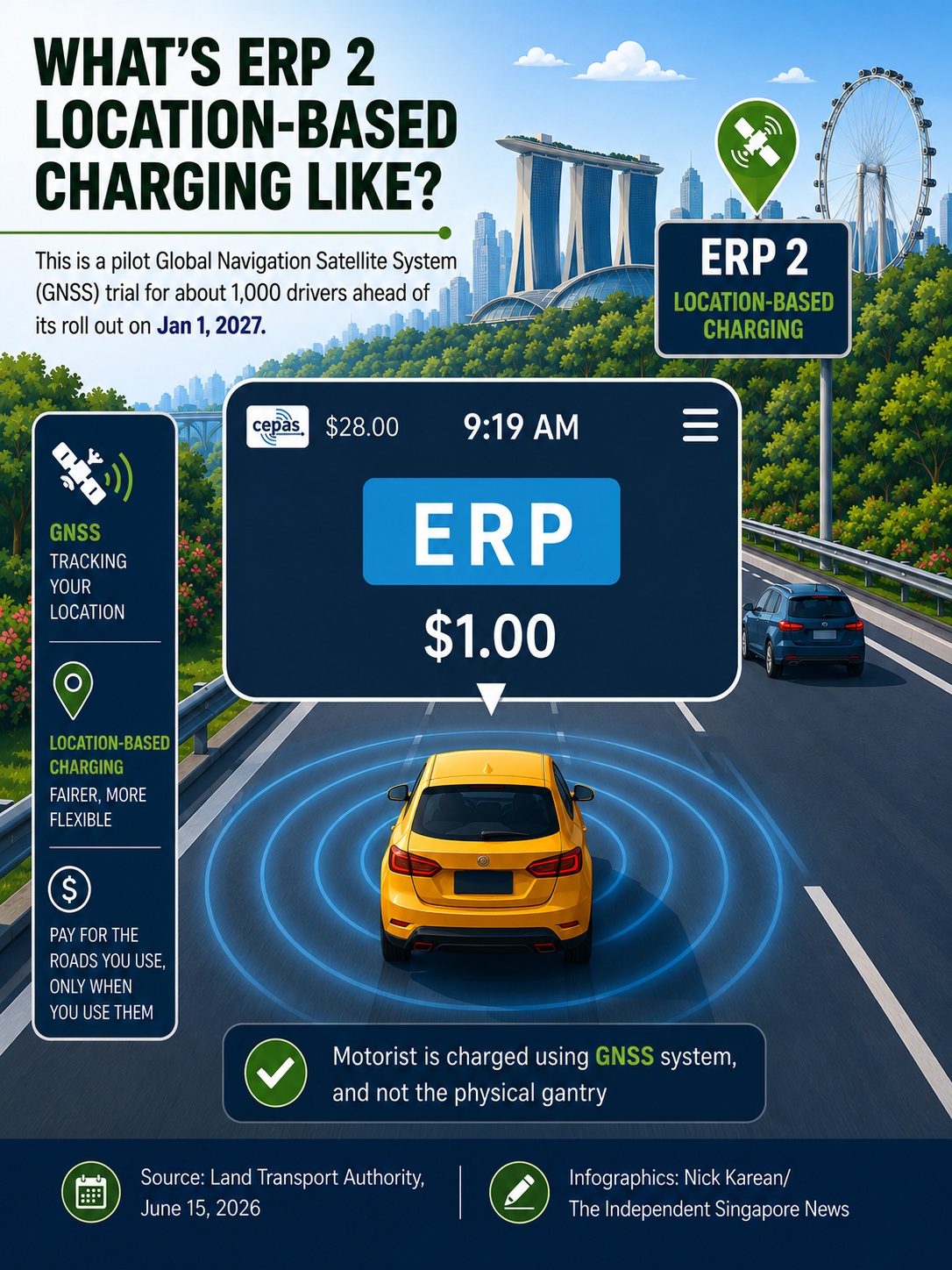
The upgrade marks one of the biggest changes to Singapore’s road pricing system since ERP was introduced in 1998. Instead of gantries triggering charges, satellite technology will determine when a vehicle enters a designated charging zone.
New blue painted markings on the road replace old standing gantries
Under the pilot, motorists receive an alert notification on their on-board unit (OBU) before entering a charging area. Once the vehicle crosses a marked ERP zone, the charge is deducted automatically.
CNA reported that blue road markings appeared to be the clearest visual cue. At one Central Expressway (CTE) location, a 25-metre section of road painted blue was highly visible and easy to identify.
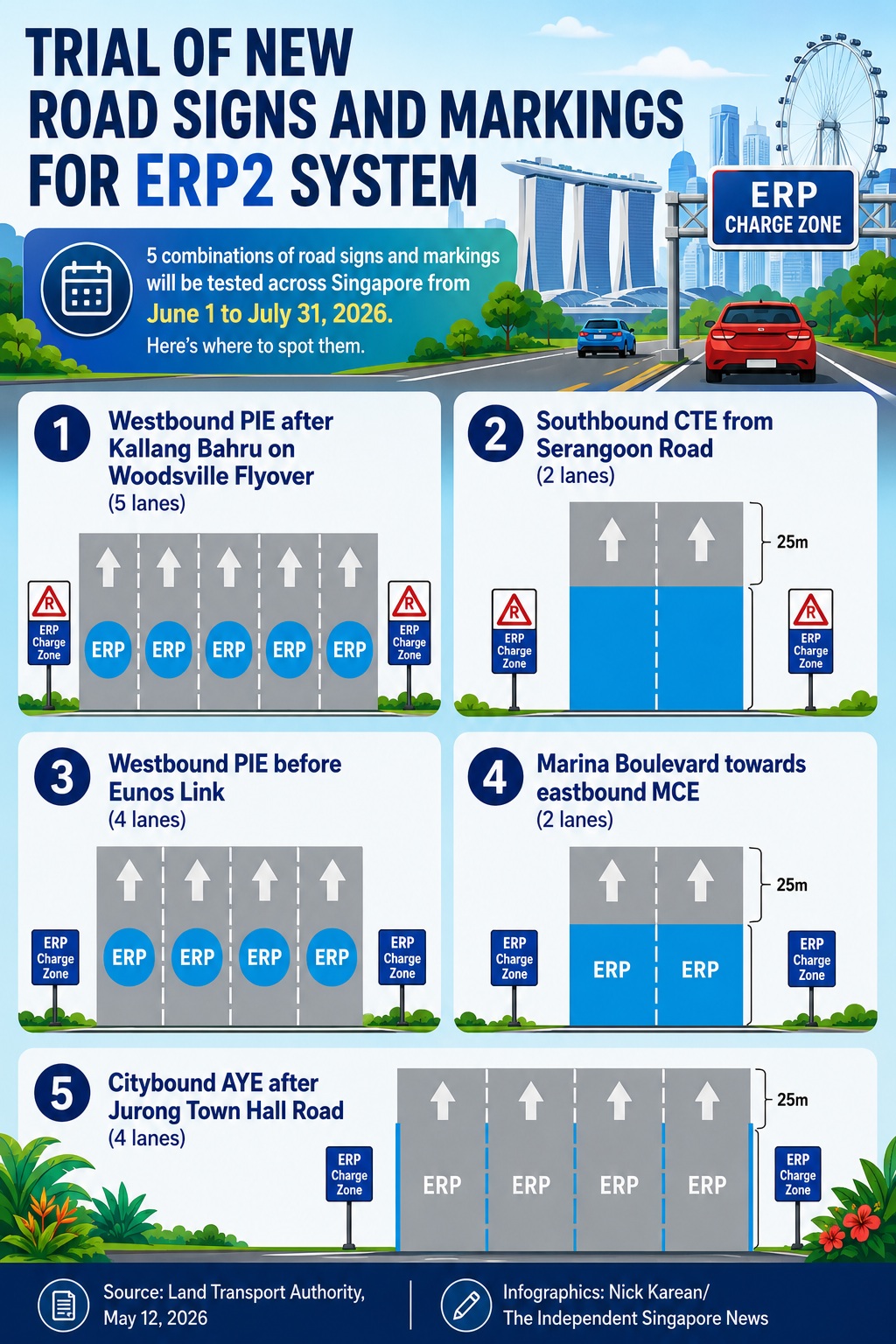
Roadside signs, however, were less effective at the moment, as some blended into various existing highway signage, while others were partly obscured. This contrast highlights a challenge for LTA.
ERP gantries are hard to miss because they stretch across the road. Replacing them with smaller roadside signs may mean vehicle drivers need clearer visual indicators to recognise charging zones faster before they arrive.
An alert notification appears for drivers to avoid the ERP-charged route
One of ERP 2.0’s new features is an advanced alert notification that allows drivers to avoid an ERP-charged route. The alert notification is designed to appear before the last available exit, giving motorists the option of taking another route.
In the CNA test, the feature worked well on smaller roads for now. An alert notice on Clementi Avenue 2 gave Justin, the driver, enough time to avoid an ERP-charged route.
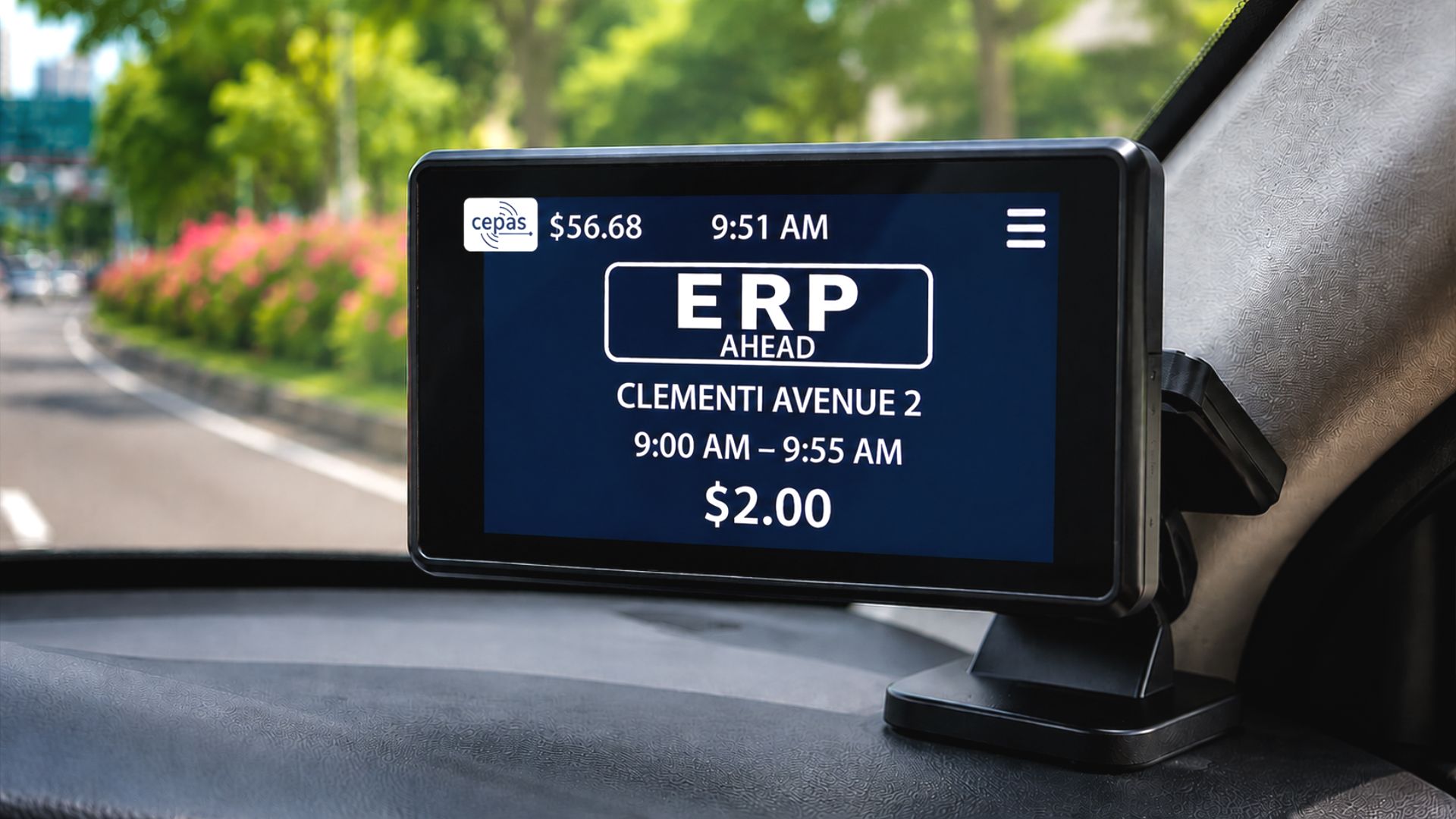
Nick Karean/AI-Generated for illustration purposes only
An ERP 2.0 onboard unit displays a road pricing alert ahead on a Singapore roadway
The experience was less comfortable on an expressway. Approaching an ERP location on the Ayer Rajah Expressway (AYE), the alert notice appeared about 200 metres before the final exit. Justin managed to change lanes in time, but it wouldn’t have been so safe if there had been traffic congestion.
That raises a practical question for future users. During peak-hour traffic, drivers in congested lanes may have less room to react safely. So while the feature offers greater transparency, some motorists may hope future refinements provide a little more early notice.
Satellite-based system charging passes the accuracy test
A common concern about satellite-based charging is whether motorists could be charged by mistake when travelling near an ERP zone. CNA tested this by driving on a parallel road near a charging area at Clementi Avenue 2.
The result was reassuring. The vehicle passed the ERP zone several times from an adjacent road and wasn’t charged on any occasion.
The outcome suggests the system can accurately distinguish between vehicles inside and outside designated charging areas. For drivers worried about accidental deductions, that precision could be one of ERP 2.0’s most important selling points.
A new roadside electronic parking (REP) system is also coming soon
These new systems are also set to simplify other transport-related payments. Checkpoint tolls at Woodlands and Tuas will become fully contactless.
Instead of inserting a card at immigration booths, motorists will receive an alert message through their OBU and have toll charges deducted automatically.
Another feature arriving later this year is a new roadside electronic parking (REP) system. From August, trial participants will be able to start parking sessions directly through their OBU.
This new system can also detect when a vehicle leaves a parking space and automatically end the session, removing the need to manually stop parking through an app.
A future glimpse of Singapore’s next road pricing era
As of May 31, over 960,000 vehicles, or 96 per cent of Singapore’s vehicle population, had already installed the ERP 2 on-board unit.
The high adoption rate suggests most motorists are preparing for the transition. The real-life test, however, will be how naturally drivers adapt to a road network without the giant gantries that have shaped Singapore’s roads for decades.
For now, the pilot shows the system largely works as intended. The remaining task is ensuring drivers can clearly spot charging zones and receive sufficient warning to make safe decisions on the road.
Read related: Motorists to trial roadside electronic parking payment via ERP 2 OBU from August
Read more: ERP rates in Singapore to increase by S$1 at AYE & PIE from June 29 to manage congestion; up to S$5 at certain timing