



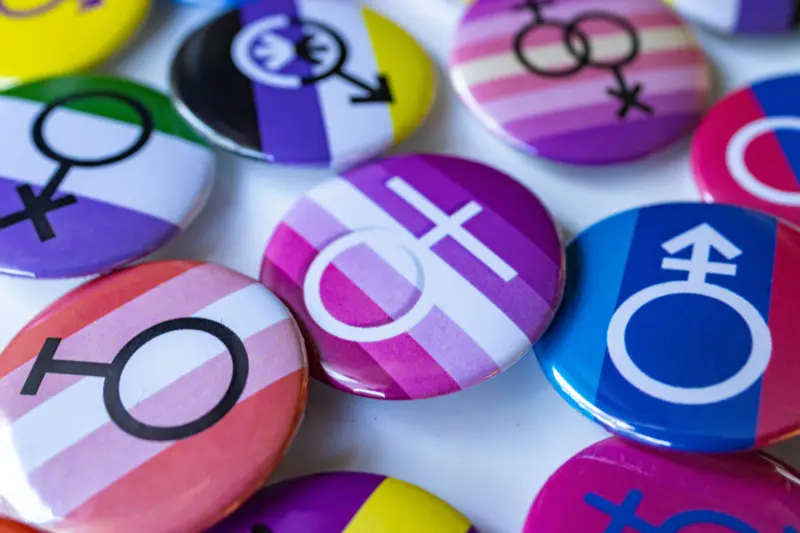
Pins displaying LGBTQ+ symbols and flags. Photo by Marek Studzinski on Unsplash: License.
This article was produced by the NGO Center E8 from Serbia through the Digital Spark granting scheme, as part of the Regional Support Mechanism EECA project, implemented by Metamorphosis Foundation and TechSoup, in partnership with CIVICUS and under the Digital Democracy Initiative (DDI) that covers the Global South. It is being published on Global Voices as part of a content-sharing agreement.
For many queer people, social media is both a space of connection and a source of risk. A single photo, comment, tag, or shared screenshot can reveal someone’s sexual orientation or gender identity without their consent.
Through the project Unmuted: Digital Voices for Democracy, Center E8 decided to explore a question that is rarely discussed in public: How does the fear of being outed influence how queer people behave online? The project will be conducted with the assistance of online media Zoomer and UNMUTED.
Looking at what remains invisible
Digital platforms are sometimes presented as spaces of freedom, self-expression, and community building. For queer people, they can indeed provide opportunities to connect with others, find support, and access information that may not be available in their local communities.
At the same time, digital spaces can create new vulnerabilities. Being outed online without consent can have serious consequences, especially in countries like Serbia, where discrimination and stigma remain. This issue is particularly evident in small towns and rural communities, where queer people develop communication strategies that allow them to connect without disclosing their identities.
But sometimes, regardless of how careful they are, they are outed anyway. A private message can be shared. A dating profile can be exposed. A photograph can reach unintended audiences. A social media interaction can reveal more than a person intended to disclose. Particularly concerning is the growing trend of sharing intimate photographs obtained through dating applications in Telegram groups or on the social media platform X.
While public discussions often focus on online hate speech and harassment, much less attention is given to the everyday decisions queer people make in order to protect themselves from being outed and harassed. Yet these decisions shape how people communicate, build relationships, and participate in online communities.
This is the issue Center E8 seeks to address through our project Unmuted: Digital Voices for Democracy.
From assumptions to evidence
Rather than relying on assumptions, we wanted to create an opportunity for queer people to describe their experiences themselves.
We already have some information available. A well-known case in Serbia involved a student from a smaller town who is part of the student movement opposing the Serbian government, being outed without his consent in pro-government tabloids using information obtained from his private profile on a dating app. The independent news outlets Zoomer and UNMUTED have already conducted extensive research within the gay community, which showed that more than 90 percent of gay men using dating applications had encountered fake profiles. The research also found that some of these encounters resulted in serious consequences, ranging from threats and extortion — both financial and sexual in nature — to physical assaults and violent attacks. The most commonly cited mechanism of coercion for all of them, however, was the fear of being forcibly outed.
The central activity of our project is the development of a large-scale survey focused on digital behavior, privacy, and experiences related to outing. The questionnaire is designed to examine whether queer people change how they use social media and digital platforms because of concerns about unwanted disclosure.
Some of the questions we explore include:
- Do people avoid posting certain content online?
- Do they use private or anonymous accounts?
- Do they separate different groups of followers?
- Do they limit interactions with partners, friends, or queer communities online?
- Which digital platforms are perceived as safe, and which are considered risky?
By collecting these experiences systematically, we hope to better understand how concerns about outing influence digital participation and expression.
Creating space for community voices
The survey is only one part of the project. The collected data will serve as the basis for a series of analytical articles that will examine the findings in greater depth.
Our goal is not only to generate statistics but also to create a space for queer voices to be heard. Discussions about online safety often overlook the specific experiences of queer communities. By focusing on outing and self-censorship, we want to highlight challenges that frequently remain invisible despite affecting everyday life.
Importantly, the project approaches queer people not merely as subjects of research but as participants whose experiences and perspectives are essential for understanding the issue.
Why this topic matters
The fear of outing is not visible. It does not appear in police reports, media headlines, or public debates. Instead, it often manifests through small decisions: choosing not to post a photo, avoiding a comment, declining to join a group, or maintaining multiple online identities. And it manifests in more serious and consequential situations, in which individuals consent to something under coercion, out of fear that their sexual orientation will be made public.
Understanding these experiences is important not only for queer communities but also for anyone interested in digital democracy. Meaningful participation online requires more than access to technology. It also requires the ability to communicate, connect, and express oneself without fear.
Looking ahead
The project is currently focused on collecting and analyzing community experiences through a survey process. We expect that the findings will provide valuable insights into how digital environments affect LGBTQ+ participation and visibility in Serbia.
Beyond the publication of analytical articles, we hope the project will contribute to a broader discussion about privacy, digital safety, and the right to control one’s own identity online.
For Center E8, the most important lesson so far has been the recognition that some of the most significant barriers to participation are not always visible. By listening to community experiences and documenting them carefully, we hope to make those barriers easier to understand — and ultimately harder to ignore.