



Families are still grieving, and many Australians remain saddened and shocked, after the killing of four women and girls in four days earlier this month. And according to Australian Femicide Watch, 37 women have been killed this year.
Many of us have been asking: what more do we need to do to stop men’s violence against women?
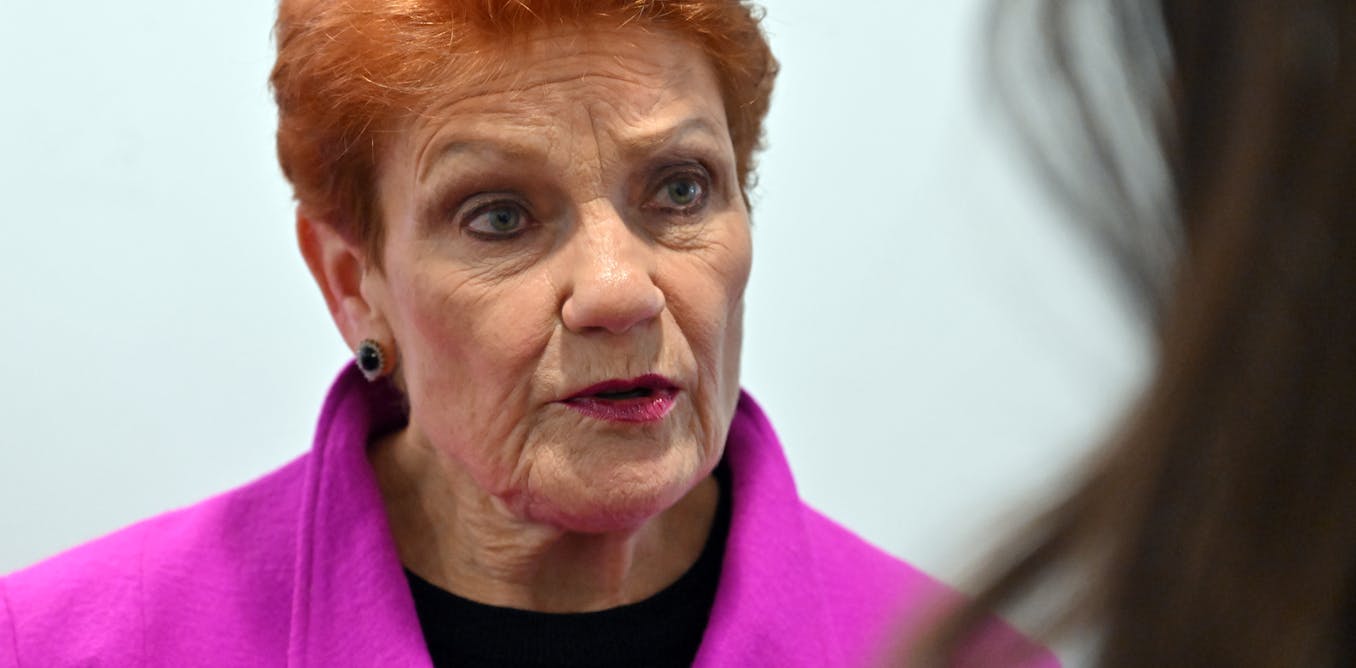
There are many evidence-backed answers to this important question. But calling this violence a “two-way street” and misplacing the responsibility for violence back onto victims, as One Nation leader Pauline Hanson did this week, is not one of them.
Words are powerful. And the words of our leaders can be especially powerful due to both their authority and their reach.
While Hanson did describe domestic violence as “wrong”, her comments made excuses for it, such as people being under pressure financially, and that women “can lose their cool” too.
For victim-survivors of men’s violence, and especially for the families of loved ones who have not survived, these words are not just deeply hurtful. They are dangerous.
Far too many victim-survivors of men’s violence already feel afraid, humiliated, shamed and isolated. Misinformation about domestic and family violence makes this worse. And rather than supporting women and children to access help, such misinformation can actually prevent them from telling others.
Here are some of the facts.
Violence is gendered
Let’s be clear on this. All violence is wrong, and we should take multiple courses of action to address violence in all its forms.
At the same time, while both men and women are similarly likely to experience any violence in their lifetime, the patterns of these experiences differ hugely.
According to our national Personal Safety Survey, one in four women have experienced violence by an intimate partner or family member since the age of 15, compared with one in eight men.
One in five women have experienced sexual violence since the age of 15, compared with one in 16 men.
And one in five women have experienced stalking since the age of 15, compared with one in 15 men.
The overwhelming majority of this violence is perpetrated by men. We cannot ignore the gendered patterns.
Read more:
New data shows 1 in 3 women have experienced physical violence and sexual violence remains stubbornly persistent
Leaving violence does not always end it
The research has long shown us that planning to leave, and leaving, are among the most dangerous times for women and children.
As anti-violence advocate and lawyer Tarang Chawla, whose sister Nikita Chawla was murdered when she tried to leave a violent relationship, put it: “It is not as simple as ‘don’t put up with it’.”
Not only can leaving be associated with an escalated risk of physical and lethal violence, but often post-separation abuse by former intimate partners continues, with detrimental impacts on women’s and children’s mental health, economic security, and long-term recovery.
And for many victim-survivors, coercive control, including financial abuse, stalking and social isolation, can leave them with little freedom or material resources to leave safely.
This is one reason why both specialist domestic and family violence services, and interventions with perpetrators, are equally important.
These services can support victim-survivors with safety plans and resources. But unless we also take actions to intervene in the perpetrators’ use of violence, we aren’t addressing the cause of the risk.
For some victims, there is nowhere safe to go
There is no doubt Australia does have a cost-of-living crisis, and at its centre is also an affordable housing crisis. I have seen this crisis firsthand while working in a family violence refuge accommodation.
The stark reality is for many victim-survivors, there is nowhere safe and affordable for them to go. Domestic violence is the leading cause of homelessness for Australian women and children.
This is also far from an individual problem. It’s a clear government responsibility to invest in a housing safety net, and address the broader housing affordability crisis.
We are making progress, but we need to do more
The above facts about domestic, family and sexual violence are among the reasons all Australian governments have endorsed a shared National Plan to End Violence Against Women and Children. Crucially, the plan includes actions across the whole spectrum of prevention, early intervention, crisis response and recovery.
The promising news is Australia’s efforts do appear to be making some progress in reducing the 12-month prevalence rates of intimate partner violence, stalking and sexual harassment.
However, our Personal Safety Survey also indicates the 12-month rates of sexual violence have not been reducing.
And though intimate partner homicides have also been reducing over the longer term (as shown by the National Homicide Monitoring Program), every life lost to violence is a preventable tragedy.
Further, there are real concerns the numbers of women and girls killed by men’s violence have increased in more recent years.
Read more:
I’m a sexual assault counsellor. Here’s why it’s so hard for survivors to come forward, and what happens when they do
We all have a role to play
At times such as these, it can feel disheartening that women and children’s lives continue to be lost to men’s violence. And that there are some views in our community that misrepresent both the problem and its solutions.
But we all have a role to play in ending violence against women.
Speaking out to correct myths and misinformation is one action we can take. This means refusing to engage in victim-blaming or making excuses for perpetrator behaviour.
We can also be ready to respond effectively to disclosures of violence, and to connect people with specialist services.
Everyone can show what safety, respect and equality looks like in our own families, workplaces and other settings.
And we can support our governments and communities to make the big changes that are needed to stop violence against women in the first place, rather than leaving that responsibility on victims alone.
If this article has raised issues for you, or if you’re concerned about someone you know, call 1800RESPECT on 1800 737 732. If you’re in immediate danger, call 000. For support for men concerned about their own behaviour or experiences of violence, call Men’s Line on 1300 78 99 78.