



This post is part of Global Voices’ May 2026 Spotlight series, “Global crisis, local solutions.” This series will offer stories of resistance and successful climate action, insight into how communities in the Global South are fighting back against the crisis, analysis of what this might mean for future generations, and more. You can support this coverage by donating here.
Just months before the 31st United Nations Climate Change Conference (COP31), in Antalya, Turkey, in November 2026, governments, financial institutions, and international organizations are at a vital stage in their preparations. Now is the best time to determine the most important issues, as there will be significantly less room for maneuver once the conference begins. The question is, what strategy, priorities, and negotiating power will Africa bring to the table at COP31?
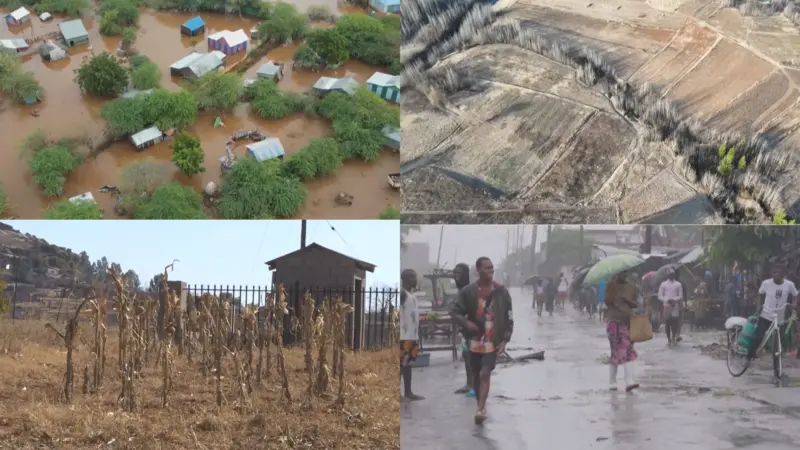
In Northern Togo, farmers no longer speak of seasons, but surprises. Rain appears unexpectedly and disappears when the seeds are planted. Harvests are failing, and families are migrating. According to the National Meteorological Agency of Togo (ANAMET), 2024 was marred by severe droughts, resulting in significant crop losses and leaving some farmers unable to repay their loans.
However, Togo isn’t alone. According to the World Meteorological Organization’s State of the Climate in Africa 2024 report, floods and landslides killed hundreds of people and displaced more than 700,000 others in Kenya, Tanzania, and Burundi between March and May 2024. Based on a global disaster database (EM-DAT), an analysis by the Indian magazine Down To Earth found that 2021–2025 was the deadliest period in Africa in 15 years. Extreme weather events affected more than 221 million people, and disaster-related deaths more than tripled compared to the previous reporting period.
Meanwhile, thousands of miles away, diplomats are negotiating legislation that will take years to have an impact on these dried-out lands. Africa must make every effort to bridge the gap between this crisis on the ground and the slow-paced negotiations when COP31 begins. Although this is the continent that emits the least greenhouse gases globally, it continues to experience the most severe consequences. With a unified voice and a finely tuned strategy, this fundamental injustice must yield precise demands.
A conference under high geopolitical tension
This conference will take place under unique circumstances. In January 2026, the United States, the world’s second-largest emitter, officially withdrew its signature from the 2015 Paris Agreement and announced its withdrawal from the United Nations Framework Convention on Climate Change (UNFCCC), weakening the multilateral climate architecture. Yet, the last three years have been the warmest ever recorded, with current projections suggesting a 2.8 degree Celcius warming by 2100, almost double the Paris Objective.
These circumstances leave millions more people vulnerable to food insecurity, rising sea levels, vector-borne diseases, and forced displacement. While Turkey will host the conference itself, Australia will act as the President of Negotiations, an unprecedented diplomatic arrangement in COP history. For Africa, this unique architecture provides an opportunity. Australia, committed to issues affecting small island states and vulnerable countries, could be an obvious ally if this continent can build opportune alliances.
Four battles Africa must fight in Antalya
Africa is facing four primary challenges. Turning the New Collective Quantified Goal on Climate Finance (NCQG), adopted by leaders in November 2024, into tangible financing is its first battle. This agreement requires an annual mobilization of at least USD 1.3 billion for developing countries by 2035, with a minimum of USD 300 billion from developed countries annually. In theory, this is a step forward, but in reality, recent history prompts caution.
The previous objective of USD 100 billion per year, pledged in Copenhagen in 2009 for 2020, was achieved only in 2022, two years after the deadline, and consisted mostly of loan arrangements. However, African countries estimated their climate needs at USD 2.8 trillion for 2020–2030, with the international community covering a USD 2.5 trillion deficit, leaving a vast gap between these pledges and real-world needs.
In Antalya, Africa must demand three specific things: the NCQG’s implementation by the set deadline, a significant increase in the share of grants over loans, and the introduction of transparent and independent monitoring mechanisms.
Making adaptation a budgetary priority is its second battle. Obtaining more financing will be insufficient if it continues to go where Africa needs it least. Climate financing has historically prioritized mitigation over adaptation. For seven years, 59 percent of the financing approved by the Green Climate Fund (GCF) in Africa has gone towards mitigation projects, compared to only 41 percent for adaptation. As Africa, a low emitter, needs to adapt to the effects of climate change that it didn’t cause as a matter of priority, this disparity is all the more paradoxical.
At COP31, the Global Goal on Adaptation should get underway. This means that merely saying adaptation is a priority will no longer suffice. It will be necessary to carefully evaluate the aid people actually receive and address any disparities. Africa must insist that at least 50 percent of climate financing be allocated to adaptation, in line with commitments under the Paris Agreement. Otherwise, Northern Togo’s farmers will continue to wait for rain that never comes, while climate financing funds renewable energy projects in wealthier countries.
Aligning the Third Generation of Nationally Determined Contributions (NDC 3.0) with conditional financing is the third battle. Financing is ultimately fundamental to these national commitments. The new generation of Nationally Determined Contributions, submitted in 2025 for the period up to 2035, will be the focus of discussion in Antalya. They are part of the third revision cycle set out in the Paris Agreement, which requires each country to raise its climate ambitions in successive cycles.
This time, the stakes are particularly high. The COP28 Global Stocktake revealed that current commitments are insufficient to keep warming below 1.5 degrees Celcius. Each country must therefore submit revised action plans that are more ambitious and effective. For African countries, this assignment is politically and technically difficult. Presenting high ambitions without guaranteed financing to make them possible means making commitments whose fulfillment depends entirely on the will of others.
Take, for example, Togo. Its revised NDC pledges a 50.57 percent reduction in emissions by 2030, but only with international support. Without external financing, this commitment falls to 20.51 percent. This isn’t due to a lack of political will, but a structural economic reality that almost all African countries face. Demanding ambitious NDCs without guaranteed conditional financing to make them possible is like asking someone to run a marathon without shoes.
In Antalya, Africa must ensure that the final decisions include an explicit and binding link between the NDCs’ level of ambition and the guaranteed corresponding conditional financing. Ambition cannot be one-sided.
Having a bearing on global climate governance is Africa’s fourth battle. The last three battles can only be won if Africa plays an effective part in the decision-making. However, 2026 is a pivotal year for this continent in global climate architecture. In 2027, COP32 will take place in Ethiopia, giving the continent a COP Presidency it must prepare for now. Now is the time to build alliances, refine common positions, and show that Africa can negotiate, not just observe.
Various initiatives are already underway, demonstrating an increased awareness. In Dakar, from February 9 to 13, 2026, the African Institute for Economic Development and Planning (IDEP) and the Center of Excellence for Leadership and Management for Africa’s Development (CELMAD) have trained diplomats and senior government officials from 14 African countries in economic and climate diplomacy, specifically for COP31. Karima Bounemra Ben Soltane, Director of IDEP, emphasized:
L’Afrique fait face à un paradoxe : des émissions minimales, un impact maximal. Cette formation est un investissement dans les diplomates qui transformeront notre vulnérabilité en plaidoyer.
Africa is facing a paradox: the lowest emissions, yet the greatest impact. This training is an investment in diplomats who will turn our vulnerabilities into advocacy.
At this event, every decision or compromise will directly affect millions of people without representatives at the negotiating table.
Although Africa neither lacks legitimacy, arguments, nor data to defend an ambitious agenda at COP31, what it sometimes lacks is coordination. In Antalya, as elsewhere, Africa can no longer go empty-handed.