



Prime Minister Mark Carney unveiled Canada’s AI for All strategy on June 4, committing over $2 billion in new spending and targeting $200 billion in additional GDP growth and 250,000 new jobs by 2031.
The plan is organized around several pillars: sovereign AI infrastructure, skills and talent, business and public-sector adoption, support for small and medium-sized businesses (SMEs), and commitments around responsible AI, trust and cybersecurity. Canada currently lags behind most G7 peers in AI uptake; this strategy plans to change that.
But the strategy’s growth targets are much clearer than its accountability measures. Canada now has numerical goals for adoption, jobs and GDP growth, but fewer concrete commitments for measuring displacement, auditing workplace AI, protecting affected workers, governing data or reporting the environmental footprint of the infrastructure needed to power it.
What the strategy says about workers
Labour organizations criticized the strategy for prioritizing business interests over workers. There is good reason for the concern. In a survey of 306 executives, 59 per cent said AI agents are already changing how they hire entry-level workers, and 63 per cent said the same for experienced hires.
Junior roles are a particular concern. The strategy promises AI literacy and work placements for young Canadians, but the deeper problem is whether enough entry-level jobs will remain when they arrive.

THE CANADIAN PRESS/Graham Hughes
The strategy states that AI will “augment human expertise rather than displace it” and commits to literacy training, employer-led upskilling and up to 90,000 work placements for young Canadians. Those commitments alone will not guarantee equitable outcomes.
AI may ultimately create more jobs than it displaces as productivity rises and new roles emerge. But those jobs will not necessarily appear at the same pace, or in the same places, as the ones being changed or lost. The strategy does not fully grapple with that gap.
When asked why the strategy included no modelling of potential job losses, AI Minister Evan Solomon said such forecasts were too difficult to predict. He did, however, acknowledge that “there won’t be no job loss” from AI.
Without displacement modelling, it is difficult to determine which workers, regions and roles are most at risk. The strategy does promise to monitor outcomes through Statistics Canada, but monitoring after the fact is not the same as proactive planning.
Tracking AI-related layoffs will also be complicated. AI can become an umbrella label for broader cost-cutting or restructuring that would have happened anyway.
The digital divide
The strategy also underestimates Canada’s digital divide. Many communities still face major connectivity gaps, and the cost of devices and internet access remains a significant barrier. One-quarter of low-income households relied solely on a mobile device to get online during the pandemic, and that gap has not closed.
The strategy pledges to provide all Canadians with access to free AI literacy training, but those programs may not reach everyone who needs them.
The gender dimension is particularly acute. According to a recent report, 71 per cent of women workers in Québec hold jobs with high AI exposure, compared to 49 per cent of men.
Women are also using AI at lower rates, but simply encouraging uptake is not a straightforward solution. A recent study found that engineers believed to have used AI were rated nine per cent less competent despite producing identical work. Women faced a 13 per cent penalty, compared with six per cent for men, and greater doubts about their fundamental abilities.
The AI strategy acknowledges women’s exposure to disruption, but treats the issue largely as one of adoption and upskilling. It says much less about the workplace penalties, bias, surveillance, evaluation practices and informal norms that may shape who can safely use AI.
Read more:
To really narrow digital divides, Canada should consistently fund adult education programs
Equity framed as participation
The strategy’s broader approach to equity has a structural problem. While it acknowledges the disproportionate harms affecting equity-seeking groups and promises support for Indigenous-led AI initiatives, it often frames equity as a question of participation rather than protection.
On Indigenous Peoples, the strategy uses language around agency and self-determination but stops short of defining enforceable rights over data, languages, cultural knowledge, consent, benefit-sharing and community decision-making.
Participation without binding protections leaves communities dependent on the goodwill of implementers rather than rights they can assert.
The strategy also does not fully address bias in AI-powered hiring systems — one of the most widespread AI uses, and one that research suggests can penalize women and racialized job-seekers.
One study found AI resume-screening tools favoured white-associated names in 85 per cent of cases and men-associated names in 52 per cent, compared with nine per cent for Black-associated names and 11 per cent for women-associated names.
The strategy recognizes that AI can affect consequential decisions such as hiring, but it does not establish a clear private-sector framework requiring notice, independent audits, explanations, appeal rights or recourse for workers who are harmed.
Lack of environmental accountability
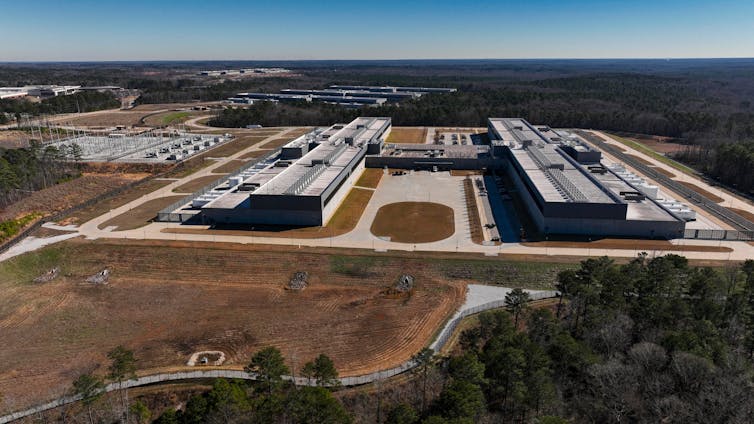
The strategy proposes 850 megawatts of domestic computing capacity by 2030 and projects that Canada will require 5.5 gigawatts worth of compute power in commercial data centres over the next four years.
It points to a specific Canadian advantage: more than 83 per cent of Canada’s electricity grid comes from renewable and low-emission sources, and data centres running on such power can reduce operating emissions by up to 90 per cent. But the strategy provides little detail on how water and land use and other environmental costs will be measured or managed.
(AP Photo/Mike Stewart)
The gap in the strategy’s development process is telling. Canada’s National Observer reported that Environment and Climate Change Canada was not invited to a key strategy planning meeting attended by other departments. National Observer also reported earlier this year that Solomon met with energy and mining companies about AI environmental impacts, but not environmental organizations.
A report released by the United Nations University Institute for Water, Environment and Health found that by 2030, AI-related water consumption could equal the annual needs of 1.3 billion people. Three-quarters of data centres planned in Alberta are in regions under high or extremely high water stress.
For affected communities, data centres can mean noise, heat, pressure on local water supplies and strain on electricity grids. Without clear measurement requirements, those costs will be harder to see and easier to shift onto communities with limited power to contest them.
What ‘AI for All’ will actually require
Delivering on the strategy’s “AI for All” promise will require governments to build the supports that workers, SMEs and underserved communities need: transition planning, worker protections and accountability for equity and environmental commitments.
Done well, Canada’s approach could position the country as a trusted alternative in a global AI landscape increasingly dominated by China and the United States: sovereign, rights-respecting and genuinely inclusive.
Today, AI is the least powerful it will ever be in our lifetime. The opportunity is real, but so are the risks. Canada’s national strategy must remain agile, treating AI’s risks as seriously as its promise.