



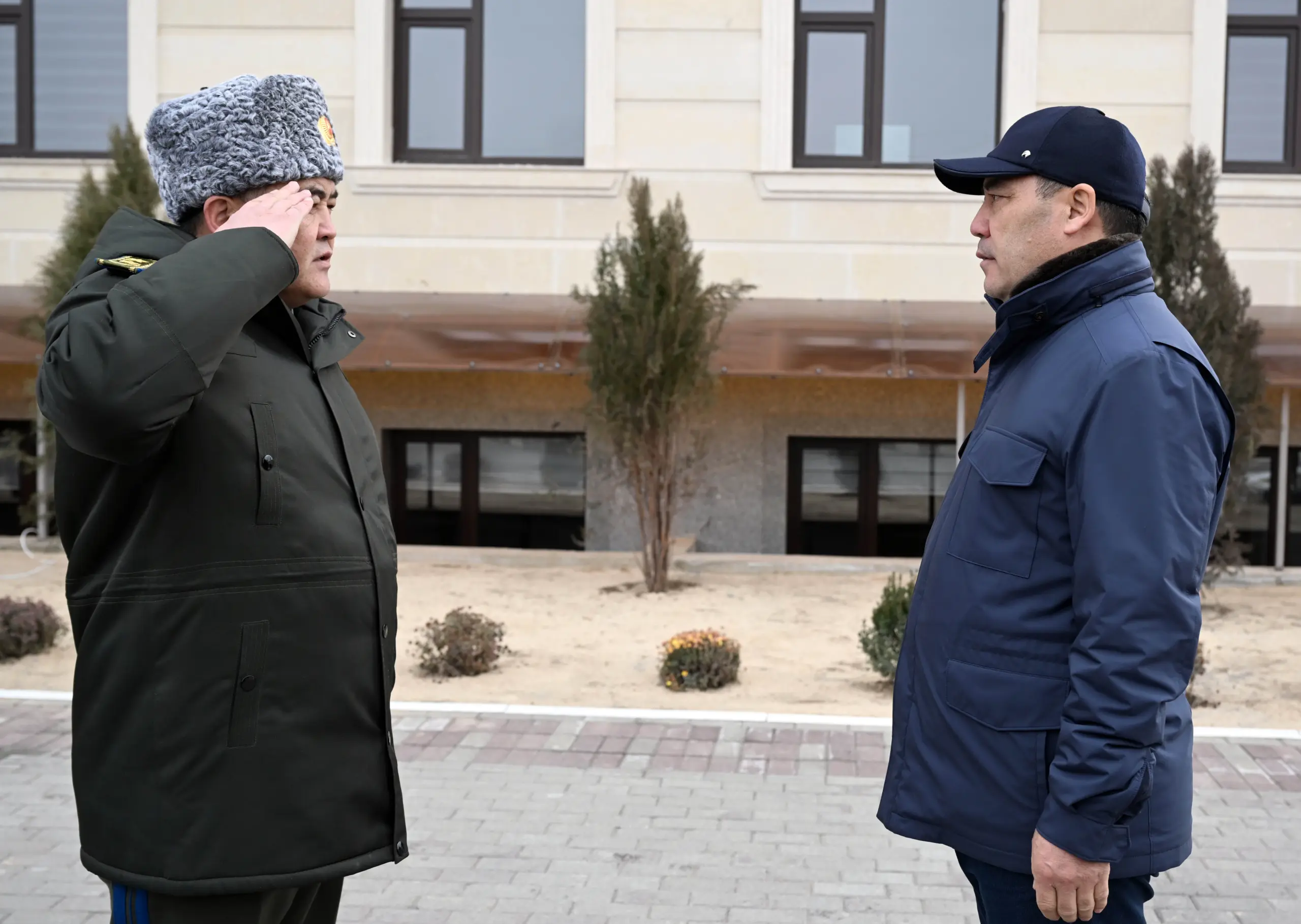
Former security chief, Kamchybek Tashiyev (on the left) saluting president Sadyr Japarov (on the right). Photo by the Kyrgyzstan President’s Office. Fair use.
In February 2026, Kyrgyzstan’s ruling tandem, consisting of the president Sadyr Japarov and the former Chief of the State Committee of National Security (UKMK) Kamchybek Tashiyev, crumbled in several days and came to an abrupt end.
This marked the end of a political era that began in October 2020, when Japarov and Tashiyev came to power following violent protests over rigged parliamentary elections, agreeing to informally share power and spheres of influence.
The president emerged victorious in what appears to have been a hidden power struggle ahead of the presidential elections in 2027, whereas Tashiyev was dismissed from his powerful post, and his entourage was purged from the state structures.
These events marked the end of the decades-long political alliance and declared friendship. The most important implication of them parting ways is for the future, as questions linger about what Kyrgyzstan will be like without the heavy-handed former security chief who had a hand in almost everything taking place in the country.
A scandalous letter
What seems to have set the falling-out in motion was the letter signed by a group of 75 public activists, former top-level government officials, and scientists to Japarov, in which they asked the president to hold the presidential elections in 2026 instead of 2027. It came out on February 9, 2026, and noted that Japarov was elected in 2021 under the old constitution, which set the presidential term at five years.
In contrast, the new constitution, adopted after Japarov’s election, set this term at six years, creating a legal conundrum, according to the letter’s authors. The only solution, they argued, was to hold the presidential elections in 2026 and end legal debates.
In addition, the letter offered an assessment of Japarov’s five years of presidency, highlighting his achievements and shortcomings, and adding that “the first stage of the activities of the current top leadership of Kyrgyzstan has been logically completed.”
Interpreting the letter as pressure, Japarov removed Tashiyev from his post as the UKMK chief on February 10, 2026, suggesting he viewed his former ally as the mastermind behind the letter. Indeed, in Kyrgyzstan’s political context, where power was monopolized by these two figures, it is unlikely that anyone other than Tashiyev would dare make such a move.
After returning from Germany to Kyrgyzstan, where he was undergoing medical treatment at the time of his dismissal, Tashiyev became utterly powerless, removed from all the government posts he held.
Commenting on Tashiyev’s dismissal, Japarov revealed that he had met with the former police chief and told him: “Rest, friend, take care of your health, be calm.” Later, he urged people not to turn the whole thing into a drama and stated:
Nothing will happen [after Tashiyev’s removal]. There’s no need to turn this issue into a tragedy. It will be even better than before. Life won’t stop. If one friend leaves, I have more than 7 million friends behind me. Our people and our blessed state are most precious to me.
Falling dominoes
Since Tashiyev’s removal, a long list of top-level government officials and parliament members have stepped down, been dismissed, or been arrested, exposing the significant influence he held over the political life. Like dominoes, the members of his loyalist network came falling down, one after another.
First, all his deputies and heads of the two biggest regional UKMK departments, Bishkek (capital) and Osh, were removed, clearing space for new leadership.
The newly minted UKMK chief, Zhumgalbek Shabdanbekov, announced his department would conduct an internal investigation, which resulted in seven employees being dismissed, 83 being relieved of their positions, and six being removed from the list of potential political candidates.
He vowed to depoliticize UKMK’s work and noted the committee “is not a personal body created for a specific individual,” taking a jab at his predecessor.
In addition, UKMK was weakened through restructuring that removed control over state borders and the security of top-level state officials. As a result, two new government bodies were formed: the State Border Service and the State Security Service under the President’s Office.
The so-called “cadre cleansing” at UKMK was just the beginning. What followed were numerous dismissals and appointments of new officials. The affected state bodies included the Interior Ministry, Prosecutor General’s Office, Ministry of Transport and Communication, Ministry of Natural Resources, Ministry of Emergency, Health Ministry, Water and Industry Ministry, Justice Ministry, and Ministry of Education.
Additionally, Japarov appointed new mayors in four major cities, including the second-largest city of Osh, where Tashiyev’s close ally and friend, Jenishbek Toktorbayev, was removed from his post.
The parliament was not immune to purges either. By mid-March, eight parliament members, affiliated with Tashiyev, gave up their mandates, including the speaker, Nurlanbek Turgunbek uulu, and Tashiyev’s brother, Shayirbek Tashiyev, who was eventually arrested and placed under temporary detention.
Tashiyev has remained completely silent throughout these purges, appearing in public only twice, first at the Eid prayer and then at the election of the new president of Kyrgyzstan’s Football Union, where Tashiyev relinquished another role.
Unclear future
Tashiyev’s own future remains unclear but looks somewhat grim. There are hints that he may face prosecution for his alleged transgressions and abuse of power.
Following his departure from UKMK, the State Tax Service released an investigation, claiming Tashiyev’s relatives and close associates built corruption schemes and benefited from the sale of state oil. The estimated damage to the state is USD 45.7 million. The ongoing criminal investigation has already placed his brother, former deputy Shayirbek, under detention on corruption charges.
Here is a YouTube video explaining the investigation.
The irony is that Tashiyev became famous for his anti-corruption campaign, called “kusturizatsiya,” a term derived from the Kyrgyz word “kusturuu” (to purge). Politicians and businessmen charged with corruption were forced to compensate for the damages caused to the state. UKMK decided on the amount and released offenders in an extrajudicial process without the involvement of courts.
According to Sharshenbek Abdykerimov, a fugitive businessman who was subjected to kusturizatsiya, the process was fully arbitrary. He revealed that the deal with the state was for him to compensate USD 20 million in property. However, Tashiyev allegedly changed his mind and demanded USD 30 million in cash instead.
Additionally, Abdykermov claimed one of his expropriated properties was assessed below market price and transferred to individuals associated with Tashiyev’s wife.
Abdykerimov is not alone in his allegations. Within two weeks of Tashiyev’s dismissal, around 500 complaints were filed against UKMK employees from businessmen and state officials, suggesting widespread abuse of power during Tashiyev’s reign.
With his entourage purged from the state and law-enforcement bodies, Tashiyev remains politically paralyzed, forcing him to accept whatever ultimatum and/or offer the president puts forward, at least for now. Reconciliation with Japarov is not off the table, but it seems unlikely at this point.
Their falling-out serves as a reminder of the political instability that has plagued Kyrgyzstan since 1991, when it gained independence from the Soviet Union. Since then, Kyrgyzstan has witnessed three revolutions: in 2005, 2010, and 2020.
Should they manage to settle their differences peacefully, Japarov will be set to consolidate his rule even further and approach presidential elections in 2027 with full confidence. Kyrgyzstan’s tumultuous political history warns against making forecasts and suggests waiting and seeing.