



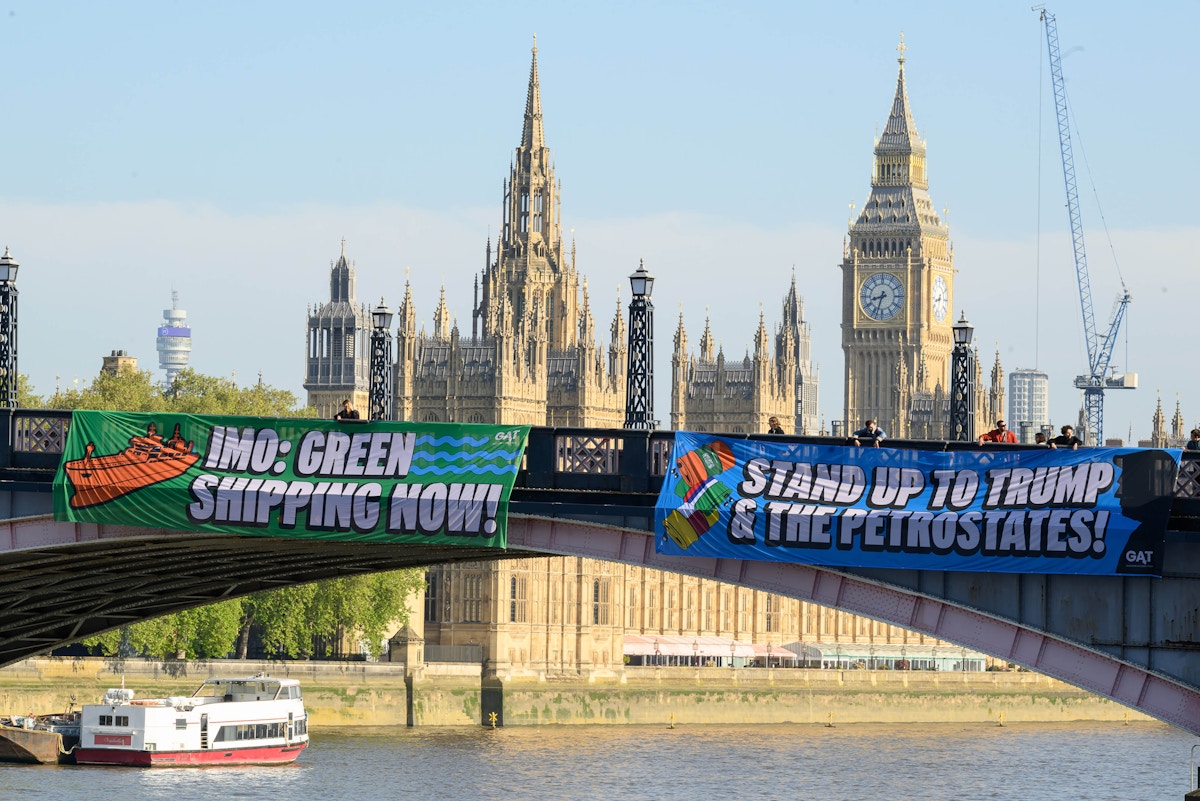
UN talks on cutting climate pollution from ships are entering a fraught second week of interim negotiations in London, as rising fuel prices and political divisions collide with a renewed push to put a global carbon price on the sector ahead of key climate talks in October.
Government officials at the IMO talks resumed work last week on the proposed Net-Zero Framework (NZF), a package of measures aimed at tackling shipping’s roughly 3 per cent share of global greenhouse gas emissions. Technical discussions ran through last week, and now roll straight into high‑level talks at the Marine Environment Protection Committee’s 84th session (MEPC 84) from 27 April to 1 May.
Em Fenton, senior director of climate diplomacy at nonprofit Opportunity Green, said the outcome will signal whether multilateralism itself can withstand mounting geopolitical strain. “The IMO Net-Zero Framework is not just a climate measure – it’s a test of whether international cooperation can survive in an era of increasing geopolitical pressure,” Fenton said in a statement on Monday.
“A majority of the world’s nations want this to succeed. Opposition may be loud, but that doesn’t mean it will drown out the voices for ambition and justice, many of whom come from communities most greatly affected by climate impacts,” he added.
“
A majority of the world’s nations want this to succeed. Opposition may be loud, but that doesn’t mean it will drown out the voices for ambition and justice.
Em Fenton, senior director of climate diplomacy, Opportunity Green
In April last year, the IMO made a long-awaited breakthrough, approving a draft mid-term measure as part of its roadmap to reach net zero by 2050. However, as negotiations progressed in their next official adoption stage in October, the process faced continuous blocking and opposition. United States president Donald Trump, who called climate change a “con job”, intervened and used trade threats that would make it harder for country members’ businesses to export to the US, ultimately derailing the process.
As a result, major shipping flags states Greece and Cyprus broke the agreement of European member states that they would support the adoption of the framework.
In Asia, Japan and South Korea, two of the world’s top ship makers, were among those that had supported a global carbon price in earlier rounds of talks. China, the biggest global ship builder, has voiced opposition against a carbon levy but advocates for more flexible targets such as achieving net zero “around mid-century,” aligning with its national goal of carbon neutrality by 2060.
But in October’s vote, China decided to back the delay, while Japan and South Korea were among those who abstained.
Observers say, however, the chances of the proposed NZF could improve this week as a US court ruling in February restricted Trump’s ability to impose sweeping tariffs.
The stakes are high as international maritime shipping emits around one billion tonnes of carbon dioxide annually — almost three times the yearly emissions of the United Kingdom — yet has largely avoided strict climate rules.
Rising fossil fuel prices are intensifying the battle lines.
“The Hormuz crisis has pushed up oil and gas prices, at least in the near term,” said Tristan Smith, professor of energy and transport at University College London. He argued that opponents of the NZF, led by the United States and others with large liquefied natural gas (LNG) interests, are effectively pushing to expand LNG’s role in shipping.
If LNG prices are already high, “this would introduce a major new source of demand from a sector that does not currently rely on it, forcing competition with countries that depend on gas for electricity and basic energy needs,” he warned, risking even higher prices that benefit exporters like the US and Qatar while hurting import‑dependent economies and users of gas‑based products such as fertilisers.
Despite the tensions, some see momentum coming from industry itself. “I’m cautiously optimistic,” said Rockford Weitz, professor of practice and director of the Maritime and Arctic Studies Program at The Fletcher School at Tufts University.
“When you look at global energy markets and the billions already being invested by industry, shipping is leading the transition. Major players across Europe and Asia are moving towards green ammonia and methanol. To me, the future is clear: it is a zero‑carbon shipping future, even if politics creates short-term disruption,” he said.