



When a whale dies, a very special natural phenomenon can come alive. The carcass might float at the surface for some time, attracting sharks and other predators. As it becomes weathered it may start to sink, falling through the water until it eventually settles on the seafloor where deep sea scavengers feast upon it.
The scientific record of “whale falls” is sparse and fragmentary. But a team of researchers, led by Xiaotong Peng from the Chinese Academy of Sciences, has discovered a vast and ancient whale necropolis in the Diamantina Zone in the southeastern Indian Ocean.
The site, described in a new paper published in Nature, dates back more than five million years and is one of the deepest known whale fall ecosystems in the world.
A whale-sized find in the middle of the ocean
During a special dive mission in February 2023 using a submersible called the Fendouzhe, the team of scientists discovered extensive whale skeletons and fossils partially buried in sediment on the seafloor.
Following the initial discovery, the team made 32 more dives to the seafloor over the next month, mapping the extent of the necropolis.
It stretched roughly 1,200 kilometres along the seafloor at depths of between 4,200 and 7,000 metres. It contained 476 whale fossils as well as five active whale falls.
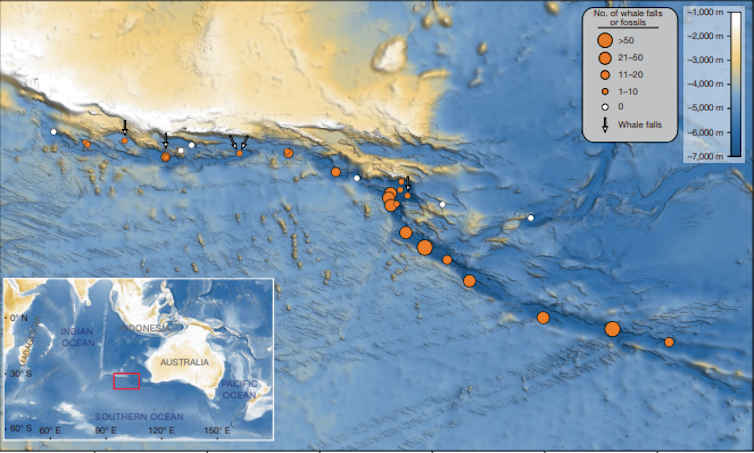
Xiaotong Peng et al, CC BY-NC
These active whale falls were teeming with many strange-looking creatures, including jellyfish, brittle stars and bone-boring worms – many of which may be new to science, according to the researchers.
From the 43 fossils the team recovered, they identified five beaked-whale species, including the Andrews’ beaked whale (Mesoplodon bowdoini) and the strap-toothed whale (Mesoplodon layardii) which are known to inhabit the region, and one species of baleen whale – the sei whale (Balaenoptera borealis).
The largest find was a dead Antarctic minke whale, five metres in length, which the team identified from its distinct ear bone shape, as well as genetic analysis. The team also identified a new whale species – Pterocetus diamantinae – which is now extinct.
Isotopic dating, where scientists use the decay of radioactive isotopes, revealed that the oldest fossils from the site are about 5.3 million years old.
The high concentration of whale remains in the region raises the question of how exactly this graveyard was formed. The authors suggest the reason probably has to do with the V-shaped topography of the Diamantina Zone which funnels carcasses onto the seafloor, plus the fact that many deep-diving beaked whale species are known to inhabit this part of the ocean.
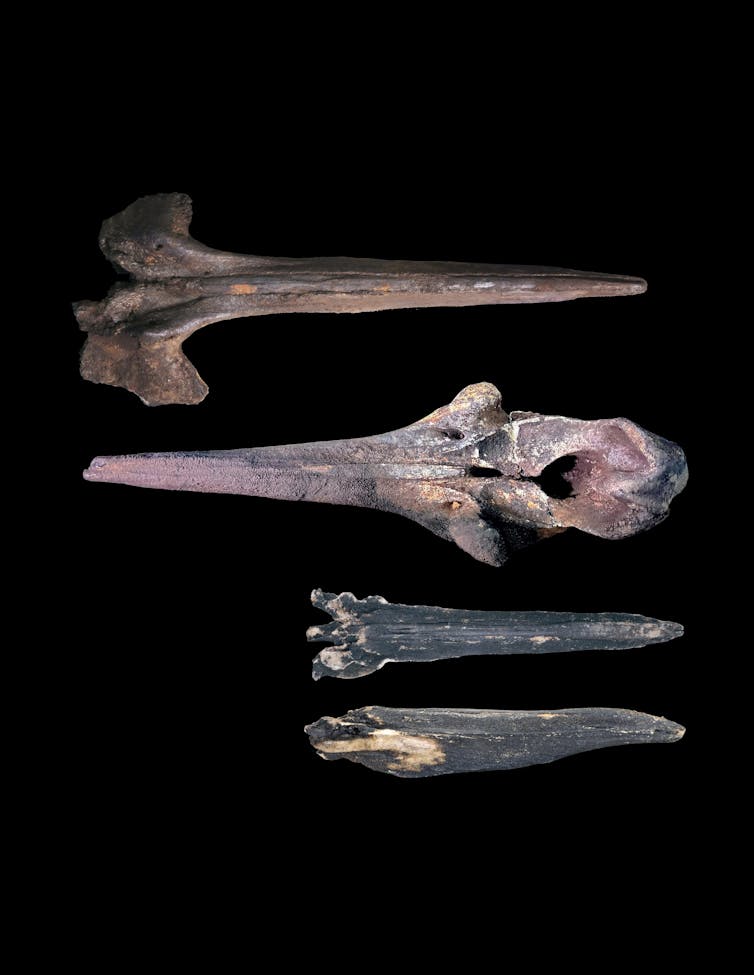
Global TREnD, IDSSE
A reminder of how little we know
This work deepens our our understanding of whale falls and the incredible ecosystems they support. It also deepens our understanding of beaked whales – usually offshore species which routinely dive up to 1 kilometre and hold their breath for more than an hour.
The finding of five million-year-old fossils provide an evolutionary window into the history of beaked whales from the Pliocene epoch to the present day.
This research is also a humbling reminder of how little we know of the deep sea – and how when we look for something, we may just find it, and so much more.