




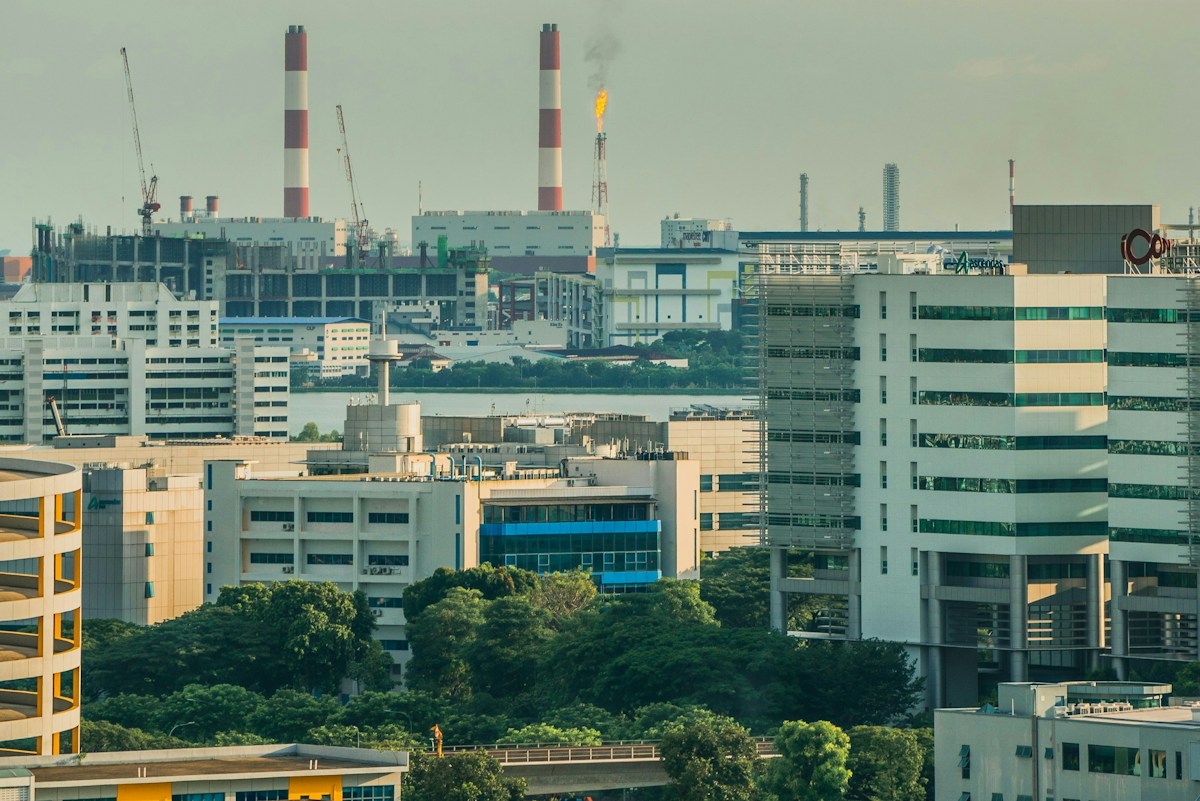
Singapore’s Energy Market Authority (EMA) will study whether a 200-hectare site on Pulau Tekong can host about 6 GW of power generation and 2 GW of electricity imports, according to tender documents seen by Eco-Business.
The tender was published on 5 October. A consultant is expected to be appointed by mid-2027, and the study should take about two years.
Besides gas, the documents list power plants that could run on hydrogen or ammonia, biomass plants that capture their emissions and geothermal power, alongside a terminal for liquefied natural gas (LNG). The energy mix will be set out in three scenarios that EMA will share only with the appointed consultant. Eco-Business understands from EMA that the site falls within the 500 hectares on Pulau Tekong that Singapore Prime Minister Lawrence Wong announced at the National Day Rally in August would remain available for future civilian use.
EMA said the study was needed because electricity demand would grow with the economy.
“It is vital that we plan ahead for our future energy infrastructure needs,” said Puah Kok Keong, EMA’s chief executive in a press release on 6 October.
The 6 GW under study would be equivalent to more than half of the 9.6 GW to 11.4 GW of peak demand EMA has projected for 2031, though the two figures measure different things.
“The significance lies not in the land area itself, but energy capacity that could be accommodated on the site,” said Peter Govindasamy, Executive Director of the Energy Studies Institute at the National University of Singapore.
“Pulau Tekong has the potential to provide headroom for future growth, replacement of ageing power assets, energy imports, hydrogen deployment, and system resilience,” Govindasamy told Eco-Business.
“Singapore’s challenge is not only about meeting today’s demand. There is a need to have adequate infrastructure for future demand growth driven by data centres, AI, advanced manufacturing, electrification, and emerging low-carbon technologies,” he said.
Demand for clean power outpaces supply
Data centres are among the fastest-growing sources of that demand. They used about 6.5 terawatt-hour (TWh) of electricity in 2024, more than a tenth of Singapore’s total and up from about 7 per cent in 2020.
The Digital Infrastructure Bill, which Parliament passed on 7 October, adds to the pressure on clean supply; operators that won capacity in government tenders can now be held by law to their green energy pledges, which in the latest tender require at least half their energy to come from clean sources.
Singapore is unable meet that demand through domestic sources given its land and resource constraints. Gas generates about 95 per cent of its electricity, and renewables, including imports, made up a record 2.58 per cent of the power mix in May 2025. The country instead aims to import 6 GW of low-carbon electricity by 2035, about a third of its expected demand, up from about 200 megawatts (MW) today.
Across the sector, however, electricity imports are behind schedule. In a report this week, consultancy Wood Mackenzie said none of the 9.25 GW of import projects Singapore has approved – from Australia, Cambodia, Indonesia, Malaysia and Vietnam – had begun construction. It projected that imported electricity would supply only 15 per cent of Singapore’s power by 2035, against EMA’s target of about a third. It cited export permits in supplying countries, financing and cross-border transmission as the main obstacles.
The study is meant to bridge the gap by opening up another landing point for energy imports. The documents provide for 2 GW of electricity imports through three sea corridors, and the hydrogen and ammonia they list, which data centre operators can also count as clean sources, would largely be shipped in.
In the meantime, gas is filling the gap. EMA’s request for proposals in September raised the number of hydrogen-ready gas power units planned for 2032 from two to five, according to the report, and the Tekong study documents state that natural gas “will continue to play an essential role” in supplying round-the-clock power.
“
The key question is therefore not whether Singapore needs gas in the near to medium term. It almost certainly does.
The question is whether today’s gas infrastructure can be designed to support tomorrow’s low-carbon energy system such as hydrogen, clean electricity imports and other low-carbon pathways
Peter Govindasamy, Executive Director of the Energy Studies Institute at the National University of Singapore
Spreading Singapore’s energy beyond Jurong Island
Govindasamy sees the cluster’s value in the strategic value it offers beyond a mere boost in energy capacity.
He described it as “a strategic option value for Singapore’s long-term energy planning”, giving the country room for future growth, the replacement of ageing power plants, electricity imports and, eventually, hydrogen.
Govindasamy is not alone. Benjamin Chang, Energy and Power Leader at insurance broker Marsh Asia, noted that Singapore’s energy infrastructure is heavily concentrated in the south-west, around Jurong Island, and said an eastern cluster would give the country a second point of access by sea.
Because energy infrastructure takes many years to plan and build, he said, the aim is to “build options before they are urgently needed”.
“Concentrating too much critical infrastructure in one location may not altogether be prudent, as this raises vulnerabilities,” Govindasamy added.
Those options come with costs and risks. Govindasamy called connectivity “one potential challenge, but not insurmountable”, as the island would likely need significant investment in transmission links, pipelines, transport access and possibly undersea connections; he also pointed to operational considerations arising from Tekong’s continued military use.
Chang shares a smiliar view.
“The important question is therefore whether Tekong can operate as a genuinely independent energy node during a major disruption, rather than simply becoming a second location with the same underlying dependencies as Jurong,” he said.
For investors, the hydrogen-ready label offers less protection than it suggests.
“‘Hydrogen-ready’ does not, by itself, eliminate the transition risk associated with a new gas plant,” Chang said, noting that such plants are often designed only so that a future conversion may be possible.
For assets expected to run for 30 years or more, he added, “insurance can cover defined physical damage and business interruption. It cannot fully protect an owner from an asset becoming commercially less competitive or stranded.”
Chang also said an LNG terminal on Tekong “would diversify Singapore’s infrastructure risk” but would leave the country exposed to global gas prices and shipping, a vulnerability the International Energy Agency flagged this week, citing this year’s disruption in the Strait of Hormuz. In his view, “the country could diversify its terminal infrastructure while remaining concentrated in one internationally traded fuel”.
The three scenarios remain unpublished, and the study is not expected to conclude until around 2029. “If it simply adds more gas infrastructure with the same upstream dependencies as Jurong, it may add capacity without delivering the full resilience benefit,” Chang said.