




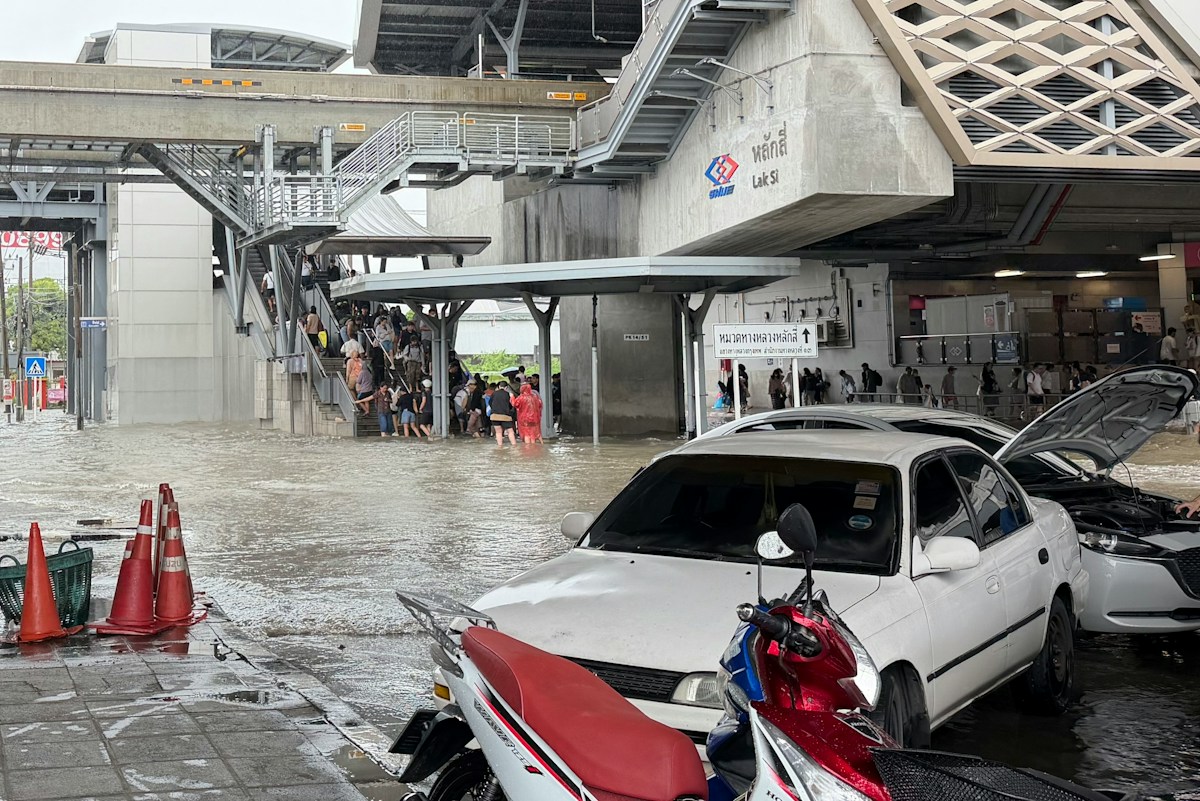
As Thailand counts the cost of devastating floods, the world’s most powerful financial institutions are gathering in the capital. Finance ministers, central bankers, and delegates have arrived for the Annual Meetings of the International Monetary Fund (IMF) and World Bank.
When familiar speeches about global stability, fiscal discipline, and economic resilience echo through conference halls, these financial prescriptions are no longer just out of touch for the Global South – they are actively lethal.
For decades, Washington-driven recipes – forced austerity, privatisation and deregulation, and unsustainable exploitation of natural resources – have squeezed developing nations. Now, the consequences of these policies collide directly with accelerating climate breakdown. Recent flooding in Bangkok and Nepal alongside extreme heat across Asia have cost lives, submerged communities, and destroyed critical infrastructure.
For developing nations burdened by debt, every climate disaster erodes the ability to rebuild, adapt, protect citizens, or fund public services. Yet the international financial architecture continues to prioritise debt servicing and fiscal restraint over the survival of vulnerable communities. Those who contributed the least to global emissions continue to shoulder the heaviest costs without prospects for a resilient future.
Report after report has revealed the horrifying scale of this systemic trap. Today, 93.5 per cent of the world’s most climate-vulnerable countries are currently in or at high risk of debt distress. Rather than funding healthcare, education, or adaptation, these nations spend an average of 65 per cent of government revenues servicing domestic and external debt.
“
Debt is far more than a financial issue. It is the primary structural barrier to human-rights-centered sustainable development and a Just Transition.
Climate-vulnerable countries spend nearly 25 times more on debt servicing than on climate action. In total, the Global South drains roughly US$8.8 trillion in debt servicing to Northern creditors, dwarfing the US$39 billion provided in grant-based climate finance by nearly 225 to 1.
The IMF, World Bank, and commercial creditors perpetuate a damaging cycle. When disasters strike, emergency spending drains meager national reserves. Forced to borrow to rebuild, countries accept loan conditions rooted in austerity and export-led growth. Generating foreign currency to service these debts incentivizes fossil fuel extraction, industrial agribusiness, and further borrowing simply to cover maturing loans.
This dependence deepens climate vulnerability, triggering subsequent disasters and further debt. The problem is compounded when climate finance itself arrives primarily as loans. In practice, international institutions continue to prioritize the interests of bondholders over a planet facing severe climate disruption.
Debt is far more than a financial issue. It is the primary structural barrier to human-rights-centered sustainable development and a Just Transition.
Refusing this status quo, civil society movements, climate coalitions, and trade unions are convening in Bangkok alongside the Annual Meetings to launch an International Peoples’ Assembly, demanding a comprehensive overhaul of global economic governance.
Transformation must begin with the immediate, unconditional cancellation of all unsustainable and illegitimate public external debt for Global South nations across all creditors, alongside the scrapping of punitive IMF surcharges and structural adjustment conditions – a transformation that centers climate reparations as the cornerstone of Global South economic justice.
Debt cancellation is itself a demand for climate reparations, confronting Global North nations, the IMF, World Bank, and private bondholders as the real debtors who owe an historical, ecological, and financial debt to the South.
Reclaiming fiscal sovereignty and securing climate justice require confronting the unchecked mobility of high-emission capital driven by the Global North. In 2022 alone, investments by the richest 0.01 per cent in carbon-intensive industries generated an estimated US$992 billion in climate debt – an amount comparable to global climate finance requirements.
Rather than treating developing nations as passive recipients of external aid, the international tax architecture must recognise their right to enforce progressive taxation on major polluters’ profits and wealth, unlocking essential resources for public services and climate action across the Global South.
Governments must deliver an ambitious UN Framework Convention on International Tax Cooperation and establish a binding UN Framework Convention on Sovereign Debt. Together, these frameworks offer an opportunity to curb tax havens, advance progressive wealth taxation, hold polluters accountable and mobilize resources for essential public services and environmental protection, as well as prevent new debt crises and offer fair solutions when they occur.
The overhaul of global economic governance also requires ending public financing for fossil fuels and other environmentally damaging business activities, closing corporate tax loopholes, stopping predatory critical mineral extraction, and protecting local food sovereignty.
Global policy must prioritize public well-being by fully funding universal health, education, water, and energy and food systems, while reversing forced privatisations and austerity measures that disproportionately rely on women’s unpaid care work.
The IMF and World Bank were established to serve post-WWII economic expansion, not to uphold human rights or protect the environment, let alone deliver climate justice. Climate justice will never come attached to an interest rate or loan conditionality. Frontline communities do not need more loans. They need liberation from an international financial architecture built on, and driven by, the economic and financial subjugation of the South.
Lidy Nacpil is the coordinator of Asian Peoples’ Movement on Debt and Development (APMDD). Jean Saldanha is the director of the European Network on Debt and Development (Eurodad). Ucizi Ngulube is a socio-environmental and tax justice campaigner with Greenpeace Africa.