



If his impressive academic record is any measure, Andrew Charlton might lay claim to one of the highest IQs in the parliamentary Labor party. Now, with his central role in the government’s AI policy, he’s grappling with issues thrown up by a very different sort of intelligence.
Charlton is only an assistant minister (for Science, Technology and the Digital Economy), junior to Industry Minister Tim Ayres, who’s in cabinet.
But he’s an expert on AI, and has been carrying much of the media load after Anthony Albanese’s speech last week on the government’s directions for handling this rapidly evolving technology that will transform modern life.
Charlton, Attorney-General Michelle Rowland and the Prime Minister’s Office were the key players in bringing together the framework Albanese outlined, setting terms to capture the benefits of AI while imposing some conditions on the rollout. Charlton undertook the talks with business.
Labor’s national conference in Adelaide, which opens on Thursday, will be a tightly controlled performance. But the debate on AI, due on Thursday, which pits issues of technological progress and productivity opportunities against the concerns of sections of the union movement, could be one of the livelier of the three-day jamboree.
As well as whatever he says on the conference floor, Charlton will address a “fringe” event on AI on the sidelines.
Last month, Charlton won the prize for Emerging Political Leader of the Year for 2025, awarded by the McKinnon Foundation, a non-partisan organisation that aims to promote “better governments”.
Its citation recognised his contribution in “shaping Australia’s response to artificial intelligence at a moment when the stakes for the country could not be higher”.
“Charlton’s work on artificial intelligence stood out for its seriousness, depth and long-term thinking,” the citation said.
“At a time when governments around the world are struggling to respond to the economic and strategic implications of AI […] Dr Charlton has brought genuine intellectual weight to the debate. His work has consistently focused on the difficult questions shaping Australia’s future: productivity, economic sovereignty, jobs, capability and national security.”
Lukas Coch/AAP
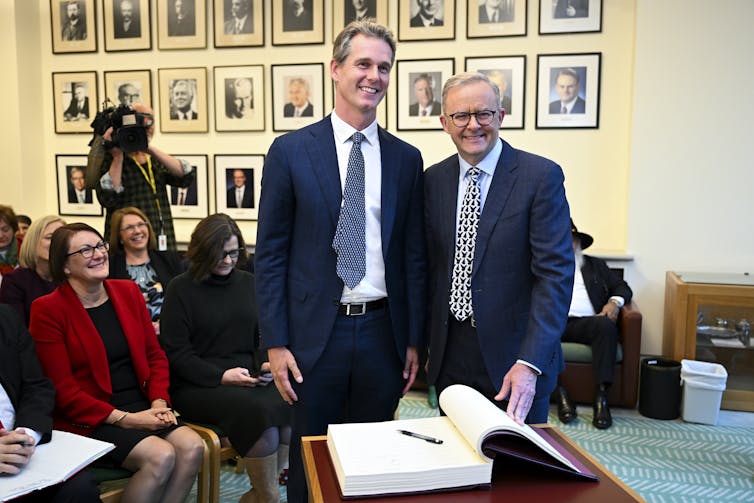
Albanese is a fan of Charlton. He made a “captain’s pick” to install him as candidate for the western Sydney seat of Parramatta for the 2022 election, even though Charlton didn’t live in the electorate and that denied the locals a preselection vote. (With few seats “safe” anymore, finding electorates in which to place outside “high flyers” is much harder than it once was. These days contests are more often around “local champions”.)
In his first term, Charlton put a lot of work into his electorate, also finding time to write a book about Australia’s relations with India.
Charlton brings stellar formal economic credentials. He won Sydney University’s economics medal; studied at Oxford for a doctorate as a Rhodes scholar; and joined the London School of Economics as an academic. During his early academic career, he was mentored by some of the world’s leading centre-left economists. He co-authored a book, Fair Trade for All: How Trade can Promote Development, with Joseph Stiglitz, a nobel-prize winner.
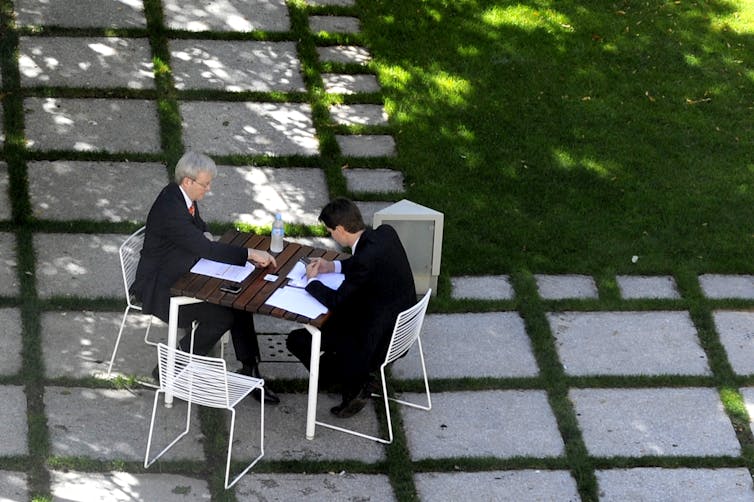
As it happened, Charlton arrived in parliament quite familiar with the heat of government. As prime minister Kevin Rudd’s economic adviser, he worked through the turbulence of the Global Financial Crisis.
Alan Porritt/AAP
Apart from elevating Charlton to an assistant minister after the 2025 election, Albanese also appointed him cabinet secretary, a position that means he attends all cabinet meetings and has a bird’s eye view across government.
Charlton has his sceptics. One Labor insider sees him as influenced by the last person he spoke to. But when his name is mentioned to Labor people, “very bright” and “intelligent” are often their first words.
Unusually in Labor, Charlton has direct business experience, having founded, and later sold, at a very big return, a startup business in consulting and technology.
Murray Hurps, Director of Entrepreneurship at UTS and Managing Director of Startup Muster, the largest survey of startups in Australia, finds it “nice having someone in government who’s had entrepreneurial experience like he’s had. He’s extremely tech savvy. Things don’t have to be explained to him” – a contrast with many ministers Hurps has dealt with over the years. Charlton “understands the opportunities and issues tech companies in Australia are facing”.
Charlton’s startup wasn’t his first stint in business. After Rudd’s sacking Richard Goyder, then CEO of Wesfarmers, hired him. Goyder says: “He’s thoughtful, driven to get good outcomes”, as well as “able to engage with the teams required in business”.
To the frenetic public debate about the May budget’s capital gains tax changes Charlton brought the expertise of his business experience, as well as more frankness than many colleagues would venture. He said:
Startups and some small businesses are a real concern because [post budget] we’ve got this new type of capital gains discount which is based on inflation.
The point that many startup founders, the point that many small businesses have been making, is valid. It’s a valid point because that new regime doesn’t interact well if you have a really low capital base because you’ve got nothing to inflate off. So, there are real concerns out there.
The government recognised those concerns, the Treasurer recognised them. […] There was a statement in the budget recognising them and we are consulting on them. So, we definitely hear those concerns.
How high can Charlton, 47, rise?
He’s not in the front tranche of candidates for the succession, whenever Albanese departs. That line up currently includes Treasurer Jim Chalmers, Home Affairs Minister Tony Burke, Health Minister Mark Butler, and Deputy Prime Minister Richard Marles.
Charlton’s time for leadership, if it were to come at all, would likely be after whoever becomes leader post Albanese.
Charlton would have a strong claim to be treasurer to Albanese’s successor (assuming Labor was in government).
If that successor were Chalmers, would he make Charlton his treasurer? As things stand, Chalmers looks over his shoulder at Charlton, although he doesn’t have to.
Chalton’s long term challenges in pursuing leadership would include that he lacks a union base, and he would need to get the support of his NSW right faction, where multiple aspirants always jostle. Colleagues would also need to be confident that a man who’s more a thinker than a brawler would be able to handle the down-and-dirty side of politics.