



The terms sustainability and environmental, social and governance (ESG) may have been fading from popular discourse, but the adoption of more sustainable business practices has continued to spread across the real economy.
Financial institutions and businesses have been looking beyond climate targets and goals to more “practical” applications of mitigation and adaptation measures, said Melissa Moi, head of sustainable business at banking group UOB.
“I think we have moved away from the 2021 to 2022 view of needing to have lofty sustainable finance goals and trying to bring in big numbers,” she told Eco-Business. “Now it is down to where we focus our energy and expertise, where we see the huge capital expenditure and investments required to transition towards being more green.”
Unlike some of their western counterparts, many Asian financial institutions have maintained their commitments to achieving net zero and decarbonising their portfolios. UOB has pledged to net zero emissions by 2050, and in 2022 became the first major bank in Asia to turn away from oil and gas.
Moi suggests that there has been a “mainstreaming of green” as consumers and businesses have grown accustomed to more environmentally friendly products and services, such as the purchase of electric vehicles.
In this interview, she covers how sustainable finance and reporting have evolved in recent months, as well as the challenges and opportunities that lie ahead for the sector.
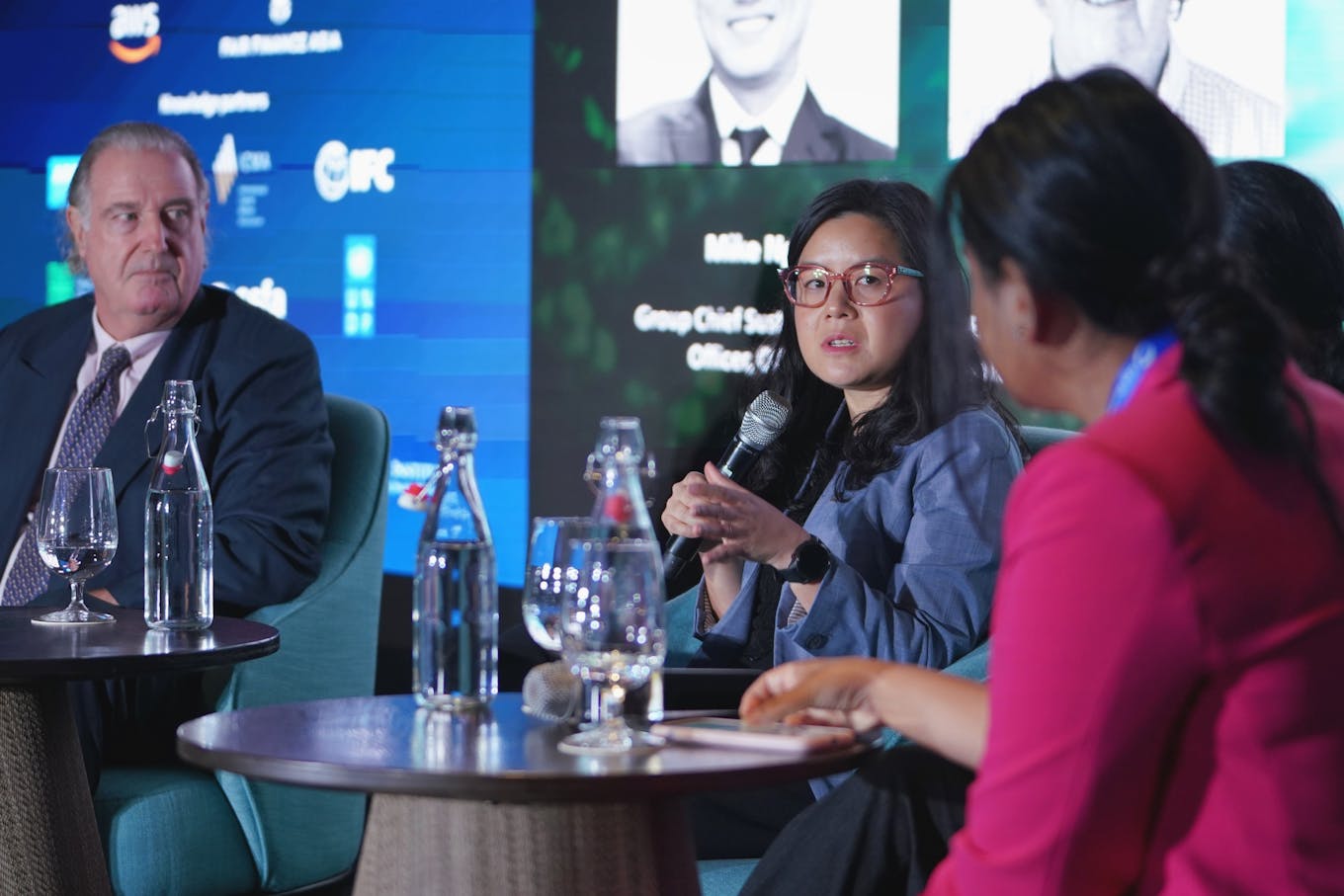
Melissa Moi, head of Sustainable Business, UOB, who is second from the left in the image, was a panel speaker at the Singapore edition of Unlocking Capital for Sustainability 2024. Image: Eco-Business
Given the ongoing global geopolitical conflicts, climate and sustainability have often flown under the radar or faced public backlash. But UOB has experienced a different reality on the ground. How have you seen sustainable finance grow?
The world has clearly changed over the last year. Given the geopolitical risks that have emerged, sustainability has taken more of a backseat in the past year, at least in terms of the rhetoric we hear.
But on the ground, and from a pragmatic point of view, we still see the real economy moving towards decarbonisation as climate change mitigation, as well as adaptation to build resilience. Policymakers and businesses are now thinking about it from a more practical point of view.
What I mean by that is that rather than thinking about climate as a lofty goal, commitment or a target that’s been set, it’s more of how we think about topics like energy demand. How do we think about the rising cost of electricity and other energy security risks? How do I ensure that my business is running in a way that is efficient? How do I think about the resources I rely on, such as water, and what is the impact of water scarcity when we have, for example, more data centres?
It becomes a more pragmatic point of view of how sustainability factors are integrated into the way we do business. How do I now think about what that means for me in terms of my short, medium and long term growth as a company and in the region?
One of the things we’re always looking at is the energy grid — how renewables come into play, the role of the Asean power grid, and the need to have continued economic growth that is decoupled from emissions. We have seen renewed interest in the Asean power grid over the last 18 months or so, and it is good to see because that has been discussed for decades.
We are also seeing more mainstreaming of green, with electric vehicles (EV) for example — in Singapore, BYD was the top selling car in 2025, taking over from Toyota.
There is a fundamental shift in how we think about entire industries, along the entire value chain – from all the different pieces that go into manufacturing and production, to the distribution and downstream.
We see trends like EVs as being part of a larger sustainability strategy — it’s just that this is where the economics are moving. The focus is more on pragmatism and execution. It is about what we do now and the immediate impact of our actions instead of just setting goals for 30 or 40 years down the road.
Does that mean we’re seeing more sustainable finance being counted as part of conventional finance?
It’s both — it can increasingly become part of regular business and still be tracked (as sustainable finance).
I think we have moved away from the 2021 to 2022 view of needing to have lofty sustainable finance goals and trying to bring in big numbers. Now it is down to where we focus our energy and expertise, where we see the huge capital expenditure and investments required to transition towards being more green.
It may be counted as sustainable finance, as a pure green play, or it may not. But I think it’s less about hitting targets and more about which industries and sectors we can have the most impact in. Power is one of them, automotives is another — where we can really think about how we engage with our clients to support them in this transition versus how many green and sustainability-linked loans and bonds we can have.
[Sustainable finance] will continue to grow as an offering, which we see as a differentiator for us and which our clients are wanting to hear more about. But the nuance of it has changed — it’s no longer chasing green. It’s understanding that green is becoming more and more mainstream, and it’s how we then bring that capability, advisory and financing to our clients.
I think if we take a step back and think about how financial institutions are looking at their net zero commitments in their portfolios, part of it is thinking about the trajectory that each sector should be moving towards. You need to think about where the client’s emissions are, what their transition plan is and what’s their trajectory.
“
It’s less about hitting targets and more about which industries and sectors we can have the most impact in.
Melissa Moi, head of sustainable business, UOB
Green finance is a related but different conversation. You can have a company with a very strong transition plan that doesn’t necessarily engage in green finance. You can have a company that doesn’t have a strong transition plan but engages in green finance products. It’s sort of a whole ecosystem approach as to how we look at and consider each of our individual clients.
To your question of whether banks are looking at emissions — it’s public information that banks are having conversations with their clients about transition plans. The outcome may be some sort of sustainable finance, or that we just track their emissions intensity profile over a number of years. Or it may be that there’s an overall business strategy [the client] is looking at, but the financing is not necessarily green. So we need to be looking at the full package.
As part of our assessment of any client, even if they are not accessing green finance, is to look at how they are managing environmental and social risks. That’s something banks — as we evolve in the way we think about decarbonisation, climate-related risk and sustainability — has seen throughout the industry.
Sustainability reporting is well under way in Asia, but we saw Singapore delay its mandatory disclosure timelines last year. At the same time, Malaysia has maintained its current schedule, while China announced its own climate disclosure standards earlier this year. What are your views on these differences in reporting timelines and what approach should companies take?
I think reporting is one lever of many to drive behaviour [but] it needs to be seen not as a means to an end or a box-ticking exercise. It is more an opportunity for banks and companies to rethink and reframe their strategy, to understand whether or not their business strategies are aligned with the potential outcomes that these reporting requirements are looking for. [And then it’s about] how they can be compared to their peers, or benchmarked against how the industry is evolving.
I think there are [then] many different drivers for companies to then decarbonise or to think about sustainability-related strategies. Reporting itself is one tool.
Each jurisdiction has its reasons for delaying or moving up timelines, but I don’t necessarily think that by delaying your sustainability reporting requirements, it means that entire industries or segments will not do the reporting.
Also, reporting is just reporting. On the other question, what does it mean for sustainability-linked finance — that requires ambition in terms of your science-based targets. So by merely meeting your reporting requirements, that isn’t necessarily how you can access sustainability-linked financing.
Companies which are serious about demonstrating [climate action] or wanting to access sustainability-linked solutions will, first, need to have the strategy behind it. Second, they must demonstrate ambition versus their industry peers. And third, they must work towards that in order to access sustainability financing.
The reporting piece is a more general [effort of] trying to get more data into the market, which will help us understand how one company ranks against another, or how the entire industry is moving towards a particular decarbonisation target or goal.
What are the climate finance opportunities or developments you’re seeing in the region that most excite you?
An area of growth we’re looking at is supply chain financing and how we’re working with ‘queen bee’ clients — anchor companies that pull in supplies — on how to incentivise their supply chains to go green. And this is where there is a link to reporting – as larger companies are required to report their Scope 3 emissions, how do they work with their supply chains to ensure that they have the knowledge, the capability and the financing that allows them to decarbonise their value chain?
They can do that through a number of programmes (such as) capacity building, preferential rates or timings in terms of payments, all of which incentivises sustainability through decarbonisation, access, implementation or taking up certifications, for example. Those particular instruments are interesting because what it does is allow us to use the finance lever, ‘queen bee’ lever, or some certification or industry-related lever that then provides a bit more of an impetus for [decarbonisation by] smaller companies which don’t necessarily have the same stakeholder pressure that a large multinational would have.
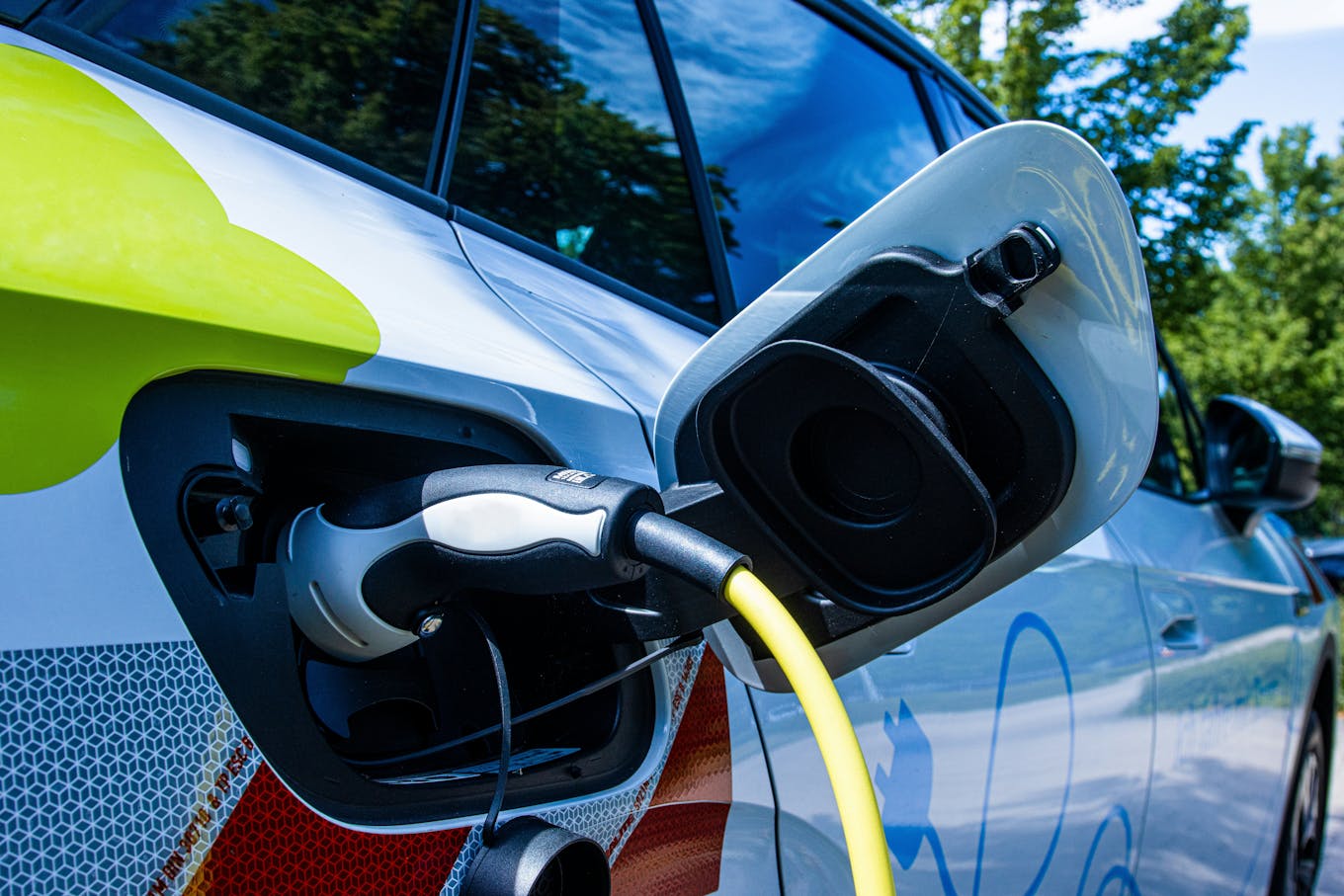
In Singapore, more electric vehicles were sold than petrol and hybrid vehicles in April 2026. Image: Marek Studzinski, CC BY-SA 3.0, via Unsplash.
If you bundle that in with some of the regulations that are being enforced, such as the European Union’s Carbon Border Adjustment Mechanism, then you start to see that there is an economic advantage for these companies to put these measures into play. That benefits multiple layers through the support of a ‘queen bee’ who’s willing to say that in order for them to do business with smaller companies, they need to be implementing these types of sustainability-related initiatives.
So I think green supply chain financing is growing — it’s not new, but it’s something that’s growing, especially given some of the geopolitics this year.
I’m also keen on adaptation and resilience in nature, whether or not in practice, we’re going to see that grow. It is still very nascent but if I just take the pulse of conversations that I’ve been having across different stakeholders and sectors, there are much deeper discussions on what adaptation actually means, how we think about it from a financing perspective and how we value that appropriately, knowing that is a very different ball game than mitigation.
How do we put a value to the protection of an asset or company? It’s a very different conversation that I think is maturing and necessarily so as we see climate change-related issues becoming far more frequent. That this is something that needs to be considered as we move forward, so I’m hopeful that this will mature in the next 12 months or so.
Finally, what are the challenges you see in scaling sustainable finance in the region this year, and how can they be tackled?
I think there are still some structural challenges that need to be solved. In particular, when we talk about the energy transition, so much of it depends on government-to-government [coordination] and things like the installation or upgrading of electricity grids. I think that’s an issue we’ve been trying to tackle for many years as an Asean bloc, and there’s again renewed momentum around it. But that doesn’t mean it is going to be easy.
I think the other thing is that we always talk about the scalability and bankability of some of the technologies that we need to decarbonise. How do we keep an eye on the need for technology adoption, particularly in hard-to-abate sectors, and then systemically think about what kinds of partnerships are needed to test the scalability of these technologies, to get them to commercial viability, and then have them grow from a bankability perspective.
There are some structures like blended finance that exist to support this, but there’s been challenges in terms of deployment, for various reasons. So how do we find the right ingredients and the right partners so that these emerging technologies are given the time and the space to be able to scale?
I think in an age where sustainability isn’t necessarily the front-running topic at the moment, the question is how can we make sure that [climate solutions] get their due investment and attention from governments and the private sector? We need to ensure that these solutions grow and are adopted at the rate we need to in order to meet some of our medium to long-term climate goals.