



More than 2.6 million Canadians work for themselves, and according to an annual RBC poll conducted in 2025, 59 per cent of Canadians aspire to own a business — the highest level since 2017.
The appeal is understandable. A recent poll found that nearly two-thirds of people feel they have plateaued at work and see owning a business as their next move. “Being your own boss” has become shorthand for freedom, control and finally getting paid what you are worth.
However, working for yourself does not reliably make people richer or happier. In our new study, we followed 12,686 individuals over three decades, from their late teens into their 50s, to see how self-employment actually played out over a their working lives.
The takeaway should give anyone weighing the leap pause. Simply being self-employed often left people no better off financially, and measurably less satisfied with life, than peers who kept a regular job. Whether the dream pays off comes down to how you do it, not whether you do it.
4 ways through a working life
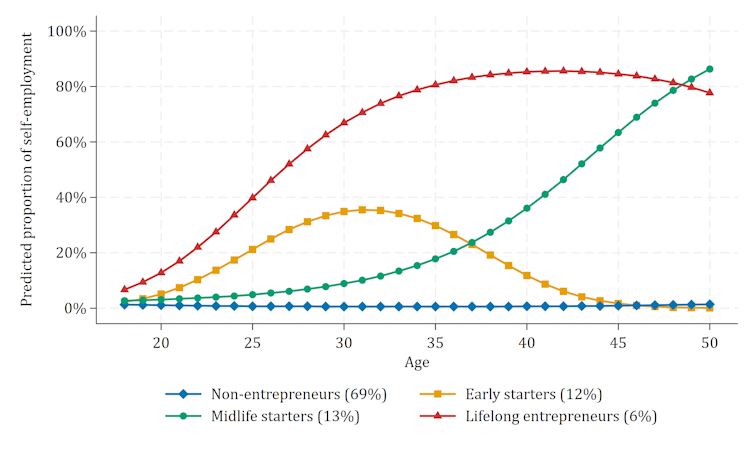
Not everyone follows the same entrepreneurial path. By tracking people year by year through the National Longitudinal Survey of Youth 1979, run by the U.S. Bureau of Labor Statistics, we found four distinct patterns across adulthood.
(Seok-Woo Kwon and Xiaoying Wang), CC BY-ND
The largest group, about 69 per cent, remained in regular employment and rarely worked for themselves. We used them as the benchmark for everyone else.
Another 12 per cent tried self-employment in their 20s, then returned to regular jobs. About 13 per cent did the opposite, entering self-employment in their 40s and becoming more involved over time. A committed six per cent started young and remained self-employed throughout most of their careers.
The same decision — “work for yourself” — produced four very different lives, with different financial and personal outcomes depending on when it happened and what form it took.
It’s not whether, but how
When we looked at both financial and psychological outcomes, one pattern stood out. What set the financially and personally successful apart was not a brilliant idea or sheer grit, but the structure of their business.
People who built a formal, incorporated business — a registered company with its own legal identity — earned more and reported greater life satisfaction than people who never became entrepreneurs. People who simply worked for themselves as solo freelancers did not. On average, they earned no more than non-entrepreneurs and reported lower well-being.
Researchers have long noted that incorporated and unincorporated business owners operate very differently. Incorporated owners tend to run more ambitious and growth-oriented ventures compared to unincorporated owners.
In Canada, people with an incorporated business are more likely to plan to expand (37.6 per cent versus 22.6 per cent of unincorporated owners), and incorporated businesses are more likely to survive and typically earn more along the way.
Our results suggest the difference goes beyond income: the legal structure of a business is closely tied to whether self-employment improves lives or wears people down.
However, it’s important to note this is not a case of incorporate and watch your life improve. People who incorporate often start with advantages like more education, professional experience and skills.
The gap showed up even among people with similar backgrounds, but incorporation usually signals something about how a business was conceived from day one rather than acting as a simple fix after the fact.
Timing and the long game
Age also matters, but not the way popular accounts suggest. The image of the brilliant young founder who drops out of school to build the next big thing is mostly a myth, and experience turns out to be an asset.
Among people who built incorporated businesses, lifelong entrepreneurs earned the most, early starters reported the strongest life satisfaction and those who started in midlife struck the best balance between the two. The most rewarding path appeared to be building a formal business after accumulating skills, savings and industry experience.
(Unsplash)
Staying in business is not only about talent or timing, either. We found that people who grew up with books, magazines and a library card at home — a form of early-life advantage researchers call cultural capital — were more likely to sustain a business over the long term, even though they were no more likely to start one.
The skills and habits that keep a business alive for decades, it seems, may be formed long before anyone writes a business plan.
So should you take the leap?
None of this argues against self-employment. Instead, it suggests being clear-eyed about which path you are choosing. If the goal is greater financial security and a better quality of life, our findings point to building a registered company after gaining skills, savings and industry experience, rather than immediately after graduation.
Lifelong founders tend to earn the most, but for most people the midlife path offers the best balance of income and well-being.
If that is true for individuals, it may also be true for the systems meant to support them. Most programs are designed to help people launch, but far fewer help them incorporate, grow and survive.
Much of the funding that helps a business grow presumes it is already incorporated, leaving the solo self-employed — the group already earning the least — on the outside. If we want more people to reach the path that pays off, the support has to start earlier and last longer than the launch.
