



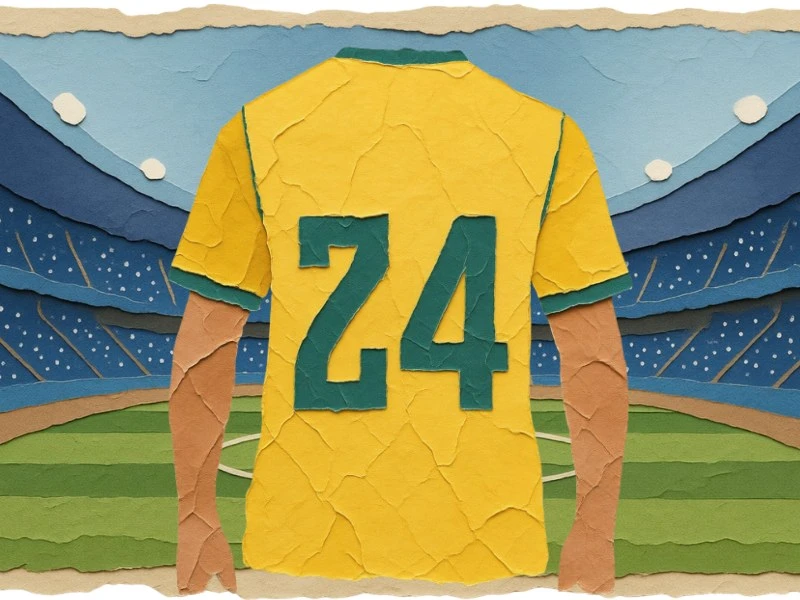
Art created by Global Voices on Canva Pro
This post is part of Global Voices’ June 2026 Spotlight series, “Gender Diversity.” This series offers insight into gender diversity and how it is being threatened, protected, and preserved around the world. You can support this coverage by donating here.
Brazil’s national football team will officially field a player wearing a jersey with the number 24 during the 2026 FIFA World Cup. The first time the iconic yellow-and-green jersey stepped out of the closet with the number 24 was almost four years ago, during the championship played in Qatar.
Until 2022, FIFA rules allowed teams to register up to 23 players for official tournaments. But even when an extra player was allowed, or outside of strict official tournaments, the number 24 has long been avoided in Brazil.
The reason lies in the cultural context around a traditional, illegal gambling game created in Rio de Janeiro in the late 19th century — the “jogo do bicho” (animal game). The lottery game, which has been outlawed since 1946, and whose leaders have been linked to criminal organizations, still has a strong hold throughout the country. The winners are chosen randomly through a raffle, with gamblers betting on numbers linked to animals. The number 24 corresponds to “veado” (deer), which in Brazil is also a sort of slang term to refer to gay people.
There are different theories as to why “veado” got this meaning among Brazilians. A story published by news outlet UOL says the origins could be from the time when the word “desviado” (diverted) was used to refer to queer people, or even from the Disney animated film “Bambi” in the 1940s. Once a derogatory term, it has been reclaimed by the LGBTQ+ community over the years.
In the 2021 Copa America, this folkloric context became a public controversy. Brazil was the only one of the 10 South American teams playing without the number 24, despite having a total of 24 players. A group of activists called Arco-Íris, which means “rainbow” in Portuguese, sued the Brazilian Football Confederation (CBF) over the absence of the number, asking that the number be worn in the finals, arguing that it violated FIFA’s anti-discrimination rules. At the time, they declared:
O fato da numeração da seleção brasileira pular o número 24, considerando a conotação histórico-cultural que envolta esse número de associação aos gays, deve ser entendido como uma clara ofensa à comunidade LGBTI+ e como uma atitude homofóbica.
The fact that the list of numbers in the Brazilian National Team skips number 24, considering the historical-cultural connotation around this number and its association with gay people, must be understood as a clear offense to the LGBTI+ community and as a homophobic act.
CBF replied that it could no longer change the numbers already assigned to each player at that Cup because of the South American Football Confederation’s (Conmebol’s) rules, and the lawsuit was archived. An analysis by the newspaper Folha de S. Paulo, comparing Brazil with 11 countries, found that the number 24 was four times more likely to be used abroad than in the Brazilian football leagues.
Over a year later, at the Qatar 2022 World Cup — the first where FIFA allowed 26 athletes on the roster — the country had a player listed with the number 24 for the first time in an official competition: defender Gleison Bremer, who plays for Italy’s Juventus. Asked about the number, he answered: “It’s a shirt like any other. The important thing is to be at the World Cup.”
The 24th player
This time, the shirt will be worn by Roger Ibañez, a 27-year-old defender who plays for Al-Ahli in Saudi Arabia:
Eu nem lembro quem foi o último camisa 24 do Brasil antes do Ibañez.
Só a fonte que não ajudou, parece que ele é o camisa Z4. pic.twitter.com/qGOCb18LNO
— Pedro Sobreiro (@pedro_sobreiro) April 1, 2026
I can’t even remember the last player to wear Brazil’s 24 shirt before Ibañez. The font didn’t really help, it looks like he’s the Z4.
As a “gaúcho,” someone born in Rio Grande do Sul, the southernmost state of Brazil, Ibañez is a fan of Grêmio FBPA, a club founded in 1903 in the capital Porto Alegre. The same club that became a pioneer in the 1970s, having an organized LGBTQ+ fan group, the Coligay. The name was a blend of the name of a nightclub, Coliseu, owned by a Grêmio fan, where the group would meet, and the sexual orientation of the fans. The idea came to Volmar Santos, the nightclub owner and a die-hard “gremista” who always watched the games at the Olímpico stadium, when other fans seemed demotivated by the team’s years-long bad streak. This was in 1977, when Brazil was under military dictatorship rule (1964–1985), which also targeted LGBTQ+ people.
Once the Coligay pack arrived at the pitch, the bleachers turned into a proper party, with music, costumes in the club’s three colors, and continuous chanting. At first, as Santos told on several occasions, remembering his Coligay days, they had to face slurs and even physical attacks — at one point, he hired security and had the members in training karate for self-defense — but once the club began to win games and titles, they were integrated as an important part of the fanbase. Santos died last January.
Nowadays, Brazil has LGBTQ+ collectives within fangroups in many clubs, but it has never seen a phenomenon like the Coligay again. Grêmio and its traditional rival, Sport Club Internacional, are among the clubs without an organized queer collective.
In 2020, a national collective formed by LGBTQ+ fangroups from several Brazilian clubs, the Coletivo de Torcidas Canarinhos LGBTQ+, launched the Observatory of LGBTphobia in Football, to monitor cases of discrimination.
Their latest report analyzes how many teams wore the number 24 shirt in the Copinha São Paulo 2025, an under-18 competition. Out of 128 participants, only 32 teams had it. According to the Observatory, the number represented a reduction of six teams compared to the previous year. Onã Rudá, a journalist and Canarinhos founder, says that the study of Copinha was made to show that this prejudice is instilled into kids from an early age:
Por que pular o número 24? Esse é o ponto. Pula-se por causa da cultura homofóbica. A ausência dele denuncia um tipo de homofobia que está estruturada nas instituições, na cultura, na semiótica, na estética do futebol. Quando o clube passa a ter alguém que usa esse número, não significa que seja menos homofóbico, mas a ausência dele é um problema porque ela é a negação de uma identidade.
Why skip the number 24? That’s the point. They skip it because of a homophobic culture. The absence of this number demonstrates a sort of homophobia that is structured within institutions, culture, semiotics, and football’s own aesthetic. When a club has someone wearing the 24, it doesn’t mean that it’s suddenly less homophobic, but the absence of it is an issue because it’s the denial of an identity.
Rudá says football is one of the main social activities in the country and part of its national identity — a unique feature for people from North to South, despite regional cultural differences in a territory with continental proportions, as he told GV:
O futebol tem responsabilidade social. É engraçado ouvir quem diz que futebol e política não se misturam, pessoas que assistiram a regimes como a ditadura militar, utilizarem o futebol para se promover. Então, o futebol tem uma relação com as mais variadas atividades sociais do povo brasileiro e tem um papel a cumprir: ele pode ser uma válvula provocadora de grandes mudanças — como contra LGBTfobia, questões de violência de gênero, entre outros.
Football has a social responsibility. It’s funny to hear people saying football and politics can’t be mixed, people who watched regimes like the military dictatorship using football to promote themselves. So, football has a link to various social activities of the Brazilian people and a role to fulfill: it can be a valve to lead to great changes — such as against LGBTphobia, gender violence, and so on.