



Colombia’s outgoing president Gustavo Petro, a former guerrilla and the country’s first leftist leader, came to power in 2022. He promised something few leaders of fossil fuel-producing countries have seriously attempted: to reduce his country’s dependence on oil, gas and coal.
Together with his vice-president Francia Márquez, a former environmental activist, Petro put together an ambitious plan to make Colombia less dependent on resource extraction. Instead, the focus was on economic diversification, renewable energy, greater democratic control over energy systems and environmental protection. With declining reserves of oil and gas, and growing costs of inaction on climate change, reducing dependence on fossil fuels has become increasingly urgent.
Four years on, as Petro prepares to leave office having served the maximum single term allowed under Colombian law, the results are mixed. His government made important progress, particularly in renewable and community energy. But many of its most ambitious reforms were undermined by political opposition, institutional inertia and the continuing importance of fossil fuel revenues.
That experience matters far beyond Colombia. Across the global south, governments face a growing debate over whether fossil fuel-producing countries should continue to extract resources to fund development and the transition to low-carbon energy, or begin moving away from extractive models altogether. Colombia has provided one of the clearest tests yet of the second approach.
The importance of the debate was highlighted at the recent First Conference on Transitioning Away from Fossil Fuels, co-hosted with the Netherlands in the Colombian city of Santa Marta. Held shortly before Petro left office, the event showcased Colombia’s attempt to position itself as a global leader in post-fossil development. It came six months after the UN’s Cop30 climate summit in Brazil failed to seriously tackle fossil fuels.
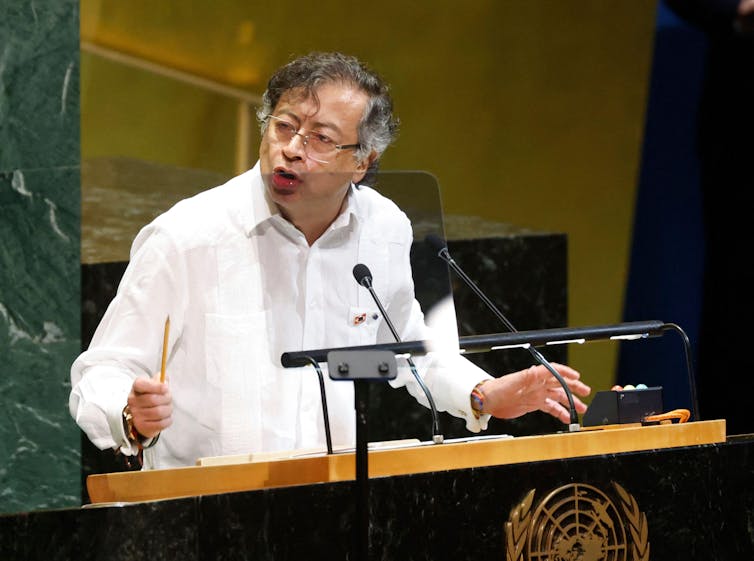
John Angelillo / Alamy
It also provides an opportunity to assess what Petro’s government actually achieved – and what stood in its way. Academics often describe his approach as “post-extractivist” – the idea that development should no longer depend on expanding fossil fuels and mining, but instead work towards what Petro has called “the economy for life”. Petro’s experience highlights the challenges faced by other states looking to follow the same path.
Lots more renewable energy
Colombia has traditionally got most of its electricity from hydropower. However, the environmental cost of huge dams, along with droughts linked to climate change and the El Niño phenomenon mean the Petro government was keen to add more wind and solar.
When Petro was elected in 2022, non-hydro renewables provided less than 2% of Colombia’s electricity generation capacity. By the end of 2025, that was up to 15%, mostly thanks to new solar. The big jump in renewable energy might be the outgoing president’s single most tangible climate achievement.
However, Petro’s government also recognised that developing renewables can reproduce inequality in the same way as fossil fuels, where profits are extracted and locals miss out. It therefore sought to democratise energy production through community energy schemes targeted at regions affected by poverty, conflict or coal dependence. Some 18,000 groups expressed interest and around 1,000 entered government-backed training programmes.
Fossil fuel struggles
But despite all this, the state struggled to slow down fossil fuel development. Petro’s administration had pledged to ban fracking, halt new exploration licences for mining, oil, gas and coal, and to remove a gasoline subsidy. The measures sparked strong resistance from the fossil industry. But around 380 contracts were already underway by the end of 2022. There was little room to prevent ongoing production, despite some wins. Meanwhile the government failed to fully dismantle other fossil subsidies such as those for diesel.
Delivering these reforms proved politically difficult. They were undermined by the lack of a majority in parliament, the cancellation of policy decisions by the country’s Constitutional Court and by political instability within Petro’s administration. Ministers and senior officials were frequently rotated and plans and priorities often changed.
In this context, it is not surprising that Petro’s administration frequently tried to slow down fossil fuels using decrees or temporary decisions, such as declaring geographical zones where mining permits cannot be given. However, these decisions can be easily removed by a future government, thus making it hard to sustain over time.
An important failure was the inability to pass a law to ban fracking despite multiple attempts. In another example, efforts to prohibit new large-scale open-pit coal mining projects were dropped from the country’s national development plan.
In building support for the post-fossil-fuel transition, some of the obstacles Petro faced are specific to Colombia: his party political circumstances, for instance, or even the threat of US military intervention.
But many similar obstacles will be faced elsewhere in the global south. These include a strong fossil fuel lobby, continued revenues from extractive industries, people worried about their jobs or energy shortages, disconnect between local urgent needs and the pace of state response and institutional inertia.
Petro succeeded in expanding renewables, building new community energy programmes and putting a fossil fuel phase-out on the policy agenda. Yet he struggled to pass laws that would lock in these changes or to overcome the state’s dependence on fossil fuel revenues.
Whether Petro’s reforms will last will partly depend on who replaces him. But Colombia’s experience already offers vital lessons for other countries attempting to move away from fossil fuels and build alternative development models.