



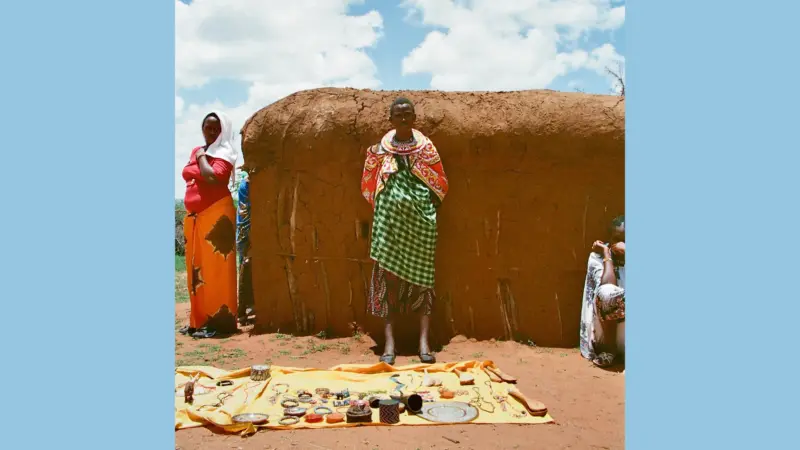
A woman sells beadwork outside a traditional Maasai dwelling. Photo by Cooper Austen. Used with permission.
By Sydney Leigh Smith and Cooper Austen
This post is part of Global Voices’ May 2026 Spotlight series, “Global crisis, local solutions.” This series will offer stories of resistance and successful climate action, insight into how communities in the Global South are fighting back against the crisis, analysis of what this might mean for future generations, and more. You can support this coverage by donating here.
In 2022, Kenya’s Lekiji community secured legal rights to the land they had occupied for more than sixty years. What followed has reshaped how land, power, and gender operate within the community.
On July 11, 2022, Kenya’s then Health Cabinet Secretary, Mutahi Kagwe, issued 766 land title deeds to residents of the Lekiji community, a pastoral settlement in Northern Kenya’s Laikipia County. With a stroke of the pen, hundreds of pastoral families who had lived on the land for decades as squatters became its legal owners.
Until this settlement, the Lekiji were not recognized as the rightful occupants of their land under the Constitution of Kenya (2010). They possessed no legal deed and no formal proof of residency beyond the roads, schools, and homes they had spent sixty years constructing. Questions of postcolonial land rights remain deeply contested across Kenya, particularly where formal title possession conflicts with long-standing occupation.
A history of dispossession and legal contestation
Conflict over land rights in Laikipia can be traced back to the period surrounding the Mau Mau uprising. In 1960, a white colonial-era farmer allocated small parcels of land to his former workers, who established a pastoral settlement of around three hundred families. These arrangements were never formalized through legally recognized titles.
In later years, the same land was transferred through what residents describe as a series of “corrupt transactions” to a private owner, Nigel Trent. By the early 2000s, Trent began threatening eviction.
Trent’s claim rested on formal ownership. Yet that ownership derived from a colonial land transfer that many postcolonial legal scholars would argue lacked a legitimate original title. The dispute, therefore, raised a deeper legal question about the relationship between formal property rights and historical dispossession.
In 2012, following a petition by Trent, the High Court of Nakuru issued an eviction order affecting more than 400 Lekiji families. Residents were given 90 days to vacate or face prosecution. The ruling affirmed the legal weight of formal title and declined to grant a stay of eviction, emphasizing that the registered owner had a right to “enjoy the fruits of their judgment.”
Over the previous five decades, the community had built a social and economic life on this land. Leaving was not a viable option.
With support from NGOs such as IMPACT Kenya, the community resisted. They delayed the eviction order and used that time to pursue legal avenues to reclaim their land.
The case was framed in court as a conflict between competing rights. Residents argued that eviction would cause substantial loss, pointing to homes, schools, and long-term settlement. The court, however, concluded that the titleholder would suffer greater loss if denied possession.
The conflict extended beyond legal proceedings. Between 2012 and 2022, violent confrontations between police and community members became part of everyday life. Community leaders established a perimeter defense system, staffed around the clock. In 2020, one resident recalled that two members of the community were killed in clashes with law enforcement.
State settlement and legal resolution
The dispute was ultimately resolved through state intervention rather than judicial recognition of customary rights.
Earlier court decisions had already prioritized formal title over long-term occupation, even where communities demonstrated a potential substantial loss if evicted.
In 2022, the Kenyan government purchased the land from Trent and transferred ownership to the Lekiji community, subdividing it among approximately 300 households. Each household received about 2.25 acres.
This outcome reflects a broader pattern in land governance, where the state resolves competing claims through purchase and redistribution rather than fully adjudicating the legality of historical ownership.
For residents like Eunice Amira, the impact was deeply personal. Born in 1980, she had lived her entire life as a squatter. She watched her family engage in repeated legal battles in Nakuru and Nairobi, which drained them financially and shaped her sense of identity and belonging. When the title deeds were issued, she told the Kenya News Agency that she felt as though she had “been born again.” She added that “some have died trying to get the same.”
The government’s decision provided legal certainty and recognition for families who had long existed outside formal property systems.
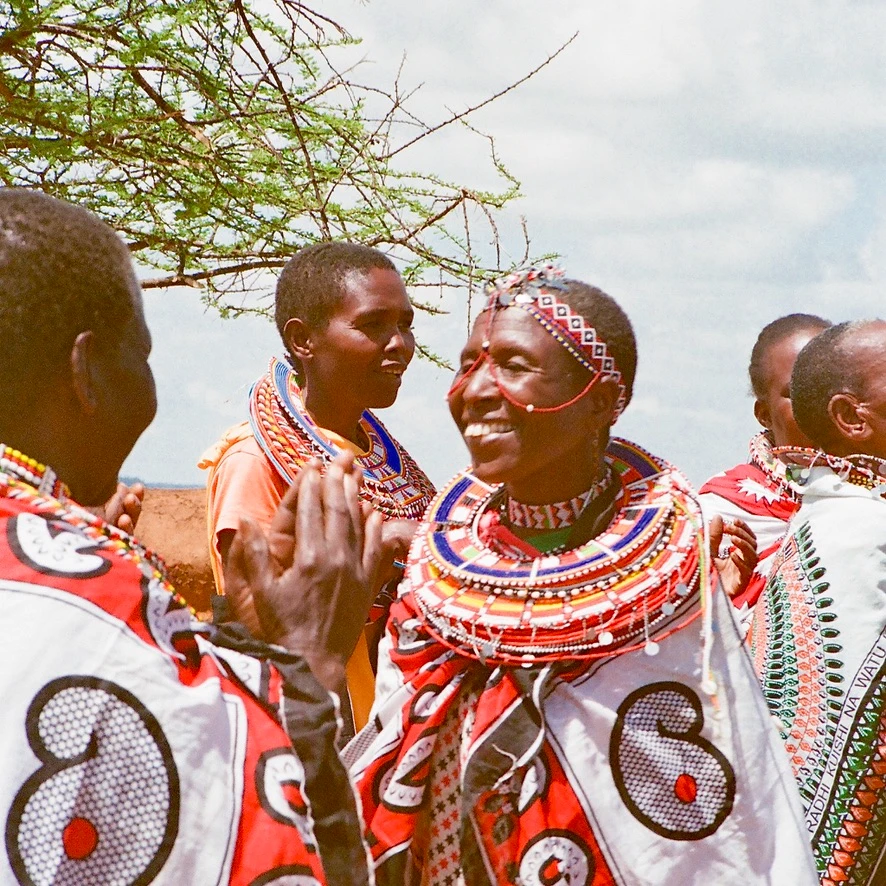
Women welcome visitors to their community with a traditional dance. Photo by Cooper Austen. Used with permission.
Women, land, and economic transformation
While the 2022 decision resolved the question of ownership, the use of that land has driven further change within the community.
Lekiji remains a patriarchal society, where men traditionally control income-generating activities such as farming and herding, while women manage domestic responsibilities. These economic structures are under increasing strain. As Fardosa Hassan, Community Outreach Officer at the neighboring Mpala Research Center and a Lekiji resident, explained, traditional livelihoods often fail to provide sufficient income or long-term security. As a result, many young people leave in search of employment, education, and more diverse opportunities.
In response, community leaders have expanded women’s economic roles.
Following the land settlement, five acres were allocated exclusively for women to develop income-generating activities. This represents less than 0.5 percent of Lekiji’s total land, but it has become a focal point for economic diversification.
Women in the community have developed multiple projects on this land. They sell beadwork to tourists visiting nearby conservancies. They are constructing a guesthouse where visitors can stay and experience local ways of life. They grow fruits and vegetables for sale in local markets. They have installed a solar-powered well to support irrigation. They also operate a chicken farm, producing eggs and meat for both consumption and sale.
According to Hassan, “these activities provide women with a source of income that is flexible and controlled directly by them,” allowing women to support household needs such as school fees, food, and healthcare. She also emphasized that these initiatives create opportunities for women to develop skills in design, marketing, and business management, supporting longer-term economic participation.
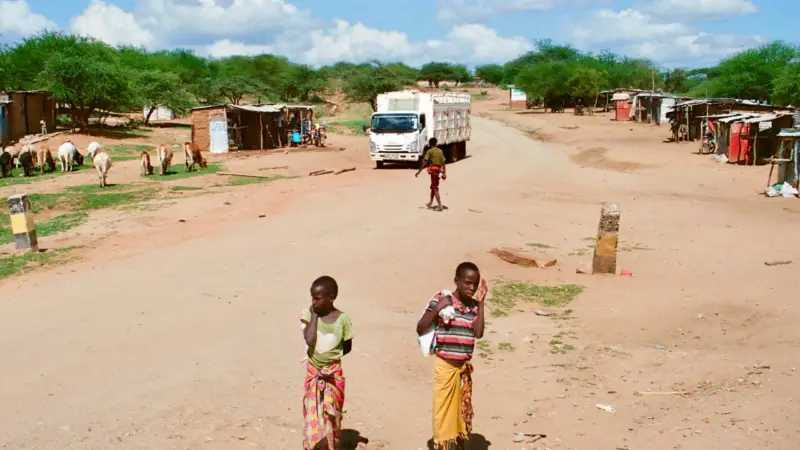
Lekiji community kids walking home from school. Photo by Cooper Austen, Laikipia County, Kenya, March 2026. Used with permission.
Shifting power within the community
The effects extend beyond income.
Access to independent financial resources has changed household dynamics. Women who previously had limited economic autonomy now have greater control over decision-making. Some have been able to navigate or leave difficult relationships. Others have remained within the community with increased independence.
The Lekiji case illustrates a broader legal and social dynamic. Formal land rights establish a foundation, but the distribution of access and control determines how those rights reshape power within communities.
These changes reflect a broader shift in how land rights operate at the local level. Legal ownership provides a foundation. The distribution of access and control determines how that foundation is used.
Looking ahead
Communities like Lekiji continue to face pressures from climate change, evolving conservation policies, and changing economic conditions. These pressures affect both livelihoods and long-term stability.
Securing land rights addressed one dimension of vulnerability.
The longer-term challenge lies in how those rights are exercised, particularly in contexts where law alone has not resolved the legacies of dispossession.
In Lekiji, expanding women’s participation in economic life has become part of that process. For postcolonial communities, ownership is only one dimension of justice. Who benefits from the land may ultimately determine whether communities can remain on it.