



It’s the time of year when parents are thinking of registering their children for kindergarten in September — a much-anticipated moment in the lives of many parents and their young ones.
The importance of early childhood education beginning in kindergarten is widely recognized across Canada. Kindergarten is publicly funded and offered in all provincial jurisdictions and territories. While the vast majority of five-year-olds across the country participate, it is not mandatory.
As parents consider kindergarten transitions, what are some important things to understand about children’s development around kindergarten age?
The child at five
The child at five is essentially a sensory being immersed in a material world they come to name, know and understand through direct tactile experiences, mediated by talk and interaction with peers and adults. They learn through endless repetition: reading the same books and singing the same songs over and over again.
Frank Wilson, a neurologist widely recognized for his book, The Hand: How its Use Shapes the Brain, Language and Human Culture, elaborates how our hands are the critical conduit to the brain in developing what is known as embodied cognition — neural systems that are central to our cognitive functions. Among young children, nimble fingers and fine motor control are associated with vocabulary knowledge.
A typical five-year-old can be expected to have an oral vocabulary repertoire of 5,000 words, or 2,500 word families (run, runs and running constitute one word family).
Read more:
What are motor skills? Evidence-based ways to support children’s fine and gross motor development
Research studies record enormous disparity in the vocabulary size of children disadvantaged by socio-economic status as young as three. Children whose home languages differ from the language of school instruction are also likely to need language learning support starting in kindergarten.
Children today as young as five are firmly of the digital device generation. Jean Twenge, a leading psychologist who has studied the impact of exposure to and involvement with digital devices among young children, has raised concerns and cautions about the ubiquity of these devices. She advises their judicious use.
Features of quality kindergarten programming
High-quality kindergarten programming has a well-organized learning environment. Look for a clean, uncluttered esthetic that is designed to store and access learning resources, display children’s work efforts and facilitate movement within the class.
The physical set-up of the classroom is likely divided into centres, as well as space for “carpet time.” The space is designed with the goal of establishing clear routines. Educators’ modelling, their talk in giving directions and managing behaviour all help to maximize time spent on learning and achieving goals.
Classroom organization allows for flexible grouping such as whole-class storybook reading at the carpet, small groups at centres and individual work such as colouring, drawing and printing.
Kindergarten curriculum is mandated by education ministries in each province or territory. Early literacy and mathematics concepts and skills are foundational to future learning and usually take precedence in the instructional day.
High-impact instructional practices
Classroom teachers have considerable discretion in how they translate the curriculum into teaching approaches and activities that engage children in meaningful learning experiences. Here are some high-impact practices:
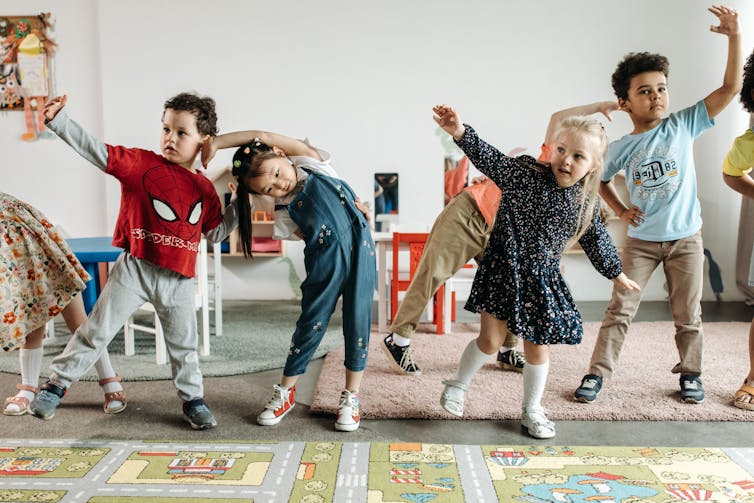
Rhythmics, music and movement: Taken together, these lay the foundations for pattern recognition associated with number concepts. The steady, repetitive beat of children’s nursery songs such as “Twinkle, Twinkle Little Star” accompanied by clapping and singing along help children understand the principles of counting.
(Pexels/Pavel Danilyuk)
Patterns help young children predict and remember the words to a song. In this way, rhythmics, music and movement foster early language and general cognitive development. These elements have long been recognized as a key component of quality kindergarten programming.
Books and read-alouds: The bookshelf needs to contain a broad range of reading materials that foster talk between the teacher and the young learners (“dialogic talk”) that has learning or instructional intent.
Wordless picture books such as the Lion and the Mouse, an Aesop fable, support teacher-child interaction by way of inviting children to make predictions, extract the central lesson from the story and apply it to their own lives.
Children benefit from and often request repeated readings of the same book. This way, they hear and learn new words in the same context. Only later do they transfer these meanings to new contexts.
Blocks and puzzles: Block play accompanied by “block talk” presents another opportunity to support language development. Questioning techniques that support increasing complexity in children’s structures — what’s known as their scaffolded play — can include open ended questions (“How are you planning to make your airport?”) and problem-posing questions (“What can you build with these blocks?”).
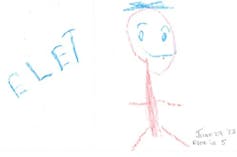
Early print literacy: The kindergarten year is a busy and demanding year for developing emergent literacy concepts and skills that are foundational for the Grade 1 year to come. It begins with children practising and becoming adept with a fine motor skills, and in particular a tripod grip for handling pencils and crayons. Activities include colouring simple drawings; drawing pre-writing shapes; drawing their own name (often all in capitals) or following path-of-motion exercises — drawing lines top-down, left to right, in circles or zigzag lines.
By the end of kindergarten, children are expected to name upper-and lower-case letters of the alphabet and draw most of them. With my colleague Adrienne Waller, I developed extensive resources related to children’s handwriting instruction for teachers and parents that are developmentally progressive and engaging for young children
(Hetty Roessingh), Author provided (no reuse)
Kindergarten programming fulfils a number of critical learning needs of the child at five. Children are active learners, constructing new understandings of their place in the world and how it works, supported through talk with their educators.
Digitally mediated simulations are no substitute for real-world experiences. Prudent use of devices as tools that enhance learning is the key. Rhythmics, movement and music, books and read alouds, block play and puzzles and the development of emergent literacy and skills set the foundations for their educational experiences in Grades 1–12.
Parents are children’s first teachers and they are aware of the contexts in which their children learn best. Look for a kindergarten program and setting that will help your five-year-old thrive.