



If today’s young people are tomorrow’s leaders, they will inherit not only the world’s problems but also the tools and ideas to solve them. One of the biggest changes they will face is a changing climate. This means hotter days, more intense storms and floods, longer droughts, and big changes in where and when rain falls.
Youth need to be actively involved now in deciding how their cities will prepare for these changes.
We are climate adaptation researchers and university professors who study how communities can prepare for floods, heatwaves and displacement. Together with our co-author, Bashiru Koroma, president of Keep Africa Beautiful Sierra Leone (a youth-led civil society climate organisation) in Bo City, Sierra Leone, we set out to discover whether a youth-centred, community-based Climate Science Hub could build the knowledge, skills, leadership, networks and adaptive capacity needed for young people in a secondary African city to cope with climate change.
Read more:
Children and young people at climate talks: seen, photographed, but not allowed to decide anything
A secondary city is one that is smaller in population and has fewer economic resources than a country’s primary city. We chose to build the Youth Climate Science Hub in Bo City, Sierra Leone because in recent decades, repeated droughts and crop failures along with war and poverty have pushed many rural farming families to move to the capital and primary city, Freetown, Sierra Leone.
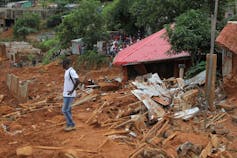
Vidal Sesay/Anadolu Agency/Getty Images
But now, sea levels are rising and heavy rains have caused deadly floods and landslides. In 2017, 312 people were killed and 600 people went missing after heavy flooding and mudslides hit Freetown. Many Freetown residents may need to move in future, this time inland to Bo City.
Coping with climate migrants will be an enormous challenge that the future leadership (today’s youth) will have to manage. Secondary cities like Bo often have far fewer resources than primary cities. But they will be on the frontline of figuring out the housing, feeding, public policies and protection for people displaced by climate change.
Read more:
Africa’s first heat officer is based in Freetown – 5 things that should be on her agenda
Our research showed that when young people combine science with local knowledge, skills and networks, they develop solutions quickly. Many began leading projects, shaping policy and building climate skills – from planting trees and running clubs to engaging leaders and climate-smart farming.
Low-cost, school-based hubs can turn students into local experts and locally engaged organisers who help their whole community adapt.
How we set up our climate hub to empower young people
We set up the Youth Climate Science Hub to support secondary school students aged 10 to 19, mostly aged 12 to 17. The project ran in two phases, starting with basic climate science lessons in schools. We worked with five nearby public schools in Bo City, chosen because transport is difficult, regular participation was needed, and the schools reflect different parts of the local community.
In the second phase, we built a curriculum together. This curriculum was developed and workshopped with one of the authors (Rebecca Morgenstern Brenner) and local leaders from Keep Africa Beautiful Sierra Leone led by the founder and president, Bashiru Koroma. The curriculum was taught to students, public-school teachers, decision-makers and administrators at the five schools.
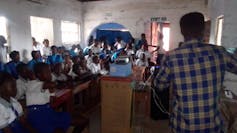
Courtesy Bashiru Koroma.
The schools identified about 100 secondary school students (at least 50% were girls) as the most likely future climate leaders in Bo City. These 100 students began meeting regularly in our climate hub. There, they watched climate science videos that had been especially developed for them, and then discussed local solutions.
We focused on these key areas that young people must know about if they want to lead climate adaptation projects:
-
Food security and sustainable agricultural practices, such as growing crops that can survive unpredictable rains and using small plots for school and community gardens.
-
Sustainability and circular economy, such as how to reuse and repair materials, reduce waste, and keep resources in use for longer instead of throwing them away.
Read more:
We asked Kenyan students about climate change. They didn’t know much
-
Sustainable waste management and recycling, such as reusing materials and managing waste water.
-
Showing how small businesses in Bo can save energy and create “green” jobs.
-
Landscape architecture, conservation and natural resource management, such as thinking how spaces and places can be best used.
-
Climate change education to bring youth the information they need and ways to reduce carbon emissions in Bo City.
-
Gender issues, such as how climate impacts can fall differently on girls and boys, and why girls’ leadership is crucial in planning solutions.
-
Microfinance, small loans and savings groups that can help families start climate-friendly businesses or recover after floods and droughts.
Read more:
Africa’s smallholder farmers are using bright ideas to adapt to climate change: G20 countries should fund their efforts
In the hub, the students learned theories of social-ecological resilience. This is the idea that people, communities and ecosystems are connected, and that strong social networks and healthy environments help everyone bounce back from shocks.
They also looked at how youth-centred approaches can bridge the gap between knowing about climate change and acting to adapt.
What we found
For Bo City and many other secondary cities across west Africa to adapt to climate change, our research found that solutions needed to be based on local, indigenous practices and ideas, connected to scientific knowledge. Solutions also needed to be built with community, teachers, decision makers, families and the young people themselves.
Bo City does not have reliable access to the internet. So we found that setting up a climate hub was vital in bringing young future climate change leaders together, and acting as a space where they could gain knowledge and information. The hub’s library continues to grow based on what the young leaders request and need.
Read more:
Targeting disaster management: New research evidence from Sierra Leone
The hub was very successful in turning ideas into action. The young future leaders worked within their group and the schools to plant around 1,500 shade and fruit trees at the hub and in nearby public spaces. They set up climate clubs in each school, organised debates, clean-up campaigns and awareness events, and celebrated World Environment Day together.
The hub is now used for regular club meetings and student led presentations and has an established school garden. This shows that the young people stayed involved even after the initial training ended.
What needs to happen next
Secondary cities in west Africa and other climate vulnerable regions must be recognised as priority sites for youth climate engagement in national adaptation and education strategies.
Read more:
Ecoball: how to turn picking up litter into a game for kids
Hubs can be set up by coordinating youth climate activities with schools and finding focal points in municipalities where young people can gather.
National governments, education ministries, local councils and international funders should support low-cost, school-based climate hubs that link student projects with city-level resilience planning.